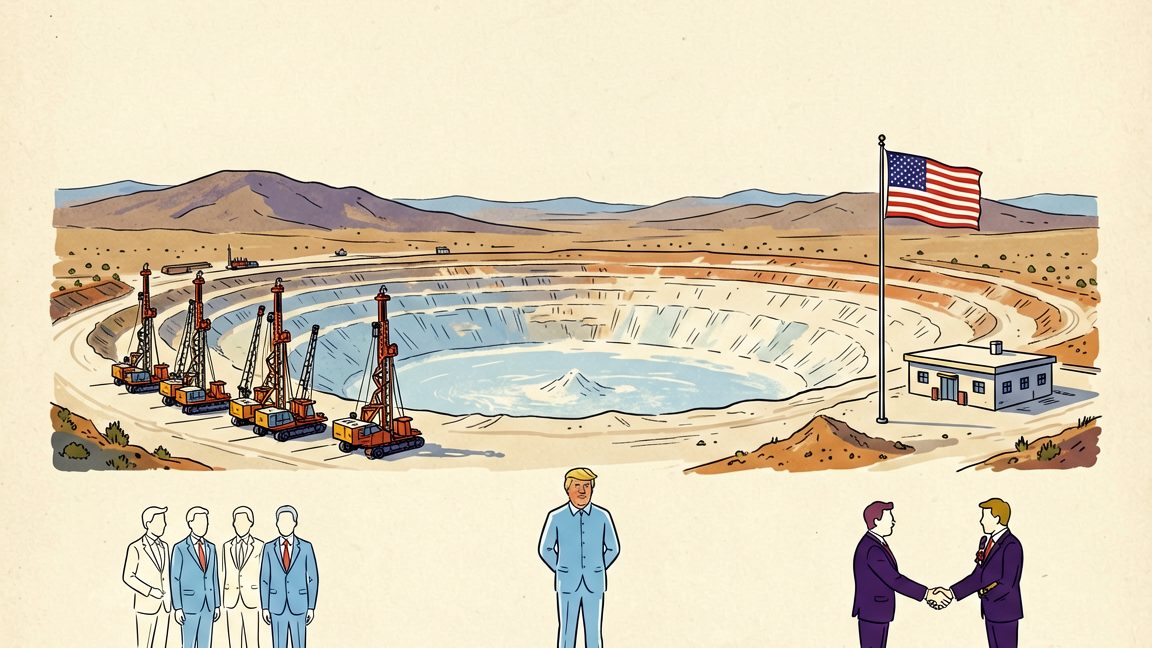
The Trump administration used a State Department roundtable on Friday to unveil a series of mining agreements and funding programmes aimed at reducing United States dependence on China for critical minerals. Senior executives from Rio Tinto, Century Aluminum, MP Materials, American Ocean Minerals and Resolution Copper attended the meeting.
Among the agreements announced was an investment in a California‑based battery manufacturer, a move intended to bolster domestic production of lithium‑ion technology. Another deal involved backing an Australian company developing a mine focused on scandium, a metal increasingly used in aerospace and defence applications. The administration also committed capital to a firm that produces magnetic materials and to a company that supplies heat‑resistant components for military use.
Funding for education formed a further pillar of the announcement. The government earmarked $100 million for fourteen institutions that provide mining‑related education, and an additional $81 million for three specialised schools that will train geologists, metallurgists and mining engineers.
Officials highlighted that more than half of U.S. imports of critical minerals such as copper, lithium, cobalt, graphite, manganese and rare earth elements currently originate in China. The president has already issued an executive order that gives priority to mining projects deemed essential to national security, and the federal government is taking equity stakes in selected critical‑mineral projects and companies.
Secretary of State Marco Rubio explained that the State Department will leverage its global presence to help secure the mineral supply chain, stressing the department’s role in coordinating international efforts. The National Mining Association’s president and chief executive, Rich Nolan, praised the administration’s actions, noting that the government is leaving no stone unturned in addressing the country’s overreliance on imported minerals.
Industry leaders at the roundtable expressed support for the initiatives, citing the need for a stable supply of raw materials that underpin American strength and power. The administration’s strategy is framed as a response to recent Chinese export controls that have created bottlenecks in the supply chain for essential minerals.
Washington also acknowledges that the United States depends on China for the production of certain military and energy technologies, including power lines and batteries. By investing directly in mining projects and expanding domestic training capacity, the administration aims to build a more resilient supply chain that can support both civilian and defence needs.