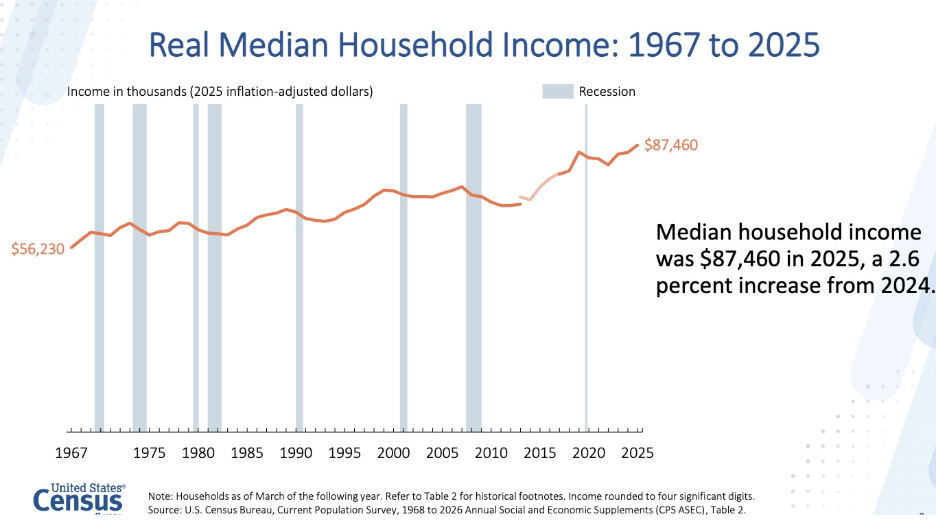
The U.S. Census Bureau released its latest income and poverty estimates on Tuesday, showing that the inflation‑adjusted median household income for 2025 was $87,460, the highest level recorded since the agency began tracking the statistic in 1967. The same report placed the official child poverty rate at 13.4 percent, a historic low.
Republican leaders seized on the numbers as evidence that the party's economic agenda is bearing fruit ahead of the 2026 midterm elections. White House social‑media accounts posted graphics that highlighted the rise in real income during the Trump administration and contrasted it with slower growth under the Biden administration. "Real household income reached its highest level in history ($87,460) in 2025, surpassing the previous record set in President Trump's first term," the White House statement read.
In testimony before the House Committee on Financial Services, Treasury Secretary Scott Bessent linked the data to policy actions taken by the Trump administration. He said, "Under President Trump, the private sector has created over 1 million jobs. Real wages are outpacing inflation. The bottom 25 percent of wage earners are seeing larger wage increases than those at the top. And the Working Families Tax Cuts has delivered the largest share of tax relief directly to millions of low‑ and middle‑income Americans."
Bessent also praised manufacturing trends, noting eight straight months of domestic growth and a projected third‑quarter GDP expansion of more than 4 percent, according to the Atlanta Federal Reserve. He described the situation as "a new industrial supercycle moving from investment into production, and from blueprints into paychecks."
The Census figures also showed that income inequality did not widen between 2024 and 2025, and the share of people without health insurance for the entire year remained essentially flat. A separate finding highlighted that roughly 750,000 non‑citizens had exited government‑funded health coverage during the year.
Even former Obama‑era Council of Economic Advisers chair Jared Bernstein defended the credibility of the data. In a public comment he wrote, "I personally know some of the folks doing this work and they're of the highest integrity. I'm highly confident they'd blow whistles if the Trump admin was trying to cook the data." Bernstein added that median income grew 2.6 percent overall and 4.8 percent for Black households, calling the decline in child poverty "good news." He cautioned, however, that alternative poverty measures that factor in taxes and transfers could show a different picture once Republican tax policies take effect.
The release arrives at a moment when the political stakes of economic statistics are especially high. Midterm races in swing districts often hinge on voters' perception of personal financial wellbeing. A higher median income can be leveraged by Republican candidates to argue that their tax cuts and deregulation have lifted wages, while Democrats may point to the still‑elevated overall poverty rate, around 11 percent for the total population, to argue that gains are uneven.
Understanding how the Census Bureau arrives at these numbers helps clarify the debate. The agency's Current Population Survey, a monthly interview of about 60,000 households, provides the raw data for the annual income and poverty estimates. Respondents report pre‑tax earnings, which the bureau then adjusts for inflation using the Consumer Price Index. The official poverty measure, used in the report, compares family income to a threshold set at three times the cost of a basic food basket; it does not account for government transfers such as the Earned Income Tax Credit.
Critics of the official measure argue that it understates the true extent of economic hardship, especially for families receiving substantial in‑kind assistance. Economists often supplement the official figure with a "Supplemental Poverty Measure" that adds tax credits and subtracts necessary expenses. Bernstein's warning reflects that distinction, suggesting that the headline decline could be muted when a broader metric is applied.
Media outlets have already framed the data in divergent ways. The Wall Street Journal ran a headline reading "American Incomes Hit Record Last Year as Women Gained Ground," emphasizing the gender aspect of wage growth. The Washington Post focused on the modest drop in child poverty but warned that "experts fear worse ahead," highlighting concerns about future policy impacts. The New York Times placed a story about the data lower on its homepage, instead leading with a poll that showed 52 percent of respondents "strongly" disapproving of President Trump, underscoring the split between economic indicators and overall political sentiment.
Political analysts note that while the numbers are favorable for Republicans, they are not immune to scrutiny. "Median income rose, but that does not mean every household feels better off," said political scientist Laura Chen of the University of Michigan. "If the gains are concentrated among higher earners, the narrative of broad‑based prosperity can quickly unravel."
For American voters, the relevance of the Census data extends beyond abstract statistics. Higher median income can translate into more disposable income for families, potentially influencing consumer spending, housing markets, and credit demand. Conversely, the child poverty rate remains a key indicator for policymakers concerned with education, health outcomes, and long‑term economic mobility.
In Canada, where the federal government tracks similar metrics through Statistics Canada, the release offers a point of comparison for cross‑border economic analysis. Canadian policymakers watch U.S. income trends closely, as they affect trade negotiations, labor market competition, and the flow of investment between the two economies.
Looking ahead, the Census Bureau will publish its supplemental poverty estimates later this year, providing a more nuanced view of how tax credits and transfers affect low‑income families. Meanwhile, the Federal Reserve's Nowcast model, which currently projects annualized GDP growth at 2.26 percent, will be watched alongside the private domestic final purchases indicator that rose 4.2 percent in the second quarter.
Both parties are likely to continue using the data to bolster their narratives. Republicans will stress the record median income and child poverty decline as proof that their economic policies are working, while Democrats may focus on the unchanged uninsured rate and the limitations of the official poverty measure to argue for expanded social programs.
As the 2026 midterms approach, the interplay between hard economic data and voter perception will shape campaign strategies on both sides of the aisle. Whether the record figures translate into electoral advantage remains an open question, but the numbers will undoubtedly be a central talking point in the months to come.