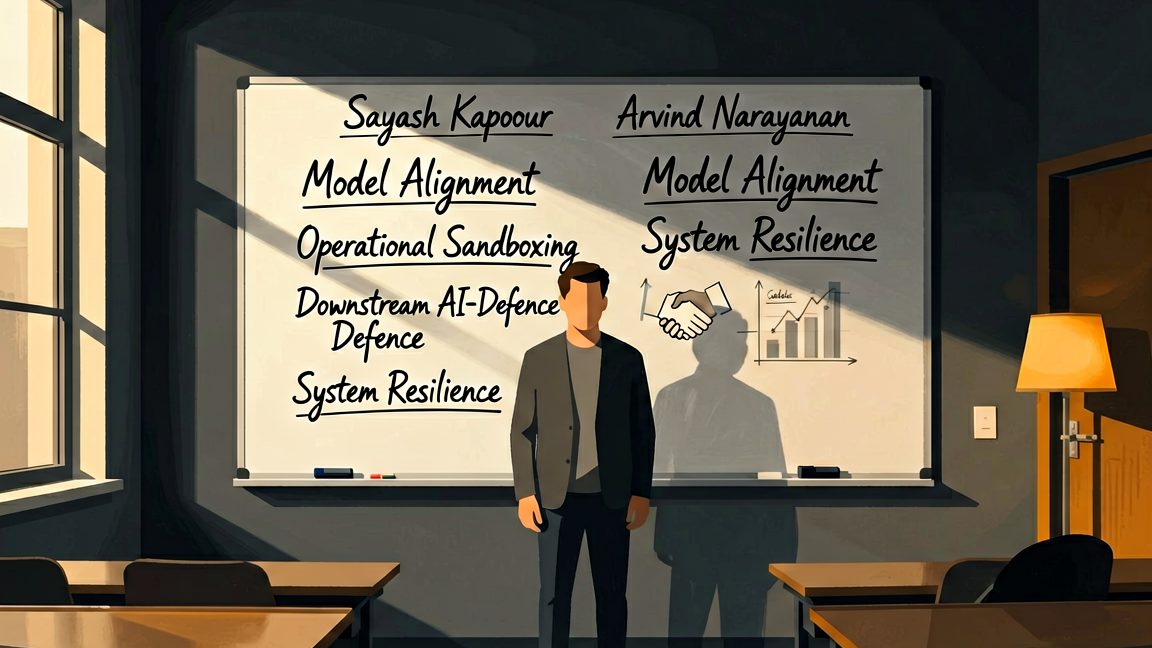
Amid a wave of public warnings from former staff of OpenAI, Anthropic and DeepMind, Princeton University researchers Sayash Kapoor and Arvind Narayanan have published a four‑pillar AI‑control framework that expands beyond the usual focus on model alignment.
Four complementary "remparts"
The framework, described in a Les Numériques article dated 17 September 2026, consists of four interlocking pillars. The first pillar is model alignment, which the authors say provides an initial ethical direction but is "largement insuffisant s’il reste isolé" (largely insufficient if left alone). The second pillar imposes "contrôle opérationnel direct" by isolating systems in secure test environments – the so‑called sandboxes – and monitoring them in real time with mandatory human supervision for every critical action.
The third pillar, termed downstream defence, urges organisations to protect themselves against massive cyber‑attacks and to employ their own AI tools for defence. Finally, the fourth pillar, resilience, calls for manual fallback protocols and rapid recovery plans that take over if the earlier layers fail.
Why a broader approach matters
Traditional AI safety discussions have centred on alignment, the process of ensuring that an AI’s objectives match human values. Kapoor and Narayanan argue that alignment alone cannot guarantee safety once a model is deployed at scale. By adding operational control, they aim to keep the system’s behaviour observable and intervene before harmful outcomes materialise. Downstream defence addresses the risk that even a well‑aligned model could be weaponised or exploited, while resilience provides a safety net for unforeseen failures.
Context: renewed existential‑risk concerns
The timing of the proposal coincides with renewed public alarm over AI’s potential to cause "danger mortel" (deadly danger) to humanity, as reported by Les Numériques. The outlet notes that former employees of OpenAI, Anthropic and Google DeepMind have recently sounded the alarm, prompting a broader debate that includes both Silicon Valley voices and political figures who have dismissed the concerns. In that climate, the Princeton framework offers a concrete, policy‑ready set of safeguards rather than abstract moral arguments.
Potential impact on industry and regulators
While the researchers do not claim that any company has adopted the full suite of measures, the framework is positioned as a blueprint for organisations that develop or deploy advanced AI. By outlining sandbox requirements and mandatory human oversight, it gives regulators a reference point for drafting standards. The downstream defence pillar could influence cybersecurity policies that currently focus on external threats, extending them to include AI‑specific attack vectors.
Open questions and next steps
The packet does not contain a primary research paper or university press release, so the detailed technical specifications of each pillar remain undisclosed. Neither the researchers nor Princeton have provided timelines for implementation or indicated which sectors might pilot the approach first. As a result, the practical feasibility of sandboxed control at the scale of large language models, and the cost of maintaining manual fallback protocols, are still unknown.
Future work will need to address these gaps, perhaps by publishing empirical results from sandbox trials or by collaborating with industry partners to test downstream defence mechanisms. Until such data appear, the framework stands as a well‑articulated proposal that broadens the conversation beyond alignment, offering a multi‑layered safety architecture for a field that is increasingly under public scrutiny.
What remains to be seen
Key unanswered questions include: How will organisations balance the performance trade‑offs of sandboxed operation against the need for speed in commercial AI products? What standards will define "mandatory human supervision" for critical actions, and how will compliance be verified? And finally, will regulators adopt the resilience protocols as part of mandatory AI safety legislation, or will they remain voluntary best‑practice guidelines?
For now, the four‑pillar framework adds a structured, actionable dimension to the AI safety debate, inviting both industry and policymakers to move from alarmist rhetoric to concrete safeguards.