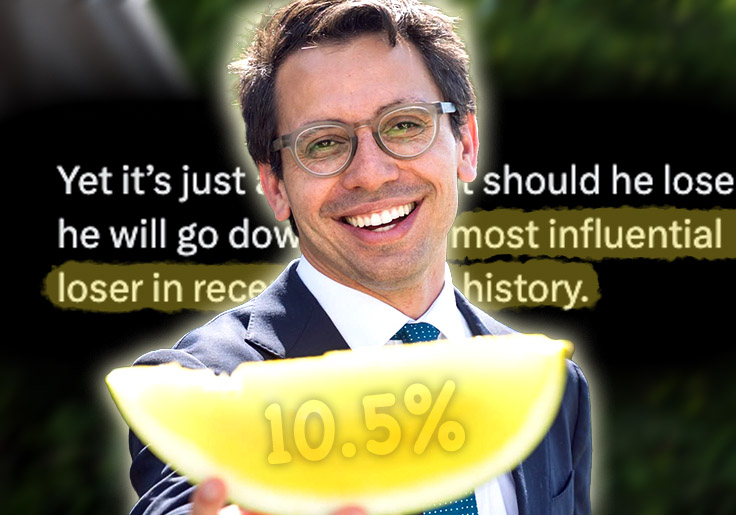
James Fishback's campaign for Florida governor ended with a double‑digit loss, yet a Politico column suggested the former debate coach could become "the most influential loser in recent political history." StateBeacon examined the claim and found it rests on speculation rather than evidence.
In the recent Republican primary, Byron Donalds captured 47.8 percent of the vote, securing the party's nomination. Jay Collins finished second with a margin that left Fishback trailing by roughly 23 percentage points. Fishback's final tally of 10.5 percent placed him well behind the two front‑runners and far from any realistic chance of winning.
The Politico piece, authored by New York Times reporter Nathan Taylor Pemberton, framed Fishback's defeat as a potential footnote in GOP history. Pemberton wrote that while Fishback's "mad dash" through Florida's political landscape was unlikely to end in victory, the candidate might "go down as the most influential loser in recent political history." The column linked Fishback's online‑first style to a broader trend of internet‑driven campaigns, citing the narrow victory of Abdul El‑Sayed in Michigan's Democratic Senate primary as an example of influencer impact.
Pemberton's profile of Fishback, first published in March, described the candidate as "refining an emerging style of far‑right politicking that has him toggling between trollish online posts and idealistic policy proposals." The article quoted Rick Wilson, a former GOP operative and co‑founder of the Lincoln Project, who praised Fishback as a glimpse of the party's future. Wilson's endorsement, however, did not translate into voter support, as the primary results demonstrate.
Fishback's campaign was marked by a series of controversies that likely limited his appeal. He faced accusations of antisemitic language, including the use of the slur "goyslop," and was linked to "manosphere" personalities such as Clavicular and Sneako. In addition, a 27‑year‑old Fishback was accused of "grooming" a student during his tenure as a high‑school debate coach, a claim that attracted media scrutiny. Financial troubles also surfaced when a judge ordered him to pay $1.3 million to a hedge fund that alleged he stole confidential data, leading to the repossession of his Tesla.
Despite these setbacks, Fishback cultivated a following among fringe right‑wing figures. He expressed admiration for Tucker Carlson and Nick Fuentes, both of whom have been labeled by mainstream outlets as promoters of extremist rhetoric. Yet, Carlson's preferred candidates have struggled in GOP primaries this cycle, and Fishback's own performance underscores the limited electoral traction of such endorsements.
The notion that Fishback could become "the most influential loser" hinges on the idea that a candidate can shape party discourse without winning office. Historically, figures like Ralph Nader have impacted policy debates despite repeated electoral defeats, but their influence is measured by concrete outcomes such as legislative changes or shifts in public opinion. In Fishback's case, there is no clear evidence that his campaign altered the Republican platform, affected voter turnout, or inspired a wave of similar candidates.
To contextualize the claim, it helps to understand how Florida's primary system works. The state holds an open primary for the gubernatorial race, allowing any registered voter to choose a party's nominee. In recent cycles, the Republican primary has attracted a crowded field, with candidates ranging from establishment figures to self‑styled insurgents. Winning the nomination typically requires a combination of fundraising, name recognition, and a robust ground game. Fishback's campaign relied heavily on social‑media outreach, a strategy that has produced mixed results for other candidates across the country.
Nationally, the rise of internet‑centric campaigns has been most visible in the Democratic Party, where candidates such as Alexandria Ocasio‑Cortez leveraged platforms like Twitter and Instagram to build grassroots support. On the Republican side, former President Donald Trump demonstrated the power of a direct‑to‑voter media approach, but his brand was built on a long‑standing media presence and a substantial donor network. Fishback's attempt to replicate a "terminally online" model lacked the infrastructure and broad appeal that have underpinned successful digital campaigns.
Political analysts note that while a strong online following can boost name recognition, it does not automatically translate into votes. Voter behavior in primary elections often hinges on local issues, endorsements from state party leaders, and the ability to mobilize volunteers for canvassing and phone banking. Fishback's limited fundraising and absence of a statewide organization left him at a disadvantage compared with Donalds, who benefited from a well‑funded campaign and endorsements from key Florida Republicans.
The broader implication for the GOP is a reminder that digital notoriety alone is insufficient for electoral success. Party officials continue to emphasize the need for candidates who can appeal to both the party base and swing voters in a state that has become a national battleground. As the 2024 general election approaches, the focus will shift from fringe primary challengers to candidates who can compete in the general electorate.
Fact‑checking organizations have evaluated Politico's assertion and assigned it a "Half True" rating. The verdict reflects that while Fishback's loss is factual, the claim about his future influence is speculative and not supported by measurable outcomes. Without evidence of policy impact, fundraising success for allied candidates, or a measurable shift in GOP messaging, the statement remains an opinion rather than a verifiable fact.
For voters and observers in the United States and Canada, the episode illustrates the tension between the allure of internet fame and the practical demands of political campaigning. While social media can amplify a candidate's voice, the ultimate test remains the ballot box. Fishback's experience serves as a cautionary tale for aspiring politicians who may overestimate the power of online notoriety at the expense of traditional campaign fundamentals.
Looking ahead, the Florida Republican Party will focus on uniting behind Byron Donalds as the nominee for governor. The party's leadership is likely to prioritize fundraising, voter outreach, and policy messaging that can resonate with a diverse electorate. Meanwhile, analysts will continue to monitor how internet‑driven candidates perform in future races, but the Fishback case suggests that influence without electoral success remains a tenuous proposition.