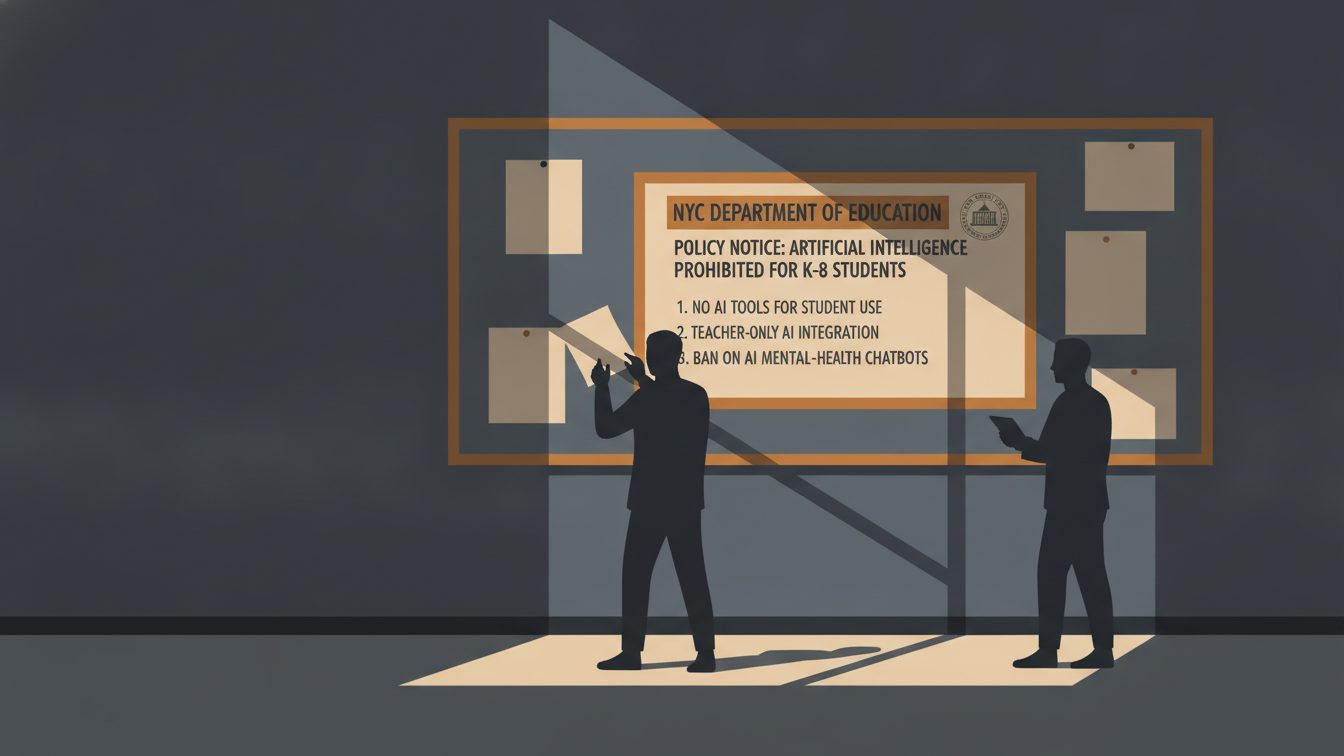
New York City’s Department of Education will prohibit the use of artificial‑intelligence applications by students up to eighth grade, with the rule taking effect next week.
Scope of the student ban
The policy applies to the United States’ largest school district, which serves roughly 900,000 students per year (The Guardian). Students in public schools through eighth grade – typically ages 13 or 14 – will be barred from accessing any AI tools, including generative text, image or code assistants.
According to the announcement, the prohibition will be announced on a Wednesday and will become operative the following week (The Guardian). The ban is part of a broader overhaul of technology use in NYC schools, which also includes a rule that classrooms will keep students off laptops or tablets through third grade, roughly ages nine or 10 (The Guardian).
Limited teacher use
Teachers will be permitted to employ AI for specific, non‑grading tasks. The Department of Education says AI may be used for lesson preparation and for drafting messages to parents, but it expressly forbids asking AI to grade assignments (The Guardian). This limited allowance reflects concerns that automated grading could undermine instructional judgment.
While the policy opens a narrow door for educators, it draws a clear line: any AI‑driven assessment of student work remains off‑limits.
Ban on AI companion chatbots
In addition to the student ban, the city will prohibit AI‑powered “companion chatbots” that offer psychological support. The ban targets tools that could be used as mental‑health substitutes, a move the department says is intended to protect vulnerable students (The Guardian).
Teachers and parents have warned against AI use in schools over concerns of ‘cognitive surrender’ (The Guardian).
Screen‑time guidance
The Department of Education also reiterated its screen‑time recommendations: 45 minutes per class for middle‑schoolers (grades 6‑8) and 30 minutes for elementary students (grades K‑5) (The Guardian). These limits are separate from the AI ban but underscore the district’s broader effort to curb digital distraction.
Impact on the district
With roughly nine hundred thousand students affected, the ban will reshape daily classroom practice. Elementary teachers will need to replace AI‑assisted tools with traditional resources, while high‑school educators (grades 9 and up) will retain limited AI access for preparation work.
The rapid rollout – announced this week and effective the next – follows a policy reversal. A 2023 ban on AI tools had been lifted earlier this year, and a 2026 framework that sought to regulate AI use sparked backlash from parents and teachers (why_now). The new rules signal a shift back toward stricter controls.
Timeline and open questions
- Wednesday (date not specified): Policy announcement (The Guardian).
- Next week after announcement: Rules go into effect (The Guardian).
The department has not disclosed how compliance will be monitored, nor has it provided details on enforcement penalties. It also did not specify whether the ban will be revisited after a trial period.
Analysis
The decision places New York City at the forefront of municipal AI regulation in education. By targeting students rather than the broader district, the policy avoids a blanket prohibition that could hinder legitimate instructional innovation at the high‑school level. However, the ban on AI companion chatbots raises questions about how schools will address student mental‑health needs, especially given the growing reliance on digital support tools.
Stakeholders are watching to see whether other large districts will follow suit. If the ban proves administratively feasible, it could set a precedent for nationwide school‑level AI policy, especially as AI tools become more embedded in everyday learning platforms.
What remains unknown is the district’s plan for teacher training on the limited AI uses that are permitted, and how the ban will intersect with existing technology contracts for hardware and software vendors. The department has not released a cost estimate for implementing the new rules.
For now, the policy’s immediate effect will be felt in classrooms across the city next week, as teachers adjust lesson plans and students lose access to AI assistants that have become commonplace in other districts.