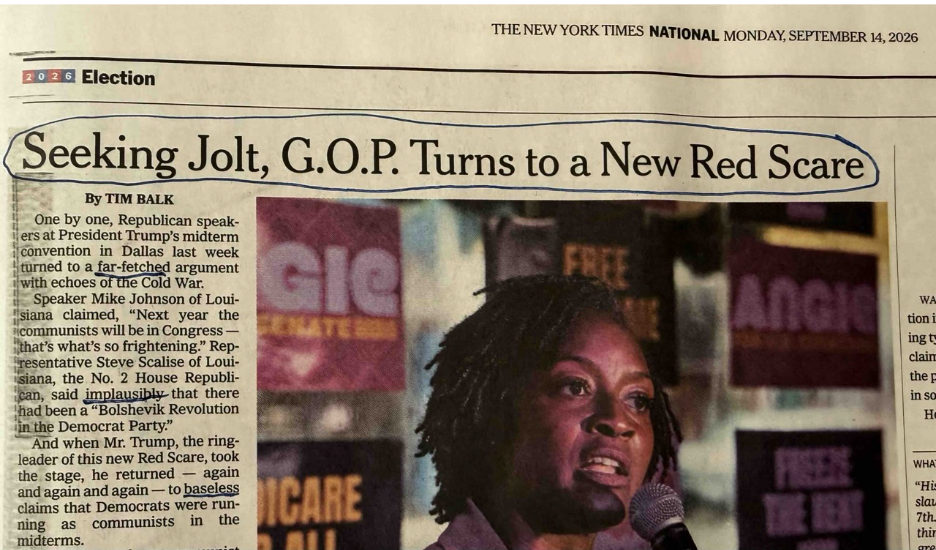
The New York Times ran a story titled "Seeking Jolt, G.O.P. Turns to a New Red Scare," in which the newspaper concluded that Republican accusations that the Democratic Party is communist are "far‑fetched" and "baseless." The article argued that no credible midterm candidate identifies as a communist and that the charge bears little resemblance to the platforms of most Democratic office‑seekers.
While the Times dismissed the allegation, the piece acknowledged that certain left‑leaning figures have contributed to the rhetoric. It cited Senator Bernie Sanders, who in 2020 described himself as a democratic socialist and praised aspects of the Cuban revolution, and New York congressional candidate Darializa Avila Chevalier, a self‑identified democratic socialist who once promoted a social‑media post urging libraries to expand Marxist literature.
Democratic Socialists of America (DSA), the nation's largest socialist organization, publishes a platform that calls for public ownership of the largest corporations and essential industries, as well as the abolition of the U.S. Senate. In a statement released on the centennial of Fidel Castro's birth, the DSA expressed "solidarity" with the Cuban revolution and praised Castro as a symbol of anti‑imperialist struggle. Those positions fuel the Republican narrative that the Democratic Party is moving toward communism, even though the party's official platform does not endorse such measures.
A Quinnipiac poll conducted earlier this month surveyed 970 registered voters and found that 59 percent of self‑identified Democrats said they support the DSA. The poll's margin of error was not disclosed in the brief, but the sample size suggests a modest level of confidence. Even if the figure is inflated, it indicates that a sizable segment of the Democratic base is at least sympathetic to the organization's ideas, complicating the Times' claim that the communist charge is "baseless."
The Times article was written by Tim Balk, who previously served as assistant opinion editor at the Daily Northwestern. In a 2015 op‑ed, Balk called then‑president Donald Trump a "clown" and warned that Trump could be the worst candidate in a Republican primary field populated by climate‑change deniers and xenophobes. The piece also listed Taylor Robinson as a contributing reporter. Robinson's 2018 statements emphasized a career advocating for immigrant and marginalized‑group rights, reflecting a clear progressive orientation.
Critics argue that the New York Times' editorial choices reveal a partisan tilt. In the same issue, columnist Michelle Goldberg promoted Naomi Klein and Astra Taylor's new book "End Times Fascism," describing it as a trenchant analysis of contemporary authoritarian trends. Goldberg has previously labeled former president Trump's rhetoric as textbook fascism, a characterization that has drawn both praise and rebuke from political commentators.
The debate over the labels "socialist" and "communist" is not new in American politics. During the Cold War, the term "communist" was used as a political weapon, often without clear definition. Today, the rise of the DSA and the popularity of figures like Sanders have revived discussions about the left‑right spectrum. While democratic socialism advocates for reforms within the existing democratic framework, communism traditionally calls for the abolition of private property and a classless society, a distinction that many voters find blurred.
Historically, the New York Times has faced scrutiny for its coverage of leftist movements. In the 1930s, reporter Walter Duranty downplayed the severity of Stalin's purges, and in the 1950s, Herbert Matthews offered a favorable portrait of Fidel Castro's revolution. Those episodes are often cited by conservatives as evidence of a longstanding bias against communist or socialist ideas.
Understanding why the label matters requires a look at the mechanics of the 2024 midterm elections. Midterms occur every two years, on the first Tuesday after the first Monday in November, and determine all 435 seats in the House of Representatives and roughly one‑third of the 100 Senate seats. Control of the House influences the legislative agenda, committee chairmanships, and the ability to launch impeachment inquiries, while Senate control affects confirmation of presidential appointments and the passage of major bills. As of the 2022 cycle, Republicans hold a narrow majority in the House and a split Senate, making the 2024 contests pivotal for both parties.
Candidate selection for midterms follows a state‑by‑state primary or caucus process, overseen by each state's election board. In swing districts, where partisan margins are thin, campaign messaging can sway undecided voters. Republican strategists have a history of employing "red scare" tactics, dating back to the 1950s McCarthy era, to rally their base by portraying opponents as threats to American values. By branding Democrats as "communists," GOP candidates aim to tap into lingering anti‑socialist sentiment, especially among older voters who recall the Cold War rhetoric.
Democratic campaign committees, such as the Democratic Congressional Campaign Committee (DCCC) and the Democratic Senatorial Campaign Committee (DSCC), typically distance mainstream office‑holders from the more radical proposals of the DSA. They emphasize policy continuity with the party platform, which in its 2020 version affirmed a commitment to "social justice, economic opportunity, and a strong middle class" while rejecting any call to abolish the Senate. This strategic distancing helps preserve appeal to moderate voters in competitive districts.
Legal scholars note that political speech, even when hyperbolic, is generally protected under the First Amendment. Supreme Court precedent, from cases such as New York Times Co. v. Sullivan, holds that false statements about public figures must be made with actual malice to be actionable. However, repeated false labeling can erode public trust in institutions, a concern echoed by media watchdog groups that call for greater transparency in how news outlets label political ideologies.
For Canadian readers, the debate offers a reminder of how American political labeling can spill over north of the border. Canadian media often reference U.S. partisan battles when analyzing domestic policy discussions, especially on issues like health care and climate change where left‑leaning parties in both countries share similar rhetoric. Moreover, the United States remains Canada's largest trading partner, and shifts in U.S. legislative control can affect cross‑border trade agreements, immigration policies, and security cooperation. A Republican‑led House that emphasizes anti‑socialist messaging may push for stricter immigration enforcement, a stance that could influence Canadian border policy and public discourse.
The upcoming midterms also intersect with ongoing congressional redistricting battles. Following the 2020 census, most states completed redrawing of congressional maps, a process that often involves partisan gerrymandering claims. Courts, including the U.S. Supreme Court, have weighed in on the constitutionality of partisan map drawing, setting precedents that shape how districts are contested. In states where maps are being challenged, the "communist" label could become a wedge issue in lawsuits alleging that the maps dilute the voting power of progressive constituencies.
Campaign finance dynamics add another layer. Federal Election Commission (FEC) regulations require disclosure of contributions, and both parties rely heavily on small‑donor fundraising, especially from younger voters attracted to progressive platforms. If the "red scare" narrative succeeds in mobilizing older, wealthier donors for Republican candidates, it could shift the fundraising balance in key swing districts.
Ultimately, the New York Times' dismissal of GOP claims may or may not dampen the rhetoric. Past experience shows that media rebuttals can be absorbed by partisan echo chambers, especially on social media platforms where algorithmic feeds reinforce existing beliefs. As the election cycle progresses, both parties will likely test the limits of political labeling, weighing the short‑term boost in enthusiasm against the long‑term risk of alienating moderate voters.
Whether the label "communist" remains a potent weapon in the 2024 midterms will depend on how voters interpret the distinction between democratic socialism and outright communism, how effectively the Times and other outlets clarify those differences, and how the broader political climate, shaped by economic concerns, foreign‑policy challenges, and cultural debates, evolves in the months leading up to November.