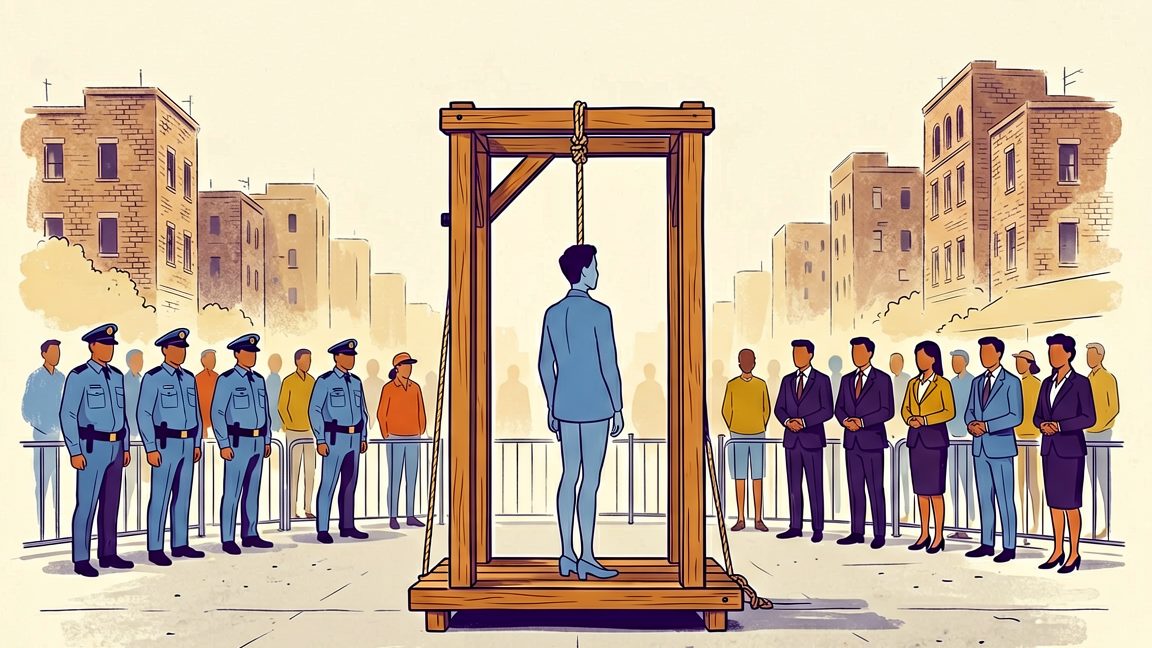
The New York Times article by Leily Nikounazar and Sanjana Varghese described public executions in Iran as “extremely rare”. The description has been challenged by the Associated Press and Iran Human Rights, who say it downplays a well‑documented pattern of frequent public killings.
Evidence of regular public executions
Iran Human Rights recorded 459 public executions in Iran between 2008 and 2025. Many of those executions were attended by large crowds that included children, a practice described as intended to instil fear. The organisation’s annual report notes that public executions rose sharply after 2010, averaging 50‑60 each year between 2011 and 2015, and that eleven public executions took place in 2025, again with children among the onlookers.
United Against Nuclear Iran also reported that Iran “regularly carries out executions in public”, adding that some executions involved notably harsh methods, such as hangings from construction cranes.
The 2012 New York Times report on Iranian executions described the events as highly public, with authorities erecting cranes or using central squares, families of victims and the condemned often attending, and spectators sometimes attempting to sway the judge. That story included a photo slideshow of hangings accompanied by a warning about graphic content.
Methods, crimes and legal context
Iran’s authorised methods of execution are hanging, firing squad, crucifixion and stoning. Crimes punishable by death under Iran’s Islamic law include incest, rape, adultery, consensual homosexual activity, apostasy, insulting the prophet and tafkhiz – a form of inter‑crural sex involving a non‑Muslim active partner and a Muslim passive partner.
Criticism of the Times’ coverage
Critics say the use of the word “extremely” exaggerates the rarity of public executions and that the article provides insufficient accuracy, thereby damaging the newspaper’s credibility. The authors did not promptly answer questions about issuing a correction. The Times has previously sent a reporting team to cover Supreme Leader Ali Khamenei’s funeral and has reported on the public nature of Iranian executions.
Political commentary
Former President Donald Trump claimed that “between 30,000 and 52,000 pro‑democracy protesters were murdered by the Iranian regime this year, many of whom were shot in the forehead”. The claim was not part of the Times article but has been cited in the broader debate about Iran’s use of lethal force.
Both authors have notable backgrounds: Leily Nikounazar holds a degree from Tehran’s Faculty of News, while Sanjana Varghese has contributed to Al Jazeera and worked for Airwars, an organisation funded by anti‑Israel charities.
The consensus among the cited human‑rights groups and media outlets is that news organisations should aim for precise and impartial reporting on sensitive subjects such as capital punishment.