On January 14, 2026, the editorial board of the New York Times published a piece titled "Iran's Murderous Regime Is Irredeemable." The editorial condemned the Iranian government for the killing of tens of thousands of pro‑democracy protesters, denounced its treatment of women and LGBTQ people, and called the regime "too depraved to be reformed." It urged a "unified expression of solidarity" with the protesters and recommended a mix of diplomatic, economic and, if necessary, military steps to weaken the government.
Central to the editorial's economic recommendations was a call for expanded sanctions. The board suggested targeting senior officials with individual sanctions and asset freezes, and it urged European governments to join the United States in "extending the sanctions it has imposed on Iran." The piece even pressed President Donald Trump to abandon his "hostility toward Europe" and his "ambition to seize Greenland," framing a coordinated Western response as essential to pressuring Tehran.
Three months later, the Trump administration announced a new sanctions initiative called Operation Economic Outcast. Treasury Secretary Scott Bessent outlined a plan to cut off Iranian officials from the global financial system, expand the list of designated individuals, and increase tariffs on companies that continue to do business with Tehran. The move aligns closely with the New York Times editorial's prescription, effectively turning the newspaper's own policy advice into government action.
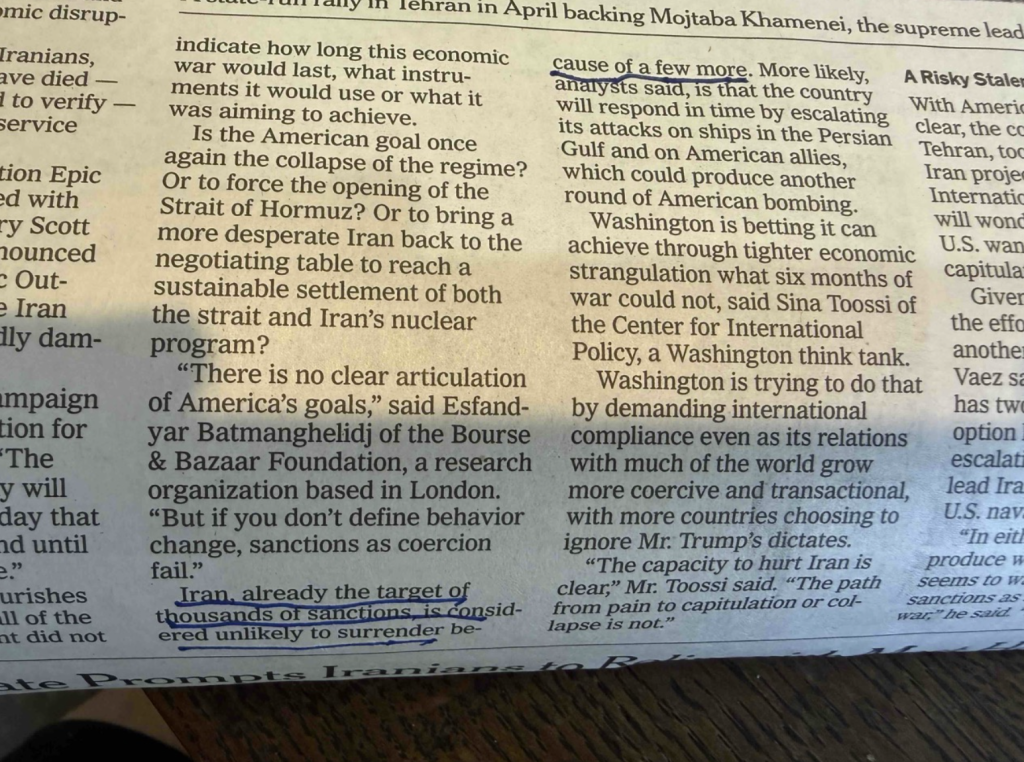
In the weeks that followed, the Times' news side began publishing a series of articles that question the wisdom of the sanctions push. In the August 27 print edition, reporter Michael Crowley wrote that "Trump's demands that other nations stop doing business with Iran underscore the difficulty in trying to impose sanctions on Iran's economy to the point of collapse." Crowley highlighted the logistical challenges of enforcing a near‑total trade ban, noting that China and other major powers could retaliate, and that Bessent himself had warned the policy could "roil the global economy."
Two days later, veteran correspondent Steven Erlanger ran a front‑page analysis that echoed Crowley's concerns. Erlanger cited "analysts" who argued that Iran, already under "many thousands of sanctions," is unlikely to capitulate because of a few more. He warned that Tehran might respond by escalating attacks on shipping in the Persian Gulf and on American allies, potentially prompting another round of U.S. air strikes. The analyst quoted was Sina Toossi of the Center for International Policy, who said "the capacity to hurt Iran is clear … the path from pain to capitulation or collapse is not."
The contrast between the January editorial and the August news pieces has drawn criticism from observers who see the Times as shifting its position to oppose the president rather than to evaluate policy on its merits. The newspaper's editorial and news departments operate separately, but both report to publisher A.G. Sulzberger, and both have been noted for a skeptical stance toward Trump among many coastal journalists.
Understanding the stakes requires a look at how U.S. sanctions against Iran have been structured historically. Since the 1979 hostage crisis, the United States has used the International Emergency Economic Powers Act and the Iran Sanctions Act to impose a layered regime of trade restrictions, asset freezes and secondary sanctions that punish non‑U.S. firms dealing with Tehran. The Office of Foreign Assets Control (OFAC) maintains a list of designated individuals and entities, and violations can trigger civil penalties of up to $1 million per violation and criminal fines of $5 million or more.
Congress also plays a role. The Iran Threat Reduction and Syria Human Rights Act of 2019 gave the president authority to expand sanctions in response to human rights abuses, while the Iran Nuclear Agreement Review Act of 2015 required congressional review of any major changes to the nuclear deal. In practice, the executive branch has often moved ahead of Congress, using executive orders to broaden the reach of existing measures.
Canada, a close trading partner of the United States, has its own sanctions framework under the Special Economic Measures Act. Canadian officials have historically coordinated with Washington on Iran, imposing travel bans and asset freezes on senior officials. The new U.S. tariffs and the prospect of a near‑total trade embargo could force Canadian firms to choose between lucrative contracts in the Middle East and compliance with both jurisdictions, a dilemma that Canadian policymakers are now weighing.
The political context in the United States adds another layer of complexity. The Trump administration is heading into the 2026 mid‑term elections, where foreign policy and economic performance are likely to be key issues for swing voters in states such as Pennsylvania and Michigan. A policy that appears to threaten global supply chains or raise energy prices could become a flashpoint in campaign debates. At the same time, the administration's hard‑line stance on Iran is popular among its base, which views Tehran as a primary security threat.
In Israel, the October 27, 2026, parliamentary election will be heavily influenced by regional security concerns. Israeli voters have traditionally supported strong action against Iran's nuclear program, and any escalation that leads to further attacks on shipping in the Persian Gulf could shape the electoral calculus for parties ranging from the Likud to the centrist Yesh Atid bloc.
Analysts who specialize in sanctions economics note that while sanctions can erode a target's revenue, they rarely produce immediate regime change. The cases of Syria, the former Soviet Union and Venezuela illustrate that a combination of internal dissent, elite defections and external pressure is usually required. In Iran's case, the government retains significant control over the economy, a robust domestic security apparatus, and a network of regional proxies that can generate revenue despite sanctions.
Critics of the current sanctions push argue that the policy could push Tehran closer to China, which has already signaled willingness to deepen economic ties with Iran in exchange for energy contracts. A shift in Iranian trade patterns could undermine U.S. leverage and complicate broader strategic competition with Beijing. Moreover, the risk of retaliatory attacks on commercial vessels could raise insurance costs for global shipping, a factor that directly affects North American importers and consumers.
Supporters, however, contend that the sanctions are a necessary signal of resolve. They point to the fact that Iran's economy has already contracted under previous rounds of pressure and argue that a coordinated, multilateral approach, particularly if European allies join, could increase the cost of defiance for Tehran's elite. The administration's emphasis on targeting individual officials, rather than broad sectors, is intended to avoid harming ordinary Iranians while still creating "competing pressures on Iran's elites," as the January editorial phrased it.
As the debate unfolds, the New York Times' editorial reversal highlights the broader tension between media institutions and an administration that frequently challenges the press. Whether the sanctions achieve their intended effect remains uncertain, but the policy is already shaping diplomatic calculations in Washington, Ottawa and Jerusalem. The coming months will reveal whether the economic pressure translates into political concessions from Tehran or simply fuels a new round of geopolitical friction.