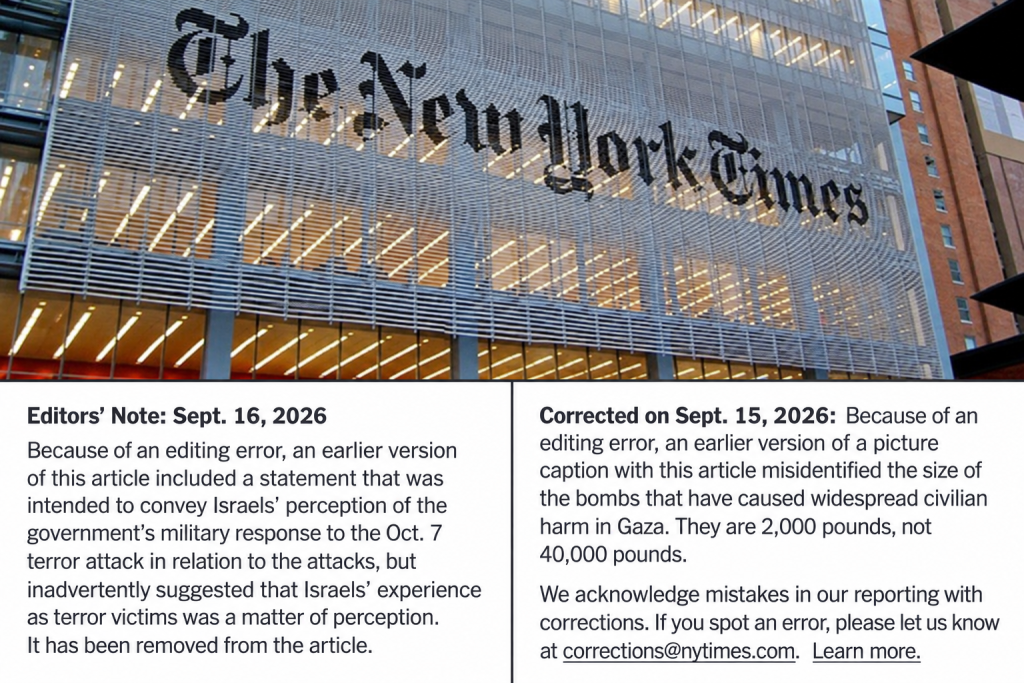
On September 15, 2026, the New York Times added a note to a story about U.S. weapons shipments to Israel, stating that an editing mistake had led to a caption that listed the bombs as 40,000 pounds instead of the correct 2,000 pounds. The correction was followed the next day by an editors' note that removed a sentence describing Israelis as "still largely view[ing] themselves as the victims of Oct. 7." Both changes were posted after a single X post by Israeli‑based commentator Eitan Fischberger generated more than a million impressions.
Fischberger, the grandson of Rabbi Avi Weiss, shared the disputed line with a scathing comment that read, "What the f**k is this, @nytimes." His post quickly spread across the platform, prompting a wave of replies from journalists, advocacy groups and politicians. The attention forced the Times to acknowledge the errors publicly, a move that underscores how social media can amplify reader concerns about mainstream outlets.
The bomb‑size correction addressed a factual inaccuracy that could have misled readers about the scale of U.S. military aid. A 2,000‑pound bomb is a standard air‑dropped munition, while a 40,000‑pound device would be comparable to a large artillery shell, a size that does not exist in the U.S. arsenal. By correcting the figure, the newspaper avoided inflating the perceived destructive power of the weapons supplied to Israel.
The second correction involved a line that, while technically true, was perceived as minimizing the trauma of the Oct. 7 Hamas attack. The original sentence suggested that many Israelis "still largely view themselves as the victims of Oct. 7," a phrasing that critics argued turned a factual reality into a matter of perception. The Anti‑Defamation League's chief executive, Jonathan Greenblatt, posted a screenshot of the line and wrote that Israelis are not "viewing themselves" as victims; they are victims. The ADL's response highlighted the emotional weight of the language and its potential to shape public opinion in the United States, where many readers rely on the Times for nuanced coverage of the conflict.
Other public figures joined the criticism. Israel's minister of diaspora and combating antisemitism, Amichai Chikli, offered a wry comparison, noting that "Americans still view themselves as the victims of 9/11." Money manager Clifford Asness added a personal jab, saying, "You can't hate the NYT enough." Fox News political analyst Brit Hume and CNN commentator Scott Jennings also weighed in, with Jennings calling the original line an "abomination." The breadth of the response illustrates how a single editorial choice can reverberate across the political spectrum.
The controversy arrives amid a broader legal push against the newspaper. A month earlier, a group of lawyers sent a letter to the Times demanding access to the company's board records. The letter warned that a "sustained editorial failure" could turn the paper into "a newspaper the public comes to regard as a propaganda operation." The request was part of a campaign by the National Jewish Advocacy Center, which argues that the Times' board has "abdicated its basic oversight duties." The center's demand cites a pattern of alleged missteps that, in its view, extends beyond any single story.
Understanding the board's composition helps explain why the demand carries weight. The New York Times Company is controlled by the Ochs‑Sulzberger family, whose shares are held in a trust that grants them voting power disproportionate to their economic stake. Critics argue that this structure can insulate the board from accountability, especially when editorial controversies arise. The family's historic role in shaping the paper's editorial standards adds another layer of scrutiny, as observers wonder whether the governance model hinders swift corrective action.
In the United States, the Times' coverage of the Israel‑Gaza war influences public debate and, by extension, congressional attitudes toward aid packages and diplomatic initiatives. Errors that appear to downplay Israeli suffering can fuel criticism from pro‑Israel lobby groups, while omissions that underplay civilian casualties in Gaza draw fire from human‑rights advocates. The recent corrections therefore matter not only for journalistic accuracy but also for the policy conversation in Washington, where lawmakers often cite major newspapers when framing legislation.
Canadian readers are not immune to the fallout. Canada's own media landscape has faced similar scrutiny over coverage of the Middle East, and the country's parliamentary committees have examined how foreign‑policy reporting shapes public sentiment. The corrections may prompt Canadian journalists to revisit their own editorial checks, especially as the two nations coordinate on trade and security matters related to the conflict.
The Times' editorial process typically involves multiple layers of fact‑checking, copy‑editing and legal review before publication. When a mistake is identified, the paper's standards require a public correction that is linked to the original article. However, the speed and visibility of the recent corrections suggest that the traditional workflow may have been strained by the rapid spread of criticism on social media. The newspaper did not name the editors responsible, nor did it outline any procedural changes to prevent similar errors.
Legal scholars note that the request for board records could set a precedent for greater corporate transparency in media companies. If a court were to order the Times to produce internal documents, it might reveal how editorial decisions are vetted and how dissenting voices within the newsroom are handled. Such disclosure could influence future litigation involving press standards and could encourage other media outlets to tighten their oversight mechanisms.
For now, the immediate impact rests on the public's reaction. Fischberger told the Washington Free Beacon that "when a major institution publishes something grotesque, sometimes you really do need to just point right at it and ask, 'Are you kidding me?'" His comment captures the sentiment of many readers who see social media as a tool for holding powerful institutions accountable. Whether the Times will adjust its editorial safeguards remains to be seen, but the episode underscores the growing power of online audiences to shape news coverage in real time.