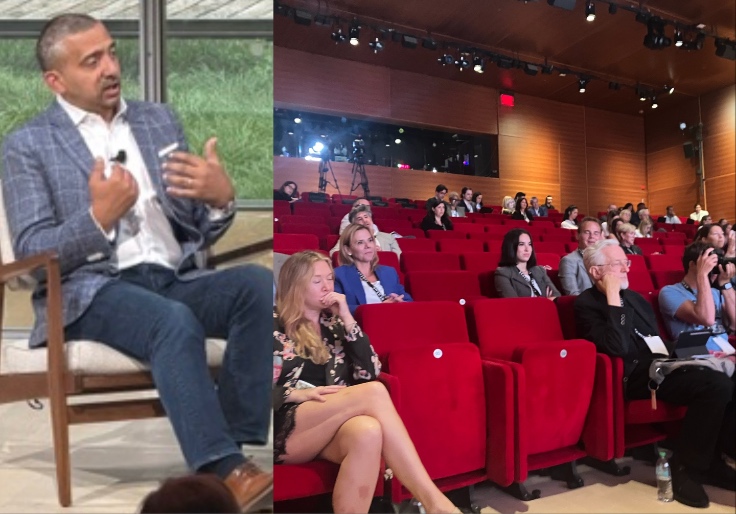
During a paid‑for conference hosted by the media‑watching firm Status News, the founder of the online outlet Zeteo, Mehdi Hasan, said his company is unable to attract "blue‑chip" advertisers and is therefore spending "tens of thousands" of dollars on defamation insurance.
Hasan made the remarks to a room of liberal‑leaning journalists, podcasters and executives inside the New York Times building. The event, billed as a "summit" for progressive media, charged $750 per ticket and featured sponsors such as Planned Parenthood, the talent agency William Morris Endeavor and the newsletter platform Beehiiv.
"You spend quite a lot of money on defamation insurance, and I'm assuming that cost has only gone up," asked Status founder Oliver Darcy, who moderated the discussion. Hasan confirmed, "It's a lot. It's a lot. It's more than tens of thousands."
Hasan, a former MSNBC host whose show was cancelled shortly after the Oct. 7, 2023 attacks on Israel, said Zeteo's editorial focus on what he calls "genocide" in the run‑up to elections makes advertisers wary. "Not a lot of people want to advertise against the content about genocide," he told the audience. "Not a lot of people want to advertise against quote‑unquote divisive, polarizing, controversial issues."
The claim that advertisers are fleeing because of Zeteo's stance on Israel fits a broader pattern in U.S. media where platforms that take strong positions on foreign policy sometimes lose corporate sponsorship. Large advertisers typically avoid content that could provoke consumer boycotts or regulatory scrutiny, a reality that has been documented in cases ranging from climate‑change coverage to debates over transgender rights.
Defamation insurance, while not a new tool for media companies, has become a more prominent line item for outlets that publish provocative commentary. The policy protects against lawsuits that could arise from statements deemed false or harmful. In the United States, the rise of "SLAPP" suits, strategic lawsuits against public participation, has prompted many news organizations to purchase such coverage. Canada's media firms have taken similar steps, especially after the Supreme Court's 2021 decision that clarified the balance between free expression and reputational harm.
Darcy, who also disclosed his own spending on defamation coverage, said his organization has "purchased as much defamation insurance as possible." He made the comment while speaking with former CNN anchor Kaitlan Collins, underscoring how even liberal‑leaning outlets feel pressure to shield themselves from legal attacks.
The summit's sponsor list highlighted the intertwining of media and entertainment interests. William Morris Endeavor, a major talent agency, and Beehiiv, a newsletter platform that hosts Status, both have business relationships with the event organizers. Such sponsorships are common in U.S. media conferences, where ticket revenue is supplemented by brand partnerships that seek exposure to a niche audience of journalists and influencers.
Planned Parenthood's involvement extended beyond a banner on the venue's Wi‑Fi network. The organization's name appeared as the password "Care4All," a detail that drew attention from observers who note the group's frequent presence in progressive fundraising circles.
Other speakers at the summit included former NBC Nightly News anchor Brian Williams, who was introduced by Darcy as "the last great anchorman." Williams, whose career was tarnished by a 2015 scandal involving fabricated war‑zone stories, has since worked on a series of celebrity interview shows for Netflix.
Tech journalist Kara Swisher used her platform to launch a series of attacks on high‑profile executives. She called Shark Tank co‑host Kevin O'Leary "that moron," accused Jeff Bezos of "destroying" the Washington Post, and labeled Elon Musk as "in need of mental help." Swisher's remarks were not challenged by the moderator, illustrating the one‑sided nature of the event's discourse.
Former CNN star Don Lemon and MSNBC personality Nicolle Wallace also took the stage, denouncing conservative media as "propaganda arms" of the Trump administration. Wallace went further, predicting that Fox News host Tucker Carlson might run for president. Their comments reflect a broader trend among liberal pundits to frame right‑wing outlets as extensions of partisan power.
New Yorker editor David Remnick, a longtime critic of authoritarianism, warned that the United States "now reminds me of the Soviet Union" based on his experience reporting from the former superpower in the 1980s. He added that Jeff Bezos's ownership of the Washington Post was "unforgivable." Remnick's remarks, while dramatic, echo concerns among some progressive commentators about corporate influence over newsrooms.
Notably, no conservative voices were invited to the panels, a fact that drew criticism from observers who argue that a truly "objective" media summit should include a range of perspectives. The absence of right‑leaning participants underscores the echo‑chamber effect that many media analysts warn can deepen partisan polarization.
Darcy's own background includes a stint at The Blaze, a conservative outlet, where he produced headlines that targeted Islam and LGBTQ issues. His transition to a liberal‑focused platform has not erased his reputation for provocative language, a point highlighted by his past articles that used incendiary phrasing to attract clicks.
In a side interview, Rebecca Kutler, the head of MSNBC, said the network does not ban Mehdi Hasan Piker, a controversial commentator who has expressed extremist views about the United States. "Mr Piker would like to be on MSNBC. There's no bans or blacklist or whatever is out there in the internet world," Kutler told the audience. Piker, who has claimed the United States deserved the 9/11 attacks, has repeatedly sought a platform on mainstream cable news without success.
The summit's financial model relied heavily on ticket sales and sponsorships. While the $750 price tag covered access to panels and networking, many attendees reported receiving complimentary tickets, suggesting that the event's profitability may have been limited. Darcy reportedly reached out to media companies in the days before the conference, asking them to attend for free, a tactic not uncommon in the industry when organizers seek to fill seats and create the appearance of a packed house.
For U.S. and Canadian observers, the episode raises questions about how progressive media outlets fund themselves in an environment where advertisers are increasingly cautious. In Canada, similar debates have emerged around the funding of public broadcasters and the role of corporate sponsorship in political programming. The reliance on high‑priced conferences and niche newsletters reflects a broader shift away from traditional ad‑supported models toward subscription and event‑based revenue streams.
Legal experts note that the cost of defamation insurance can vary widely based on the outlet's perceived risk profile. A policy that costs "tens of thousands" may be justified if the outlet regularly publishes content that could be construed as defamatory under U.S. law, where the standard for public figures requires proving "actual malice." In Canada, the threshold is lower, meaning media firms may face higher insurance premiums for similar content.
Looking ahead, Hasan's admission that Zeteo is struggling to secure major advertisers could influence how other progressive platforms approach controversial topics. If advertisers continue to shy away from content that challenges Israel's policies, outlets may either self‑censor or double down on niche funding sources, potentially reshaping the media ecosystem for both American and Canadian audiences.
The summit concluded without any concrete resolution to the advertising dilemma, leaving participants to ponder whether the liberal media's reliance on elite sponsorships will endure or give way to new financing models that can withstand legal and commercial pressures.