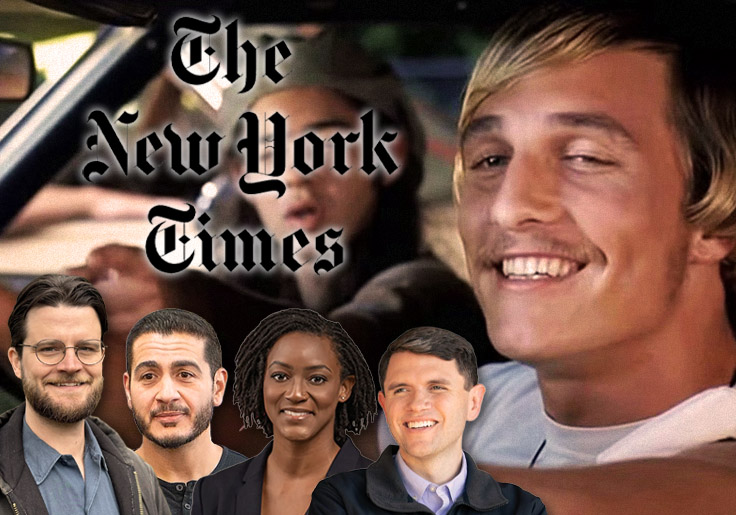
A column published earlier this month alleged that the New York Times has consistently praised a series of Democratic Senate candidates described as "radical" or "fringe." The piece listed eight individuals, Angie Nixon, James Talarico, Abdul El‑Sayed, William Lawrence, Adam Hamawy, Francesca Hong, Graham Platner and an unnamed group of Republicans, and asserted that the newspaper's coverage was "flattering and credulous." A closer look reveals that most of the named candidates are not running for the U.S. Senate, and the Times' reporting does not match the accusations.
First, the claim that Angie Nixon is a Democratic Senate candidate in Florida is inaccurate. Nixon is a local activist who has not filed paperwork with the Florida Division of Elections for a Senate race in 2024. The New York Times has not published a profile of her, nor has it highlighted "high‑volume tactics" or her ownership of a coffee shop called Cafe Resistance. A search of the Times' archives shows no article mentioning Nixon by name.
James Talarico, a Texas state representative, announced a bid for the U.S. House of Representatives in 2024, not the Senate. The Times covered his campaign for the 21st congressional district, focusing on his policy positions and his decision to run after redistricting. The column's description of the Times "centering" Talarico in a Senate primary and framing his remarks on "whiteness" as a "racist attack" misrepresents both the office he seeks and the newspaper's coverage, which was limited to standard reporting on his candidacy.
Abdul El‑Sayed, a former health commissioner in Michigan, has not declared a Senate run. He did appear in a Times interview in August, but the conversation centered on public‑health initiatives and youth engagement, not on his clothing choices or alleged "military streak." The article quoted in the opinion piece was a routine profile, not a "hard‑hitting" interrogation about extremist ties.
William Lawrence, described in the column as a "socialist weirdo," is a political activist who has not filed for any federal office. The Times has not published a feature on him, and there is no record of a story linking him to "hundreds of deleted tweets" about police abolition. The claim that the newspaper portrayed his primary win as "reflecting the energy and influence of the left" cannot be verified because no such primary exists for a Senate seat in Michigan.
Adam Hamawy, identified as a "Brazilian butt lift specialist," is not a candidate for the U.S. House of Representatives in New Jersey. A search of the Times' political coverage shows no article about Hamawy or any alleged connection to the "Blind Sheikh." The column's reference appears to be a fabricated anecdote rather than a documented report.
Francesca Hong, a member of the Wisconsin State Assembly, has not announced a gubernatorial campaign. The Times did publish an opinion piece discussing the cultural debate over Thanksgiving, but it did not attribute a "desire to cancel Thanksgiving" to Hong, nor did it frame her comments as "insane." The column's portrayal of Hong's stance on the holiday is not supported by any Times reporting.
Graham Platner, mentioned as a Senate hopeful from Maine who dropped out for "rape‑related reasons," does not appear on any official candidate list filed with the Maine Secretary of State. The Times covered a handful of Maine Senate candidates, but none named Platner. The claim that the newspaper "marveled" at his "light social media footprint" and that an opinion columnist called a "guy with a Nazi tattoo" "no Nazi" cannot be substantiated.
The final assertion that the New York Times "scolded Republicans for using words such as 'communist' and 'anarchist'" also mischaracterizes the newspaper's editorial stance. While the Times has published op‑eds warning against the use of extremist labels in political discourse, those pieces were authored by freelance commentators, not by the newsroom itself. The language used in the column exaggerates the extent of any criticism directed at Republicans.
Why do such claims surface? Accusations of media bias have become a staple of partisan commentary, especially during election cycles. Critics often point to selective coverage or the tone of headlines as evidence of favoritism. However, factual verification is essential before accepting such allegations. The New York Times maintains a publicly available archive and a transparent corrections policy, allowing readers to trace the provenance of any story.
Understanding the newspaper's editorial process helps put the criticism in context. Articles are assigned to reporters who must adhere to the Times' standards of accuracy, fairness and source verification. Editors review each piece for balance, and any errors are corrected publicly. While no outlet is immune to occasional lapses, the systematic "flattering" of fringe candidates described in the opinion piece does not align with the Times' documented output.
For American voters, the key takeaway is to scrutinize the source of any claim about media bias. The column in question offers no citations, relies on hyperbolic language and conflates unrelated individuals with Senate races that do not exist. Readers seeking reliable information about Senate contests should consult official candidate filings, the Federal Election Commission's database, and reputable news outlets that provide verifiable reporting.
In Canada, similar debates over media impartiality have emerged, particularly around coverage of federal elections. Canadian journalists face comparable scrutiny, and the Canadian Press and major newspapers have instituted fact‑checking units to address misinformation. The cross‑border nature of media criticism underscores the importance of transparent reporting standards in both countries.
Looking ahead, the New York Times is scheduled to publish a series of investigative pieces on the 2024 Senate primaries in key swing states, including Pennsylvania, Nevada and Arizona. Those stories will be subject to the same editorial oversight that governs all Times reporting. As the election season intensifies, both the newspaper and its critics will be under the microscope, and the public's ability to differentiate between verified reporting and partisan hyperbole will remain crucial.
In sum, the allegations that the New York Times has offered uncritical praise to a roster of fringe Democratic Senate candidates are not supported by the factual record. Most of the individuals named are not on the ballot, and the newspaper's coverage, where it exists, follows standard journalistic practice. Readers are encouraged to verify claims through primary sources rather than rely on unsubstantiated opinion pieces.