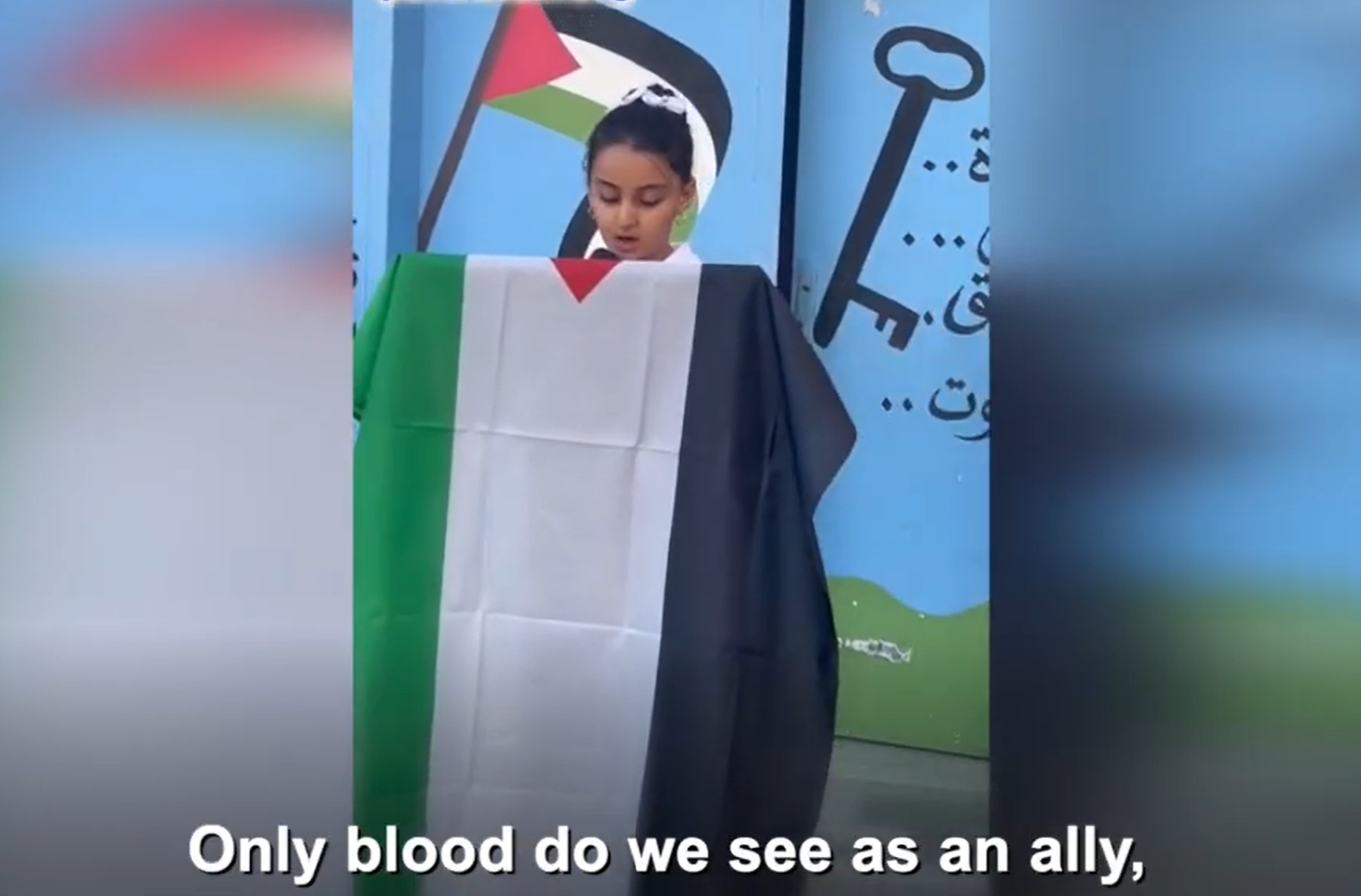
Materials obtained by the Washington Free Beacon reveal that teachers in at least eleven Palestinian Authority‑run schools have used the October 7, 2023 Hamas assault on Israel as the basis for arithmetic exercises and school‑wide ceremonies that praise the violence. The findings, compiled by the Israeli research group Palestinian Media Watch, have been shared with senior U.S. diplomats who say the practice violates promises by the PA and the PLO to end incitement in education.
One worksheet from Al‑Kuwait Co‑ed Elementary School asks a nine‑year‑old to multiply "150 Israelis killed in one day" by nine, arriving at "1,350 killed." The teacher's comment on the page reads, "May Allah protect you! Excellent!" A second problem describes "150 Jihad fighters sent to each of nine settlements" and again rewards the correct answer with a note praising "victory to the residents of Gaza." Similar questions about "martyrs" in Gaza appear in other classrooms, each accompanied by celebratory remarks from the instructor.
Video recordings from assemblies at schools such as Kharas Girls' Elementary in Hebron show children reciting poems that describe the Oct. 7 attacks as a "beautiful dream" and a "historic day" that brought "joy" and "hope for liberation." In another school, a girl declares, "We will cool the fire in our heart with the body parts and screams of soldiers," a line that mirrors rhetoric used by Hamas propaganda. Posters displayed at the events feature slogans like "Our land will be liberated from the Jews" and "Open your door, we are death."
Palestinian Media Watch notes that the PA Ministry of Education has previously named dozens of schools after individuals involved in attacks against Israelis, including Dalal Mughrabi, who killed 38 Israelis in 1978, and the World War II era figure Amin al‑Husseini, a Nazi collaborator who served as Jerusalem's Grand Mufti. The new evidence suggests that the curriculum now embeds the Oct. 7 narrative across subjects that are not directly related to history or civics.
U.S. State Department officials, speaking on condition of anonymity, said the PA must end all forms of incitement, glorification of violence, and refusal to recognize Israel's right to exist before it can be considered a partner in any post‑war Gaza administration. "The PA still has not and must end its incitement, glorification of violence, support for terrorism, and refusal to recognize Israel's right to exist in its educational curriculum and materials," a spokesperson told the Free Beacon.
The remarks come as the Trump administration advances a plan to dismantle the United Nations Relief and Works Agency (UNRWA) and replace it with a U.S.‑led "Board of Peace" that would oversee reconstruction and governance in Gaza. The board's proposals envision a "reformed" PA playing a central role, but Israel has publicly opposed any PA involvement, citing the very type of school indoctrination documented in the new report.
Congressional leaders have echoed the State Department's concerns. Representative Pat Fallon, a member of the House Armed Services Committee, warned that giving the PA a leadership role in Gaza would be "the definition of evil" because of its "systematic promotion of the October 7 attacks for children." Other lawmakers have called for a complete overhaul of the PA's education system before any funding or administrative authority is granted.
Understanding the stakes requires a brief look at how the Palestinian Authority's education system operates. The Ministry of Education, based in Ramallah, controls curricula for the roughly 500,000 students in West Bank public schools. Textbooks are approved centrally, and school principals are appointed by the ministry. Since the Oslo Accords, the PA has been responsible for education in Areas A and B of the West Bank, while Israel retains authority over Area C and the Gaza Strip. The curriculum has long been a flashpoint, with previous U.S. and European reviews noting language that delegitimizes Israel and glorifies resistance.
In the early 2000s, the United States and the European Union pressured the PA to revise textbooks, resulting in modest changes that removed some overtly hostile language but left many passages praising "martyrdom" and "resistance." The latest findings suggest that the PA has not only retained those elements but has now woven the Oct. 7 attacks into everyday lessons, a development that could undermine any effort to present a neutral educational environment in a post‑conflict Gaza.
The Trump administration's reconstruction plan hinges on establishing a civilian authority in Gaza that can manage reconstruction contracts, coordinate humanitarian aid, and maintain security. Critics argue that without a thorough purge of educators who promote violence, any PA‑led administration would risk reproducing the same radicalization that fuels attacks. The State Department's senior diplomat on Palestinian affairs said the board intends to "ensure that Gaza is not only demilitarized, but deradicalized, and that its schools educate the next generation for peace and opportunity, not hatred and conflict."
Replacing the current PA education leadership would be a massive undertaking. The ministry employs thousands of teachers and administrators, many of whom have been in their positions for decades. Restructuring would require new hiring standards, vetting processes, and likely external oversight. Some observers compare the task to the post‑World War II supervision of German schools by the Allied powers, a model that involved extensive curriculum review, teacher retraining, and monitoring by occupying authorities.
Adding to the complexity, a U.S. Agency for International Development (USAID) Inspector General investigation has uncovered that Hamas operatives have served as principals and teachers within UNRWA schools in Gaza. While the PA does not control UNRWA, the overlap raises concerns about the ability of any Palestinian authority to police its own educational staff without external assistance.
Internationally, several Western nations have recognized a Palestinian state, but they have largely ignored the evidence presented by Palestinian Media Watch. The organization's founder, Itamar Marcus, told the Free Beacon that "making some symbolic changes in school books without replacing the educational directors, school principals, and teachers is like treating a cancer with aspirin." He urged the United States to lead a coalition that would demand a full restructuring of the PA's education ministry.
For American and Canadian taxpayers, the issue matters because billions of dollars in reconstruction aid are at stake. If the PA's schools continue to promote extremist narratives, donors risk funding an environment that could produce future militants, potentially destabilizing the region and jeopardizing U.S. and Canadian security interests. Moreover, the perception that the United States is willing to work with an entity that glorifies attacks on civilians could affect domestic political debates over foreign aid and Middle‑East policy.
The next steps are likely to involve formal briefings to the Board of Peace, followed by a decision on whether to condition any PA participation on a verifiable overhaul of the education system. The State Department has indicated that any such overhaul must be "complete," with the removal of teachers who have praised the Oct. 7 attacks and the introduction of curricula that focus on basic skills and vocational training rather than martyrdom.
As the Trump administration pushes forward with its Gaza plan, the revelations about PA schools add a new layer of scrutiny. Whether the United States will demand the sweeping changes called for by diplomats and watchdog groups remains to be seen, but the evidence suggests that without a fundamental shift in how Palestinian children are taught, any effort to rebuild Gaza could be undermined from the classroom up.