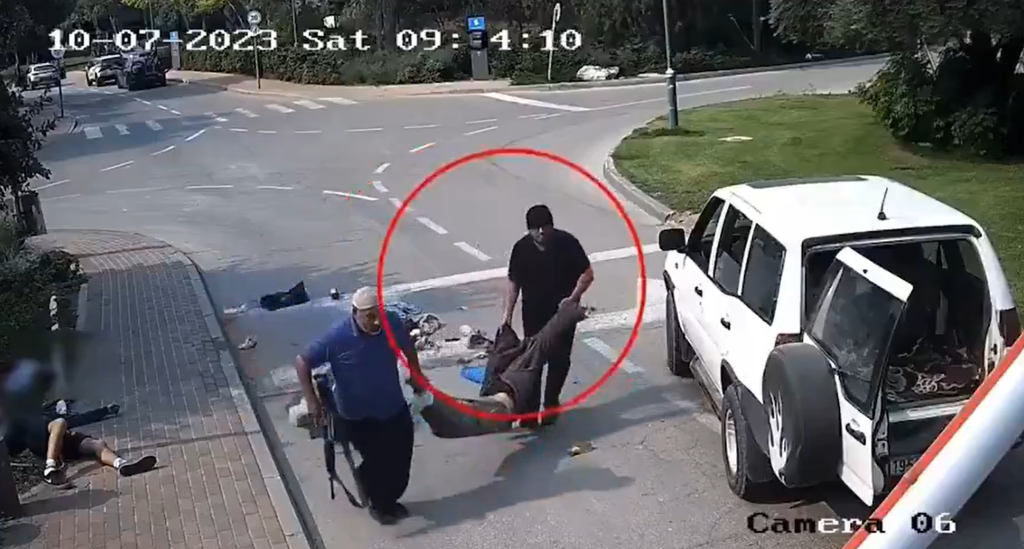
According to a confidential investigative summary obtained by the Washington Free Beacon, the United States Agency for International Development's Office of Inspector General (OIG) has concluded that a man identified as Faisal Ali Al‑Naami, who was recorded moving a dead Israeli civilian into the trunk of a vehicle during the Oct. 7 Hamas assault, was simultaneously employed by the United Nations Relief and Works Agency (UNRWA) and served as a Hamas "military communications" operative.
The video, captured by security cameras in Kibbutz Be'eri, shows Al‑Naami and an armed accomplice loading the body of 21‑year‑old Yonatan Samerano into an SUV before leaving the scene. Israeli authorities publicly named Al‑Naami in February 2024 after releasing a list of at least a dozen UNRWA employees they said took part in the Oct. 7 attacks. Israel's intelligence officials described the individuals as "active participants" rather than peripheral witnesses.
The Free Beacon report says the USAID OIG independently verified the Israeli claims through its own evidence collection, which it says includes "non‑public investigatory records." The OIG allegedly determined that Al‑Naami was not merely a by‑stander but an operative who helped coordinate the killings. The agency also reportedly linked more than 100 current or former UNRWA staff members to Hamas activities, including three school teachers who are still alive and were said to have taken Israeli hostages.
In a statement to the Free Beacon, a senior State Department official described the OIG findings as "a significant development that clarifies the extent of Hamas infiltration in a major humanitarian organization." The official added that the State Department is reviewing the OIG's referrals, which could result in a ten‑year ban on U.S. foreign‑aid projects for the individuals named.
The United Nations, which oversees UNRWA, has not released a public response to the OIG's alleged conclusions. In July 2024, a UN‑conducted internal review said the evidence presented by Israel "could only prove guilt if it were authenticated and corroborated independently," a standard the UN said had not been met. The UN's own investigation has thus far stopped short of labeling any UNRWA employee a terrorist.
UNRWA, founded in 1949, provides education, health care and food assistance to roughly 1.5 million Palestinian refugees in Gaza, the West Bank, Jordan, Lebanon and Syria. The agency receives roughly $400 million annually from donor governments, including the United States, which contributed about $60 million in fiscal year 2023. Canada also allocates several million dollars each year to UNRWA projects.
The allegations against UNRWA staff have intensified a policy debate that began during the Trump administration. In 2021, senior officials in the former administration called for the agency to be designated a foreign terrorist organization and for its funding to be terminated. While the administration did not ultimately list UNRWA as a terrorist entity, it did direct the State Department to halt new funding pending a review.
Since then, several members of Congress have introduced legislation to either strip UNRWA of U.S. aid or to place the agency on a blacklist that would bar it from receiving any American assistance. Proponents argue that the presence of Hamas operatives within UNRWA jeopardizes the safety of aid workers and the integrity of U.S. taxpayer dollars. Critics counter that cutting funds would exacerbate humanitarian suffering among Palestinian civilians, many of whom rely on UNRWA for basic services.
Canada faces a parallel discussion. In early 2024, the Canadian Parliament debated a motion to suspend its contributions to UNRWA pending a thorough audit. While the motion did not pass, it prompted a review by Global Affairs Canada, which is now assessing the OIG's findings alongside its own intelligence. Canadian officials have emphasized the need for "robust safeguards" to ensure that aid does not fund extremist groups.
The OIG's alleged referrals to the State Department also raise the prospect of criminal investigations. The report, as described by the Free Beacon, indicates that the agency may forward additional cases to the Department of Justice for possible prosecution under U.S. anti‑terrorism statutes. If pursued, such cases could set a precedent for how U.S. law addresses foreign‑aid workers who are simultaneously members of designated terrorist organizations.
Humanitarian experts caution that any abrupt termination of UNRWA funding could create a vacuum in Gaza's already fragile service network. "UNRWA runs schools, clinics and food distribution points that reach the most vulnerable," said a senior analyst at the International Rescue Committee, who asked to remain anonymous. "If those programs collapse, the humanitarian cost could be severe." The analyst noted that alternative NGOs would need time and resources to fill the gap, and that any transition would require coordination with both Israeli and Palestinian authorities.
From a legal standpoint, the United States has limited authority to designate a United Nations agency as a terrorist organization. Such a designation would require a determination by the State Department under the International Emergency Economic Powers Act, followed by congressional approval. The process is lengthy and has never been applied to a UN body.
In the meantime, the USAID OIG says its investigation is ongoing and that the total number of UNRWA employees under review has risen to more than 1,500. The agency's mandate, as outlined in its charter, includes "ensuring that U.S.‑funded assistance does not fall into the hands of foreign terrorist organizations." The OIG's office has highlighted its "global oversight capacity" as a tool for preventing the recirculation of extremist actors across aid networks.
State Department spokesman Tommy Pigott, speaking to the Free Beacon, reiterated the administration's stance: "President Trump and Secretary Rubio have affirmed that no State Department funding will be provided to UNRWA while credible evidence of Hamas infiltration exists." Pigott added that the department is "reviewing all referrals" and will act in accordance with U.S. law and policy.
As the investigation proceeds, both U.S. and Canadian policymakers will need to balance security concerns with the humanitarian imperative to keep essential services running in Gaza. The outcome could reshape how Western governments vet and monitor staff of large, multilateral aid agencies, and may influence future funding decisions for UNRWA and similar organizations.
For now, the USAID OIG's findings, as reported, remain unverified by an independent public release. Observers note that the lack of a publicly available report makes it difficult to assess the strength of the evidence. Nonetheless, the allegations have already spurred legislative proposals, diplomatic reviews and a renewed scrutiny of how humanitarian aid is delivered in conflict zones.