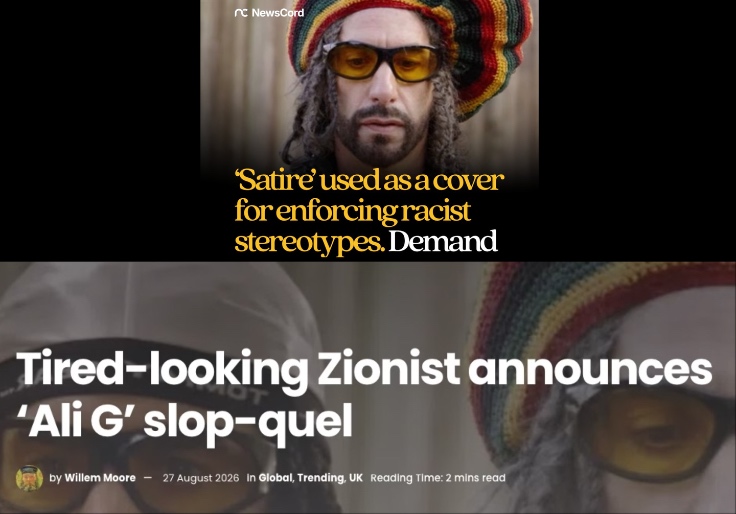
NewsCord, a British media watchdog that describes itself as a platform against bias in coverage of the Gaza conflict, has launched a coordinated effort to pressure cinemas worldwide to refuse screenings of Sacha Baron Cohen's upcoming film Ali G: Who Iz I?. The group claims the character reinforces outdated caricatures of Jamaican culture, but documents reviewed by the Washington Free Beacon reveal that the campaign is funded by Irish investor Cecil Hetherington, whose portfolio includes several outlets known for aggressive criticism of Israel.
Baron Cohen, a British‑Israeli actor who has publicly supported Israel for more than a decade, is slated to reprise his Ali G persona for the first time in twenty years. The film, produced by MGM and distributed by Amazon, debuted its trailer last week and has already attracted attention from both fans and detractors. NewsCord announced on August 26 that it would generate tens of thousands of emails to theater chains, urging them to cancel the release. The group also claimed that Picturehouse Cinemas in the United Kingdom had decided not to show the movie, a statement the chain publicly denied.
Critics of the campaign point out that the language used by NewsCord and its affiliates often blends concerns about racial representation with a broader anti‑Israel narrative. In a post on the social platform X, a user labeled the film "Ali Genocide" and accused Amazon of "directly assisting the Israeli military in killing people." Similar accusations have appeared on the website Canary Media, a publication that Hetherington partially owns and that has repeatedly described Baron Cohen as a "tired‑looking Zionist."
Hetherington's involvement became public after financial disclosures showed that his company Ulidia Investments Limited acquired a twenty‑percent stake in NewsCord earlier this summer. In an interview with the Free Beacon, NewsCord founder and chief executive Nima Akram said the investment "has never had any influence on any of our campaigns." Akram maintained that the anti‑Ali G effort is solely about "the racist stereotypes the Ali G character reinforces."
While Akram's denial is on record, the timing of the investment raises questions. Hetherington also sits on the board of Declassified UK, another outlet that frequently publishes pieces critical of Israel's actions in Gaza. In addition, Hetherington holds a substantial share of Canary Media, which has been vocal in calling for the film's cancellation and linking Baron Cohen's work to "Israel lobbyist" activities.
NewsCord's origins trace back to late 2023, when a group of developers launched a "hack for Gaza" initiative aimed at creating digital tools to support Palestinian resilience. The platform quickly evolved into a media‑monitoring site that labels mainstream coverage of the Israel‑Gaza war as "genocide" or "ethnic cleansing." Its homepage features a tab titled "Gaza Genocide," and the organization claims to have filed more than twenty‑thousand formal complaints to Western news outlets about their reporting on the conflict.
The watchdog's methodology has drawn scrutiny from media scholars and legal experts. In April, NewsCord published a report accusing the BBC of failing to name Israel as the perpetrator in half of the articles it analyzed about civilian deaths in Gaza. The report was cited by former Labour leader Jeremy Corbyn, who described the BBC's coverage as "manufactured consent for genocide." Critics argue that NewsCord's framing often relies on charged terminology that can influence public perception without providing balanced evidence.
Beyond the Gaza focus, NewsCord has recently taken credit for influencing the Committee to Protect Journalists (CPJ) to broaden its definition of who qualifies as a journalist in conflict zones. The organization argued that "organizations affiliated with militant groups" should be counted as legitimate news sources, a stance that sparked debate within the CPJ's board and among international humanitarian law scholars. The board ultimately voted to adopt the broader definition, a decision that NewsCord highlighted as a victory for its agenda.
The controversy surrounding the Ali G film arrives at a moment when the American and Canadian film industries are grappling with questions of representation and corporate responsibility. Both MGM and Amazon have faced pressure from advocacy groups in the United States over the portrayal of racial and ethnic minorities in recent releases. In Canada, the Canadian Radio‑television and Telecommunications Commission (CRTC) has been monitoring foreign ownership of streaming platforms and the impact of content that may be deemed culturally insensitive. While the current campaign is centered in the United Kingdom, the involvement of a U.S.‑based distributor means that any boycott could have ripple effects on box‑office expectations in North America.
For American and Canadian voters, the episode underscores how foreign media watchdogs can shape discourse around entertainment products that cross borders. The campaign's emphasis on "racist stereotypes" aligns with ongoing debates in U.S. Congress about the role of the Motion Picture Association in enforcing diversity standards. In Canada, the issue may surface in discussions about the upcoming federal election, where parties are weighing how to address cultural representation in media while balancing free‑speech concerns.
Legal experts note that the effort to block a film's release faces significant hurdles. In the United Kingdom, cinema chains are not legally obligated to screen any particular title, but they must avoid unlawful discrimination. A coordinated email campaign could influence business decisions, yet any attempt to suppress a film on the basis of political speech could trigger challenges under the European Convention on Human Rights, to which the UK remains a signatory. In the United States, similar campaigns would be evaluated under the First Amendment, which protects expressive conduct even when it is unpopular.
Baron Cohen's representatives have not responded to requests for comment, and MGM/Amazon has declined to address the allegations directly. The actor's public record shows a pattern of supporting Israel, including donations to pro‑Israel charities and vocal opposition to the Boycott, Divestment and Sanctions (BDS) movement. Those actions have made him a target for activists who view any cultural product associated with him as a vehicle for "Israel lobbyist" messaging.
As the release date approaches, the outcome of NewsCord's petition will likely depend on how theater owners weigh the potential backlash from both anti‑racism advocates and free‑speech proponents. The episode illustrates how a single film can become a flashpoint for broader geopolitical disputes, linking debates over racial caricature in comedy to the contentious politics of the Israel‑Palestine conflict. For audiences in the United States and Canada, the controversy offers a reminder that cultural products are increasingly entangled with international advocacy networks, and that the battle over representation may extend far beyond the screen.