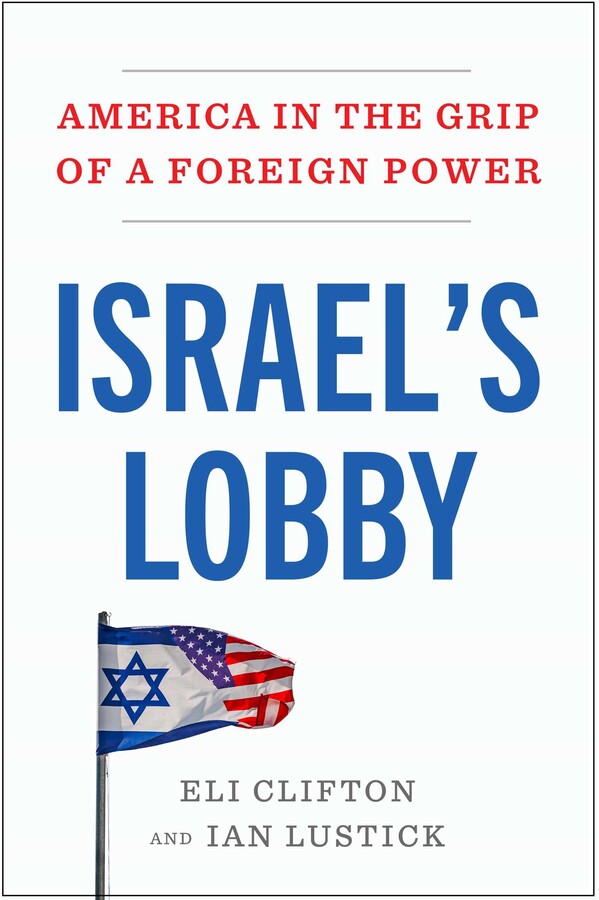
"Israel's Lobby: America in the Grip of a Foreign Power," co‑authored by Eli Clifton and Ian Lustick, hit shelves this month under the One Signal imprint of Simon & Schuster. The 304‑page volume, priced at $29, purports to expose the influence of pro‑Israel donors on U.S. policy, yet critics say the book is riddled with errors that undermine its credibility.
Washington Free Beacon senior writer Ira Stoll, who first reported on the book, described the reading experience as "so vile that it left me physically nauseated." Stoll cited a passage that labels American supporters of a strong U.S., Israel relationship as "agents of the ally," a characterization he argues misrepresents loyal citizens as foreign operatives.
Beyond tone, the text contains a series of demonstrable inaccuracies. The authors describe former Navy analyst Jonathan Pollard as a "traitor," despite his conviction for a single count of conspiracy to deliver national‑defense information, not treason as defined in the Constitution. The misspelling of Morris Amitay's surname as "Amitai" is another basic error.
One claim asserts that Representative Ritchie Torres (D‑NY) "aligns himself completely with and is strongly supported by Israel's Lobby" because he represents the nation's poorest district. In fact, Torres's Bronx district includes Riverdale, a neighborhood with a Jewish population in the tens of thousands, supporting several synagogues, a kosher Chinese restaurant, and a Jewish day school that maintains a close relationship with the congressman.
The book also alleges that Sara Netanyahu posted an Instagram image two weeks into the war depicting "two lions leaning against each other" to suggest a return to a "non‑Islamic imperial past" for Iran. The flag shown in the post features a lion and a sun, symbols that predate the Pahlavi dynasty and have long been part of Iranian cultural heritage. Moreover, the shahs were themselves Muslim, a nuance absent from the authors' narrative.
Other factual slips include referring to "Timberland founder Sidney Swartz" when the company was founded by Nathan Swartz, and describing Sheldon and Miriam Adelson as "the largest donors by far" in the 2012 election cycle with a $92 million spend. In reality, the Koch network outspent them, contributing $122 million according to the New York Times, while the Adelsons' total was lower.
Stoll points out that the book omits major donors who fund anti‑Israel causes, such as the Koch brothers, George Soros, and the Rockefeller Brothers Fund. The index lists the Adelson family fifteen times but makes no mention of these other influential players.
Further mischaracterizations involve organizations and events. Friends of the IDF is called a "pro‑Israel think tank," yet the group operates as a charity that provides housing for "lone soldiers" and offers mental‑health services, including therapy dogs for veterans. The authors also reference "peaceful demonstrations against ICE raids in Los Angeles in 2025" while ignoring recent convictions of three individuals who threw rocks, cement, and lighter fluid at police during a violent riot, a detail the book uses to attack a Trump aide who is Jewish.
On policy, the authors claim "It is Israeli violence against Palestinians that increases antisemitism," a statement that ignores historical spikes in anti‑Jewish hate during the Spanish Inquisition and the Holocaust, periods that predate the modern state of Israel. Clifton and Lustick also argue that Israel's "obsessive use of 'terrorist' as an adjective" is a false narrative, yet Israel routinely uses the term as a noun to describe groups it confronts.
Even broader geopolitical assertions are contested. The book states that "between Truman and George H.W. Bush, every American adopted containment as their grand geopolitical strategy," overlooking President Reagan's shift to "rollback," a strategy credited with ending the Cold War. Such oversights, Stoll argues, reveal a limited grasp of foreign‑policy history.
The most striking question raised by the book's acknowledgments is the source of its financial backing. The authors thank "the generous support provided by Lina and Ali." Investigations trace Lina Lazaar and Ali Munir to the Qatar Investment Authority (QIA). In July, QIA chairman Sheikh Bandar bin Mohammed bin Saoud Al‑Thani met with KKR co‑Chief Executive Scott Nuttall in New York, a meeting documented by the Qatari government.
KKR, a private‑equity firm that owns Simon & Schuster's One Signal imprint, has faced scrutiny for its ties to Gulf sovereign wealth funds. Lina Lazaar heads the Kamel Lazaar Foundation, a Geneva‑ and Tunis‑based cultural organization, while Ali Munir serves as a trustee of Ibraaz, a London cultural centre funded by the same foundation. Corporate filings show Munir's Panarae Limited is registered in the Jersey Islands, an offshore jurisdiction.
Both Lazaar and Munir appear on the donor list of the Quincy Institute, a Washington think tank that lists Clifton as co‑founder and senior adviser. The institute's public disclosures place their contributions in the $100,000‑$250,000 bracket, alongside the Open Society Foundations and the Rockefeller Brothers Fund, but below the Koch network's "Stand Together Trust." The lack of transparency about these contributions has prompted calls for greater disclosure under U.S. lobbying and foreign‑influence rules.
U.S. law prohibits foreign nationals from making direct contributions to federal candidates, but foreign‑origin money can flow to think tanks, advocacy groups, and publishing houses. The Federal Election Commission requires any entity that receives more than $10,000 from a foreign source to disclose it, yet the book's publisher has not filed such a report, raising questions about compliance.
Critics argue that the book's reliance on Qatar‑linked donors creates a conflict of interest, especially given Qatar's own geopolitical agenda in the Middle East. The acknowledgment of "Lina and Ali" without full names or details, Stoll notes, appears designed to obscure the true source of funding.
Simon & Schuster's One Signal imprint, launched in 2022, focuses on politically charged nonfiction. The imprint's parent company, KKR, acquired a majority stake in Simon & Schuster in 2023, a deal that has drawn attention to the private‑equity firm's influence over the publishing pipeline. The partnership has sparked debate about whether profit‑driven owners might prioritize controversial titles that generate media buzz over rigorous editorial standards.
In the wake of the book's release, several congressional staffers and advocacy groups have requested that the House Committee on Oversight examine the role of foreign money in U.S. political publishing. If the investigation proceeds, it could lead to tighter enforcement of the Foreign Agents Registration Act, a statute that requires individuals and entities acting on behalf of foreign principals to disclose their activities.
For now, the book remains on the market, but its reception among scholars and policy analysts has been overwhelmingly negative. The combination of factual errors, selective sourcing, and opaque funding has turned what might have been a contribution to the debate over the Israel lobby into a cautionary tale about the perils of undisclosed foreign influence in American political discourse.