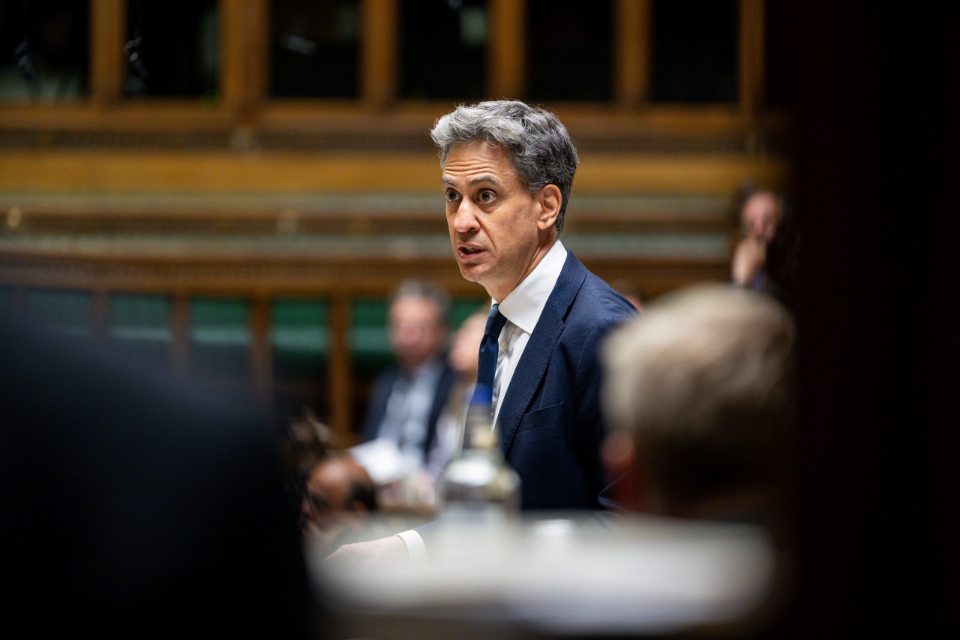
On Tuesday the British foreign secretary announced a package of measures aimed at curbing economic support for Israeli settlement activity in the occupied Palestinian territories. The move marks the most comprehensive set of sanctions the United Kingdom has imposed on Israel since the 1970s and arrives at a moment when the country is seeing an unprecedented outflow of high‑net‑worth individuals.
Foreign Secretary Ed Miliband unveiled a package of measures on Tuesday that bans the export of British arms and other items that "materially contribute to the occupation" of the Palestinian territories. The announcement also includes an import prohibition on goods produced in settlements deemed illegal under international law and a pledge to target companies and individuals that provide construction, infrastructure, financing or real‑estate services supporting settlement expansion.
Israel's foreign minister, Gideon Sa'ar, responded by saying the United Kingdom's diplomatic presence in Jerusalem would be reduced. Sa'ar announced the closure of the British consulate, the expulsion of several British diplomats and a ban on entry for additional UK officials. "The message to any government that harms us is clear," he said, adding that he had spoken with opposition leaders Kemi Badenoch and Tom Tugendhat, whom he thanked for their "firm opposition" to the Labour policy."
At the same time, Bloomberg reported that hedge‑fund founder Chris Rokos, identified as one of the United Kingdom's largest taxpayers, is relocating to Greece. Rokos joins a list of high‑net‑worth individuals who have recently announced moves abroad, including steel magnate Lakshmi Mittal, his son Sharvin Bharti Mittal, fintech entrepreneur Guillaume Pousaz, Egyptian businessman Nassef Sawiris, and private‑equity partners John Fredericksen and Michael Platt.
Platt, who has shifted his base to Switzerland and the United Arab Emirates, told reporters that "the UK is no longer a serious contender as a jurisdiction in which to do business." Fredericksen, now residing in Cyprus and the UAE, described Britain as having "gone to hell." Their statements echo concerns among investors that upcoming fiscal measures could erode the United Kingdom's attractiveness.
The departures come as the bond market signals heightened risk for British sovereign debt. Yields on the 30‑year gilt rose to nearly six percent, the highest level since 1998, reflecting investor anxiety over the country's fiscal outlook and the potential impact of Labour's tax proposals.
Labour's fiscal platform, outlined in its recent election manifesto, calls for a rise in corporation tax from 19 percent to 25 percent, the introduction of a wealth tax on assets above £5 million, and higher rates on capital gains and dividends. Analysts say the combination of higher taxes on income, capital and property could prompt entrepreneurs and investors to seek more favourable regimes elsewhere, a trend already evident in the recent billionaire exits.
Britain's relationship with Israel has traditionally been close, with defence cooperation and trade ties dating back to the post‑World‑War II era. However, the Labour government's move marks a shift toward a more confrontational stance on settlement policy. Previous UK governments have imposed limited restrictions on settlement‑related products, but the current package expands the scope to include services that facilitate settlement growth.
For North American investors, the developments raise practical considerations. U.S. and Canadian funds with exposure to UK‑based assets may need to reassess risk profiles in light of higher borrowing costs and potential trade disruptions. Moreover, the sanctions could affect multinational corporations that source components from Israeli firms operating in settlements, prompting compliance reviews similar to those undertaken after the United States re‑imposed certain restrictions on Israeli entities in 2021.
Chief Rabbi Sir Ephraim Mirvis cautioned that the sanctions "do nothing to advance the cause of peace" and warned they could fuel hostility toward Jewish communities. Opposition figures in the UK, including Kemi Badenoch, have criticised the measures as "gesture politics" that risk alienating both domestic and foreign partners.
Parliament is expected to debate the sanctions in the coming weeks, with the possibility of legal challenges from affected companies. If the measures are upheld, they could trigger reciprocal actions from Israel and complicate the United Kingdom's broader trade agenda, especially as it negotiates post‑Brexit agreements with the United States and Canada.
The legislative process for the sanctions will begin with a statutory instrument laid before the House of Commons and the House of Lords. Under the National Security Act 2023, the foreign secretary can issue export controls without a full parliamentary vote, but the instrument must be examined by the Joint Committee on Statutory Instruments and is subject to a possible annulment motion. Historically, similar measures have been challenged in the High Court on grounds of breaching trade agreements, though courts have tended to defer to the executive on foreign policy matters.
In terms of international law, the United Nations Security Council has repeatedly affirmed that Israeli settlements in the occupied territories are illegal. The United Kingdom, as a permanent member of the council, has historically voted in favour of resolutions condemning settlement expansion. The new import ban aligns the UK with the European Union's position, which has prohibited the import of goods produced in settlements since 2019.
Economists note that the surge in gilt yields reflects not only fiscal concerns but also the market's reaction to geopolitical risk. Higher yields increase the cost of borrowing for the government, which could force the Treasury to reconsider the timing or scale of its planned tax reforms. The Treasury has warned that a wealth tax could raise up to £12 billion a year, but critics argue that the administrative burden and potential capital flight could offset any revenue gains.
Historically, periods of high tax rates in the United Kingdom have coincided with capital outflows. In the early 1990s, the introduction of the top income tax rate at 40 percent was followed by a measurable increase in the number of high‑income individuals relocating to jurisdictions with lower rates. The current wave of departures mirrors that pattern, though the scale appears larger due to the concentration of wealth among a small group of global investors.
For the UK government, balancing moral foreign policy objectives with economic competitiveness will be a defining challenge of the current parliamentary term. Labour argues that the sanctions demonstrate a commitment to human rights and international law, while opponents warn that the policy could erode the country's reputation as a stable hub for finance and innovation.
As the debate unfolds, the next few months will reveal whether the sanctions become a lasting element of British foreign policy or a temporary political statement. The outcome will have implications not only for UK‑Israel relations but also for the broader calculus of investors weighing the costs of operating in a jurisdiction that is simultaneously pursuing higher taxes and a more activist foreign policy.