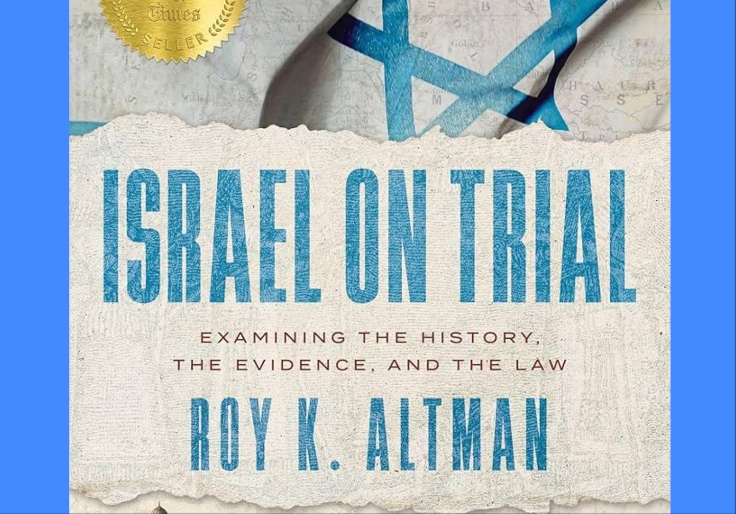
Federal Judge Roy Altman has entered the public debate over Israel with a 304‑page volume titled Israel on Trial. The book, released by Advantage Books at a price of $32, expands on a series of lectures the judge has given on university campuses since 7 October 2023, where he sought to counter what he describes as the central arguments of modern delegitimisation campaigns.
Six Core Challenges Addressed
Altman structures his defence around six claims – three concerning Israel’s founding and three about its conduct. He rejects the description of Israel as a “settler colonial project”, citing archaeological evidence that he says proves Jewish indigeneity in the Land of Israel. He also lists six historical moments when Jewish leaders agreed to the creation of a Palestinian state, only for Arab parties to reject the proposals.
Turning to legal history, the judge traces the territory’s status from the Ottoman Empire through the League of Nations’ Mandate for Palestine, commonly known as the British Mandate. He argues that the doctrine of uti possidetis juris gives Israel a legal inheritance of the borders established under that mandate.
Right‑Wing Revisionism and Historical Counterpoints
Altman notes a growing trend on the political right, including fringe theories popularised by Tucker Carlson, that question Jewish historical ties to the land. He counters these narratives with lesser‑known episodes such as the Arab ban on Jewish access to Hebron’s Cave of the Patriarchs eight centuries ago and Napoleon’s 19th‑century proclamation that recognised Jews as the “rightful heirs of Palestine”.
The “Mirroring” Thesis
The most original element of the book is what Altman calls the “mirroring” thesis. He argues that Palestinian claims often echo Jewish experiences: the term “ghetto”, originally used for European Jewish quarters, is now applied to Gaza, and the designation “State of Palestine” mirrors Israel’s own naming. He also draws a parallel with the Holocaust, contending that accusations of genocide against Israel conflate wartime civilian casualties with intentional mass murder and lack evidence of systematic extermination.
Legal Arguments on Occupation
Altman challenges the prevailing legal view that Israel occupies Gaza despite having withdrawn its physical presence in 2005. He maintains that control over Gaza and the West Bank before that date did not amount to occupation under international law, given their status under the British Mandate. He suggests this framework helps explain anomalies such as Jordan’s borders and Syria’s ethnic tensions.
Reception and Impact
Legal scholar Eugene Kontorovich, a professor at George Mason University’s Scalia Law School and senior legal fellow at Advancing American Freedom, described the work as “indispensable” for students navigating campus debates.
Altman concedes that legal rebuttals may not sway public opinion, likening the situation to the Dreyfus affair, where an acquittal failed to convince detractors. He hopes the book offers a roadmap for understanding the conflict’s legal and historical dimensions amid escalating rhetoric on campuses and in the media.
First reported by the original wire report.