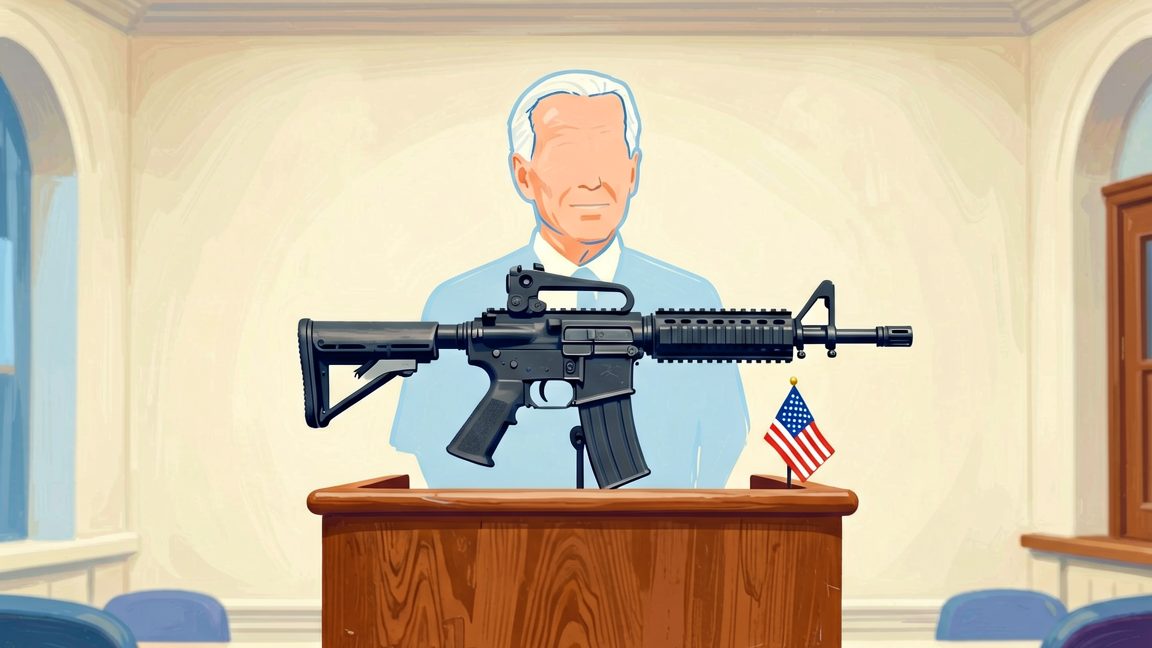
President Joe Biden has reiterated his pledge to ban assault weapons and high-capacity magazines, telling fellow Democrats that he will push for the legislation 'come hell or high water.' In a speech at the House Democratic Caucus Issues Conference in Baltimore, Biden acknowledged that his stance on gun control may make some people uncomfortable, but he remains resolute in his commitment to restricting access to certain types of firearms.
Biden's comments on gun control have been a subject of controversy in the past. In November, he sparked criticism from Republicans when he told reporters that allowing the purchase of semi-automatic weapons is 'sick.' He argued that these weapons have no socially redeeming value and are only profitable for gun manufacturers. The president's remarks were met with backlash from Republicans, who pointed out that semi-automatic weapons include handguns, rifles, and shotguns, which account for 50 percent of all gun sales in the United States.
Republican lawmakers have been quick to criticize Biden's stance on gun control. Rep. Mark Alford (R-Mo.) described the president's views as 'sheer ignorance,' while Rep. Thomas Massie (R-Ky.) accused Biden of 'maligning most gun owners.' Actor James Woods also weighed in on the issue, tweeting that Biden's comments implied that all guns are 'on the chopping block.' The criticism from Republicans and gun owners highlights the challenges that Biden faces in pushing for stricter gun control laws.
Despite the opposition, Biden remains committed to his goal of banning assault weapons and high-capacity magazines. His administration has argued that such legislation is necessary to reduce gun violence and prevent mass shootings. However, the prospects of passing such a bill remain uncertain, given the strong opposition from Republicans and the gun lobby. The debate over gun control is likely to continue, with Biden's comments reigniting the controversy and sparking a renewed discussion about the role of firearms in American society.
The issue of gun control is a complex and contentious one, with deeply held views on both sides. While Biden and his supporters argue that stricter gun laws are necessary to protect public safety, opponents contend that such measures infringe upon the Second Amendment rights of law-abiding citizens. As the debate continues, it remains to be seen whether Biden will be able to fulfill his promise to ban assault weapons and high-capacity magazines, or whether the opposition will prove too strong to overcome.
The gun control debate has significant implications for American politics, particularly in the context of the upcoming election. Biden's stance on gun control has the potential to mobilize both supporters and opponents, and could play a crucial role in shaping the electoral landscape. As the president continues to push for stricter gun laws, he will likely face intense opposition from Republicans and gun owners, who will argue that such measures are an overreach of government authority and an infringement upon individual rights.
Ultimately, the outcome of the gun control debate will depend on the ability of Biden and his supporters to build a coalition of lawmakers and voters who are willing to support stricter gun laws. The president's commitment to banning assault weapons and high-capacity magazines is a significant step in this direction, but it remains to be seen whether he will be able to overcome the opposition and achieve his goal. As the debate continues, one thing is certain: the issue of gun control will remain a contentious and deeply divisive one, with significant implications for American politics and society.
In the United States, the process of passing gun control legislation is complex and involves multiple branches of government. The president can propose legislation, but it must be approved by both the House of Representatives and the Senate before it can be signed into law. The House of Representatives has already passed several gun control bills, including the Bipartisan Background Checks Act and the Enhanced Background Checks Act, but these bills have stalled in the Senate due to Republican opposition.
The Senate, which is currently controlled by Democrats, would need to pass the legislation with a simple majority vote, but it is unlikely that enough Republicans would support the bill to overcome a filibuster. Even if the legislation were to pass the Senate, it would still need to be signed into law by the president, who has already expressed his support for the measure.
For American readers, the gun control debate has significant implications for public safety and individual rights. The Second Amendment, which guarantees the right to bear arms, is a deeply ingrained part of American culture and identity. However, the rise of mass shootings and gun violence has led many to question whether this right should be absolute, or whether some restrictions are necessary to protect public safety.
For Canadian readers, the gun control debate in the United States has significant implications for cross-border relations and trade. Canada has stricter gun control laws than the United States, and the two countries have a long history of cooperation on issues related to firearms and public safety. The outcome of the gun control debate in the United States could have significant implications for the relationship between the two countries, particularly if the United States were to pass legislation that is seen as weakening gun control laws.
In conclusion, the gun control debate is a complex and contentious issue that has significant implications for American politics and society. While Biden's commitment to banning assault weapons and high-capacity magazines is a significant step towards reducing gun violence, it remains to be seen whether he will be able to overcome the opposition and achieve his goal. As the debate continues, it is essential to consider the perspectives of all stakeholders, including lawmakers, gun owners, and public safety advocates, to find a solution that balances individual rights with the need to protect public safety.