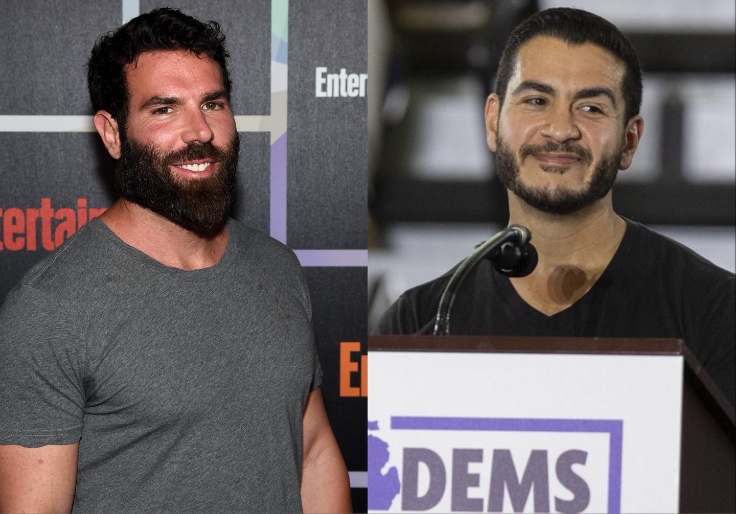
Federal Election Commission filings reveal that at least twelve individuals donated to both Dan Bilzerian's controversial congressional bid and the campaign of Michigan Senate hopeful Abdul El‑Sayed, with some contributors splitting thousands of dollars between the two races.
Bilzerian, a social‑media personality known for lavish displays of wealth and a history of extremist statements, entered the race for Florida's 6th District as a Republican challenger to incumbent Rep. Randy Fine. El‑Sayed, a Democrat and former Detroit health official, is running for the U.S. Senate seat being vacated by Sen. Debbie Stabenow. Their policy platforms share little beyond a vocal opposition to the lobbying influence of AIPAC and a criticism of Israel's government.
The overlapping donor list includes Ibrahim Awad, a Georgia‑based personal‑injury lawyer who contributed more than $19,500 in total to the two campaigns. Awad's record shows a $12,651.88 contribution to the Bilzerian Victory Fund, a joint‑fundraising committee that exceeds the $3,300 limit for an individual donor to a single candidate. If the money was later transferred to Bilzerian's principal campaign committee, it could constitute a violation of federal campaign‑finance rules, which require each contribution to be reported at the amount actually received by the candidate.
Awad's public statements place him firmly in the anti‑Zionist camp. He co‑founded Palistory, an organization that describes itself as "anti‑Israel," and has posted on social media equating Zionism with Nazism. In a March 2025 post on X, he wrote, "Zionism is Nazism. And history will remember every single person who calls themselves a 'Proud Zionist' as a Proud Racist, Genocide Enabler."
Another significant donor, Hussein "Sam" Mahrouq, a Texas entrepreneur who makes money in the subprime auto‑loan market, has given more than $150,000 to candidates and committees that oppose Israel. His contributions have gone to Rep. Ilhan Omar, Rep. Rashida Tlaib, Rep. Summer Lee and former Rep. Cori Bush, in addition to $1,000 to the Anti‑Zionist America PAC, which is run by Michael Rectenwald, a former NYU professor who has promoted conspiracy theories about Jewish involvement in 9/11.
Mahrouq did not respond to a request for comment, but his pattern of giving illustrates a network of donors who prioritize anti‑Israel positions over traditional partisan lines. The fact that these donors also supported Bilzerian, whose campaign featured overtly antisemitic advertising, suggests that the anti‑Israel sentiment can bridge the far‑right and far‑left in U.S. politics.
Bilzerian's campaign material leaned heavily into extremist imagery. One television spot presented an AI‑generated nightclub singer chanting, "Jewish supremacists, Satan's creepy little minions," while an animated version of Rep. Fine was depicted with horns and labeled a "Shylock." The ad also referenced the Gaza conflict, describing civilian victims as "goyim cattle." Bilzerian ultimately lost to Fine by roughly 40 points after spending more than $1 million of his own money.
Bilzerian's background adds another layer to the story. He reported a net worth exceeding $100 million in his financial disclosures and is the son of Paul Bilzerian, a corporate raider convicted of securities fraud in the 1990s. Dan Bilzerian has faced multiple civil lawsuits alleging violence against women, including a 2014 case in which a Miami model claimed he kicked her in the face, and a 2015 arrest at Los Angeles International Airport on bomb‑making charges.
Abdul El‑Sayed, by contrast, is a former health commissioner who rose to prominence during the COVID‑19 pandemic. He entered the Senate race with a platform focused on expanding health care access, protecting voting rights and reforming the criminal‑justice system. While he has repeatedly stated that his criticism is directed at Israeli policy rather than Jewish people, his campaign has been criticized for employing surrogates who have made antisemitic remarks. One of his most vocal supporters, Hasan Piker, is a known Hamas sympathizer who has faced calls to disavow extremist rhetoric.
El‑Sayed's race is now a competitive contest against Republican U.S. Rep. Mike Rogers. Recent polling shows a narrow margin, making the seat one of the few that could flip in the 2024 election cycle. The presence of donors who also backed Bilzerian may become a point of attack for Rogers and other Republicans, who could argue that El‑Sayed's fundraising base includes individuals who endorse extremist views.
The legal framework governing these contributions is worth noting. The Federal Election Commission limits an individual to $3,300 per election for a candidate, $10,000 per year for a political action committee and $5,000 per year for a national party committee. Contributions that exceed these limits, or that are funneled through joint‑fundraising committees without proper reporting, can trigger investigations and potential fines. Historically, the FEC has pursued cases where donors used "bundling" arrangements to circumvent limits, as seen in the 2018 enforcement actions against several high‑profile donors.
Beyond the legal angle, the overlap raises questions about the broader coalition of anti‑Israel donors in American politics. Organizations such as the Anti‑Zionist America PAC and Palistory have cultivated networks that span both progressive and nationalist circles. Their donors often cite the Palestinian cause as a primary motivator, but the rhetoric used by some, including calls to equate Zionism with Nazism, crosses the line into hate speech. This convergence challenges the conventional left‑right divide and complicates the narrative that anti‑Israel sentiment is confined to a single ideological camp.
In the context of U.S., Canada relations, the issue resonates with Canadian debates over foreign‑policy funding and the influence of diaspora groups on elections. Canada's own campaign‑finance rules impose stricter limits on foreign contributions, and recent controversies in Toronto and Vancouver have highlighted how overseas money can shape local politics. American donors who fund anti‑Israel candidates may also support Canadian politicians who share similar views, potentially affecting cross‑border policy discussions on trade, security and human‑rights advocacy.
While Bilzerian's political ambitions appear stalled after his loss, El‑Sayed's campaign remains active. He has not responded to requests for comment on the donor overlap, and neither has Bilzerian. As the November election approaches, both campaigns will likely face increased scrutiny from watchdog groups, media outlets and opponents eager to expose any connections to extremist financing.
The FEC has not announced any formal investigation into the overlapping contributions, but the agency's public records make the data accessible to journalists and advocacy groups. If the joint‑fundraising committee that received Awad's $12,651.88 contribution is found to have redistributed funds in violation of contribution limits, the donors and the campaigns could face penalties.
For voters in Michigan and Florida, the revelations underscore the importance of tracing where campaign money originates. In an era where political messaging can be amplified by social‑media influencers and fringe organizations, understanding the financial ties that bind disparate candidates helps voters assess the motivations behind policy positions, especially on sensitive foreign‑policy issues like the Israel‑Palestine conflict.