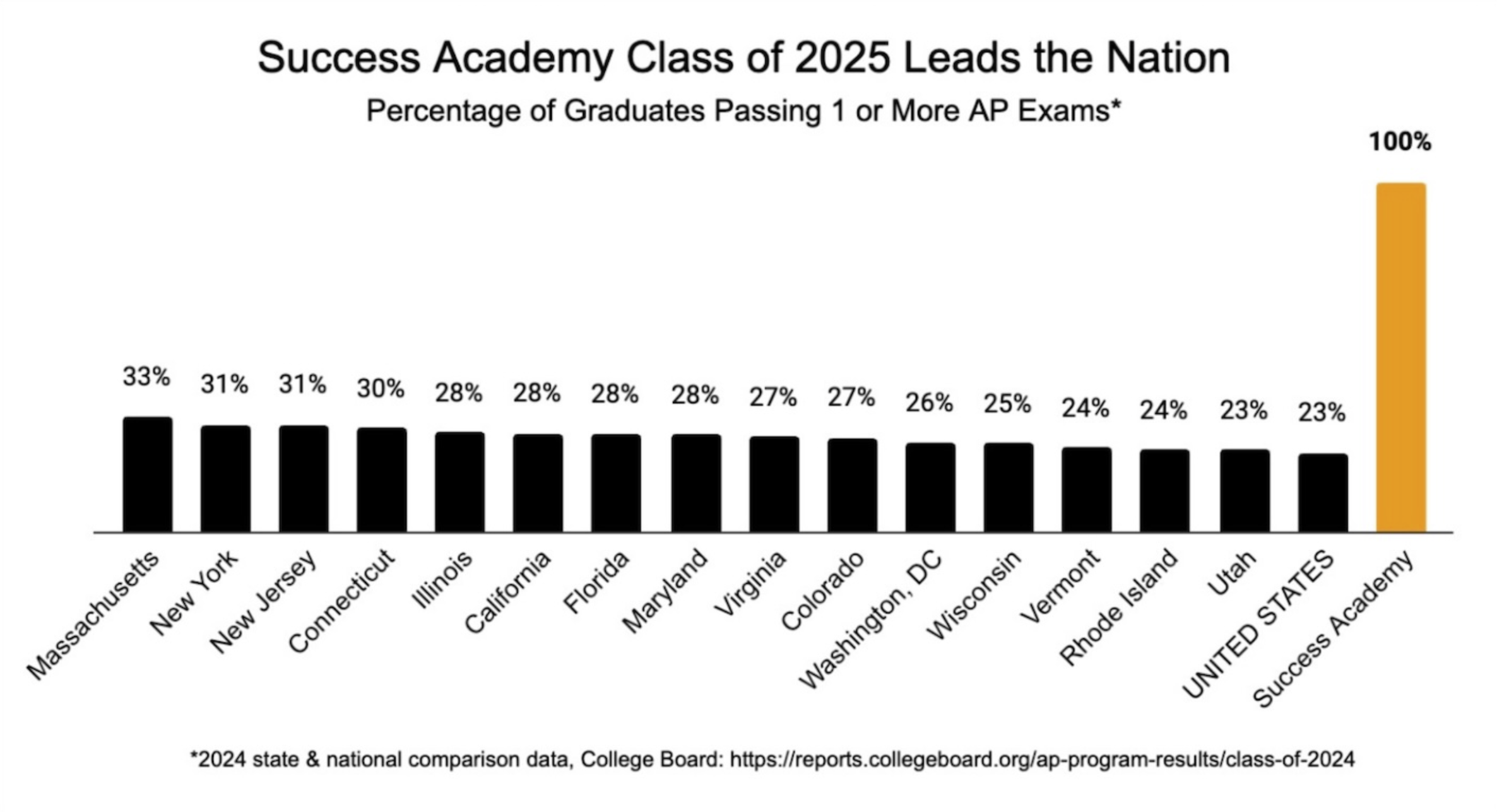
Success Academy Charter Schools, the city‑wide network run by former council member Eva Moskowitz, lodged a complaint in federal court on Tuesday accusing New York State Education Commissioner Betty Rosa of blocking the release of the school's Advanced Placement (AP) test data to U.S. News & World Report. The suit argues that the denial violates the charter operator's First Amendment right to convey factual information about student achievement.
According to the complaint, Rosa acted at the request of the New York State United Teachers union, which has been lobbying to reduce the emphasis on standardized testing in the state's public‑school system. The lawsuit says that by preventing the College Board from providing the data, the state effectively silenced a "government‑created information blockade."
Success Academy points to its AP performance as a core selling point. The filing notes that fewer than 25 percent of high‑school students nationwide pass at least one AP exam by graduation, while 95 percent of the network's 2026 graduating class passed three or more exams, 79 percent passed five or more, and 60 percent passed seven or more. The charter argues that these figures are "among the most objective and compelling evidence" of its curriculum's rigor and its students' college readiness.
In a memo released alongside the filing, the network said the dispute is "about whether parents and the public will have access to clear, objective evidence of whether students in New York's public schools are actually learning." The memo adds that the school wants the data to reach prospective families, college admissions officers, journalists, policymakers, philanthropists and the broader public, with particular emphasis on U.S. News, which publishes a widely cited high‑school ranking.
New York's education department, through spokesperson J.P. O'Hare, declined to comment on the pending litigation but reiterated its commitment to student‑data privacy. "Compliance with New York's student privacy laws is not optional, and it does not take a back seat to U.S. News & World Report's commercial ranking methodology," O'Hare said. He added that the state makes "extensive educational data, including AP participation information, available on its website."
The lawsuit asks Judge Jesse Furman of the Southern District of New York to order Rosa to notify the College Board that it may release Success Academy's AP results to U.S. News. The filing stresses that the charter is not seeking the public release of individual student scores, only aggregate data that would not identify any particular student.
Legal experts note that the case sits at the intersection of First Amendment jurisprudence and state privacy statutes. New York's Education Law § 3020‑e, for example, restricts the disclosure of personally identifiable student information without consent. While the law permits the release of de‑identified aggregate data, the department has argued that even such data could be used to infer individual performance in small schools or classes.
"The privacy argument is a pretext for suppressing information that is unflattering to the government‑operated schools," the complaint asserts. Critics of the department's stance argue that the data in question is already publicly reported in statewide dashboards, albeit without the granularity that AP scores provide.
Success Academy's legal team is led by Eric Grannis, a litigator and the husband of Moskowitz. The network operates nearly 60 schools across the five boroughs, serving tens of thousands of students, and plans to expand to Florida in 2027. The expansion has drawn attention from both education reform advocates and opponents who question the scalability of the charter model.
The broader context involves a long‑running debate in New York over the role of standardized testing. The state's "Regents" exams have faced criticism for encouraging teaching to the test, while teachers' unions have pushed for more project‑based assessments. In recent years, the Department of Education has reduced the weight of Regents scores in school accountability reports, a move that some charter operators view as undermining objective performance metrics.
AP exams, administered by the College Board, are nationally recognized as a benchmark for college‑level coursework. Schools that achieve high participation and pass rates often tout the results in marketing materials and in applications for grants. For charter schools that rely on performance data to attract families and donors, the ability to publicize AP outcomes can be a significant competitive advantage.
U.S. News & World Report's rankings, which incorporate AP participation and pass rates among other factors, influence public perception of school quality and can affect enrollment decisions. A higher ranking can translate into increased demand for seats, higher tuition for private schools, and greater political capital for school leaders.
In New York, the Department of Education maintains a public data portal that includes school‑level AP participation numbers, but the portal does not break down pass rates or the number of exams taken per student. Success Academy argues that the missing data points are essential for a full assessment of its academic performance.
Legal scholars point out that the case may set a precedent for how state education agencies handle requests for aggregate performance data. If the court rules in favor of Success Academy, it could compel the state to adopt more transparent reporting practices, potentially reshaping how charter schools and traditional public schools present their outcomes.
Conversely, a ruling that upholds the department's privacy stance could reinforce the authority of state agencies to limit data releases, even when the information is already publicly available in a less detailed form. Such an outcome would likely be welcomed by teachers' unions and privacy advocates who fear that data could be weaponized for commercial or political purposes.
Both sides have signaled that the case could move beyond the immediate dispute over AP scores. The charter network has hinted at filing additional suits if it perceives further attempts to curtail the dissemination of performance metrics. Meanwhile, the education department has indicated that it will continue to review its data‑release policies in light of evolving privacy concerns and federal guidance.
The next procedural step is a hearing before Judge Furman, who will consider whether to issue a preliminary injunction compelling the release of the data while the case proceeds. The decision could come within weeks, given the court's busy docket.
For parents and policymakers in the United States and Canada, the lawsuit underscores a broader tension between transparency in education and the protection of student privacy. As more jurisdictions grapple with the balance between data‑driven accountability and confidentiality, the outcome of this case may offer a reference point for future legislative and legal debates.