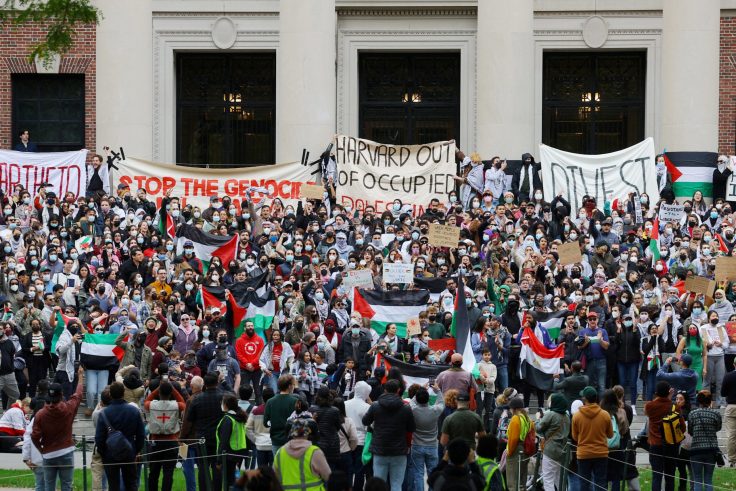
U.S. District Judge Richard Stearns, a Harvard Law School alumnus appointed by President Bill Clinton, issued a ruling on Thursday that dismissed the Department of Education's civil rights complaint against Harvard University. The case, filed in March 2026, alleged that the Ivy League school failed to address antisemitic harassment in violation of Title VI of the Civil Rights Act.
Stearns explained that the government's evidence focused "almost entirely on incidents that took place during the 2023‑2024 school year." He noted that only three alleged incidents occurred after that period, all in March 2025, and described them as "too isolated and episodic to support a plausible inference that any institutionalized noncompliance with Title VI persists at Harvard to this day." The judge's language made clear that he did not find a pattern of ongoing discrimination.
The dismissal is a legal victory for Harvard, but it does not end the broader scrutiny the university faces. In March 2026 the Office of Civil Rights (OCR) of the Department of Education announced two new investigations into Harvard's handling of antisemitism complaints. A separate probe by the Justice Department's Civil Rights Division was launched in July 2026. Both investigations remain active while the university continues to defend its policies before multiple oversight bodies.
Harvard is also confronting an appeal in a related case that is moving through the U.S. Court of Appeals for the First Circuit. The appellate team representing the university does not include the lawyers who secured the favorable district‑court ruling from Stearns. Legal analysts say the appeal could test how courts interpret the "isolated incident" standard under Title VI.
Congressional scrutiny has intensified. Minutes after Stearns's order, the House Select Committee on China and the House Education and Workforce Committee released a 53‑page report alleging Chinese Communist Party influence at Harvard. The report highlighted the creation of "Harvard Global," an entity the university reportedly uses when it cannot accept a sponsor's terms for legal or financial reasons. While the report does not allege direct violations of civil rights law, it adds a political dimension to the university's challenges.
Financial pressures are mounting as well. Harvard's legal expenses have been estimated at $126 million a year, a figure that dwarfs the $50 million settlement paid by Brown University in a separate discrimination case. An alumni magazine calculated that an endowment tax increase enacted by the Trump administration and Congress could cost Harvard $300 million or more annually. These costs are being absorbed while the university also funds its expansive research portfolio.
Stearns's decision follows a mixed record on campus‑related civil rights cases. In August 2024 he ruled that "Harvard failed its Jewish students," a finding that sparked a wave of protests and legislative hearings. Earlier, he had denied Harvard's motion to dismiss a suit brought by Alexander "Shabbos" Kestenbaum and other Jewish students. Yet he also ruled against Jewish students at MIT and against a Harvard Business School student, Yoav Segev, in separate matters. Lawyers who represent plaintiffs describe him as unpredictable, while some defense attorneys note his willingness to dismiss suits that lack a clear pattern of institutional failure.
Reaction from advocacy groups was swift. Kestenbaum mocked the opinion, saying, "Your honor, my client may have killed the victim, but he hasn't killed anyone SINCE!" Mark Goldfeder, CEO of the National Jewish Advocacy Center, called the ruling "terrible." He argued that the court treated the university's post‑notice quiet as proof of compliance, a standard he said ignores the lived experience of students who report that antisemitism has gone underground. Goldfeder cited a July 2026 survey in which 170 Harvard faculty and staff said they observed hidden kippot, concealed Stars of David, and a reluctance among students to identify themselves as Jewish.
The Department of Education's Office of Civil Rights has indicated it will continue to monitor Harvard's response to these reports. Officials said they intend to pursue administrative remedies if they find that the university's policies remain insufficient. The Justice Department's Civil Rights Division has not yet disclosed the scope of its investigation, but a spokesperson confirmed that it is reviewing the same set of complaints.
Beyond the legal arena, Harvard is feeling the impact of a competitive talent market. Several high‑profile faculty members have left in recent months: James Hankins joined the University of Florida, Terrence Johnson moved to Emory University, Tomiko Brown‑Nagin accepted a position at Stanford, Michael Kremer went to the University of Chicago, and Michael Mina entered the biopharmaceutical sector. Applications to rival institutions such as Vanderbilt University have risen sharply, prompting Harvard to delay the public release of its own admissions data until required by federal authorities.
University leadership has framed the challenges as part of a broader geopolitical struggle. President Alan Garber warned that actions taken by the Trump administration against Harvard's research funding could weaken the United States in its competition with China. Senior fellow Penny Pritzker echoed the concern, noting that "for the first time we're no longer in number one" among global universities. Their remarks were quoted in the Harvard Crimson and have been referenced in debates over federal research grants.
Academic commentary offers a counterpoint. Ariel Procaccia, the Alfred and Rebecca Lin Professor of Computer Science at Harvard, published a February 2026 op‑ed in the New York Times titled "Don't Trust the Rankings That Put China's Universities on Top." He argued that many Chinese institutions produce a high volume of papers but that the quality of those publications is often questionable. Procaccia's piece suggests that rankings can be misleading and that the United States retains strengths in research impact despite funding disputes.
Student sentiment reflects a more nuanced picture. In a July article for the Free Press, professor Mark Poznansky described a climate in which some students and faculty feel unsafe expressing their Jewish identity, mentioning concerns about mentioning Israel on résumés, wearing religious symbols, or listing Jewish affiliations. He wrote that many choose self‑protection as a strategy for navigating their education.
The ongoing investigations and lawsuits occur against the backdrop of a decades‑long affirmative‑action case involving Harvard. That litigation, which began in the early 2010s, has moved through district courts, appellate courts, and ultimately the Supreme Court. While the university has secured victories at various stages, the case illustrates how legal outcomes can shift but do not eliminate political pressure.
For Canadian observers, the Harvard saga offers a glimpse of how Title VI enforcement can shape university policy in the United States. Canadian post‑secondary institutions face similar complaints of discrimination, but they are addressed under provincial human rights codes rather than a federal civil‑rights statute. The U.S. approach, which ties federal funding to compliance, creates a powerful lever that Canadian policymakers watch closely as they consider reforms to their own equity frameworks.
As the legal process continues, Harvard must balance compliance obligations, financial stewardship, and its reputation among prospective students and faculty. The university's next steps will likely include detailed reporting to the Office of Civil Rights, possible adjustments to its campus climate initiatives, and a strategic response to the First Circuit appeal. How the administration navigates these challenges could influence the broader conversation about free speech, campus safety, and the role of federal oversight in higher education.