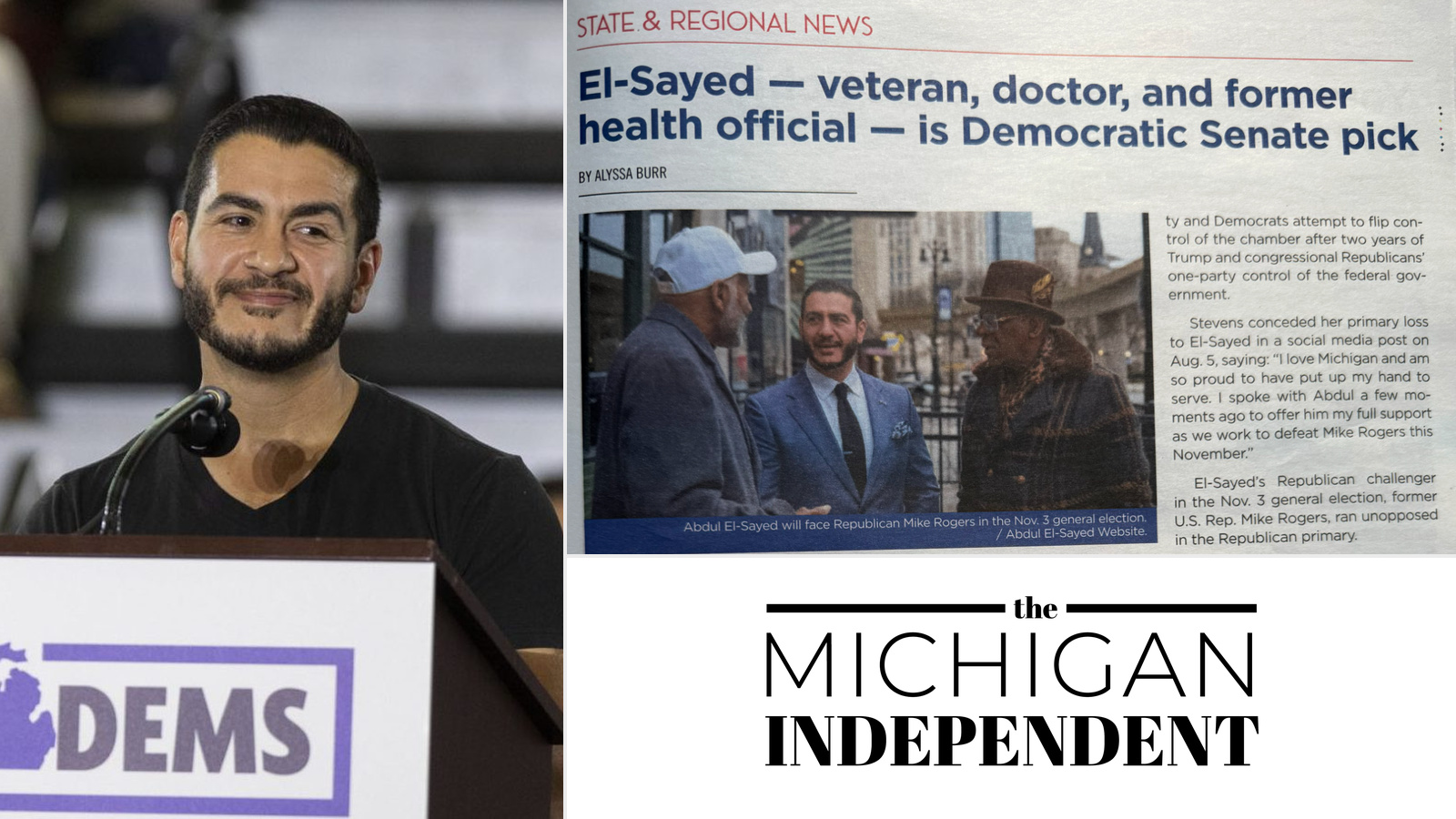
The Michigan Independent, a publication tied to the liberal nonprofit American Independent, sent out unsolicited newspaper‑style mailers that listed Democratic Senate nominee Abdul El‑Sayed as a "veteran." El‑Sayed has never served in the armed forces, and his campaign said the claim was a false portrayal that could confuse voters.
The mailer, which blended a recipe for blueberry streusel coffee cake with partisan commentary, featured a headline reading "El‑Sayed, veteran, doctor, and former health official, is Democratic Senate pick." While El‑Sayed attended medical school and has described himself as a physician, he is not a licensed doctor and has never claimed veteran status. Politico confirmed the inaccuracies.
The error was traced to the American Independent Foundation, a 501(c)(3) organization that received $500,000 from George Soros's Open Society Foundations in 2022. Joe Conason, president of the foundation, told the Washington Free Beacon that the mistake was a typo. He said the intended phrasing was "veteran doctor and public health official," with "veteran" meant to modify the latter two descriptors, not to suggest military service.
Conason's explanation did not satisfy El‑Sayed's campaign. Roxie Richner, a spokesperson for the candidate, said, "Abdul has never claimed to be a veteran, he never would out of his respect for those who served, and any outlet or group writing about our campaign should do their homework and not allow this to happen again." The campaign has not indicated any legal action but warned that the mischaracterization could mislead voters.
The Michigan Independent's online article on El‑Sayed's primary victory carried the headline "Abdul El‑Sayed wins Democratic nomination for Michigan open Senate seat." The piece was authored by Alyssa Burr, a former New York Times news assistant who earned a master's degree in journalism from Syracuse University. Burr's LinkedIn profile shows prior work for MLive, a Michigan news outlet that described the Michigan Independent as "pink slime," a term used for partisan publications that masquerade as local news.
The mailer is part of a broader strategy by the American Independent and its for‑profit arm, American Independent Media, to influence elections through targeted outreach. In 2021, the group's "Virginia Edition" sent mailers falsely attributing a quote about COVID relief to Republican gubernatorial candidate Glenn Youngkin. In 2022, state‑level operations in Pennsylvania and Arizona ran paid Facebook ads that pushed articles critical of Republican positions on abortion.
In August, the Michigan Independent also launched a Facebook ad aimed at El‑Sayed's Republican opponent, former Congressman Mike Rogers. The ad's headline read, "Rogers, Trump support bridge delay to bully Canada." The ad, which appeared in the Meta ad library, cost between $20,000 and $26,000, according to the platform's records.
The American Independent was founded in 2016 by David Brock, a Democratic operative known for creating Media Matters for America. The organization operates under two nonprofit entities: the American Independent Foundation, a 501(c)(3) that cannot directly support or oppose candidates, and American Independent Media, a 501(c)(4) that faces fewer restrictions on political activity. Conason serves as the principal officer of both entities.
Financial filings reveal that the foundation provided American Independent Media with $11.2 million in 2024. The two entities together paid Conason a total of $231,000 for the fiscal year. The Michigan Independent's donation page redirects donors to the foundation's site, underscoring the close relationship between the two arms.
Mailings from the Michigan Independent have reached nearly one million households since the publication's launch in May 2024, according to local reporting. The organization does not maintain a public subscription list for its print edition; instead, it selects recipients based on internal criteria that appear to target likely Democratic voters. Conason declined to detail the selection process, saying only that the mailers are "mailed to people in Michigan."
The controversy arrives as the Michigan Senate race draws national attention. The open seat, previously held by a Republican, is seen as a potential pickup for Democrats if they can mobilize suburban and urban voters. Missteps in campaign messaging, especially those that could be perceived as deceptive, risk alienating swing voters who are already skeptical of partisan advertising.
For American readers, the episode illustrates the growing influence of "dark money" groups that operate under the nonprofit shield of 501(c)(3) and 501(c)(4) status. While the foundation's tax‑exempt status prohibits direct electioneering, the affiliated media arm can produce content that blurs the line between news and advocacy. This structure allows donors such as Soros to fund political communication without the same disclosure requirements that apply to traditional campaign committees.
Canadian observers may note parallels with Canada's own nonprofit political advocacy landscape, where groups can receive foreign funding but must disclose contributions above certain thresholds. The Michigan Independent's tactics raise questions about cross‑border transparency, especially given the United States‑Canada trade relationship and the shared concern over misinformation that can affect elections on both sides of the border.
Legal scholars point out that the Federal Election Commission has limited authority over nonprofit political speech, leaving most regulation to the Federal Communications Commission and state election boards. In Michigan, the Secretary of State's office could investigate whether the mailer violated state laws governing false statements in political advertising, but such inquiries are rare and often hampered by First Amendment considerations.
The New York Times did not respond to a request for comment on the incident. Burr, the author of the online piece, noted that the Michigan Independent added an editor's note to the digital article after the Free Beacon highlighted the misplaced comma that suggested veteran status. Conason said Burr was not responsible for the print headline, reinforcing his claim that the error was a typographical mistake.
As the campaign season intensifies, both parties are likely to scrutinize each other's messaging for inaccuracies. The El‑Sayed incident may serve as a cautionary tale for political groups that rely on pseudo‑news formats to reach voters. While the American Independent defends its approach as a legitimate way to inform the electorate, critics argue that the lack of clear labeling erodes trust in the media and can mislead citizens who assume the content is unbiased reporting.
Whether the Michigan Independent will adjust its editorial process remains to be seen. For now, the episode adds another chapter to the ongoing debate over the role of nonprofit organizations in American elections and the transparency required to keep voters accurately informed.