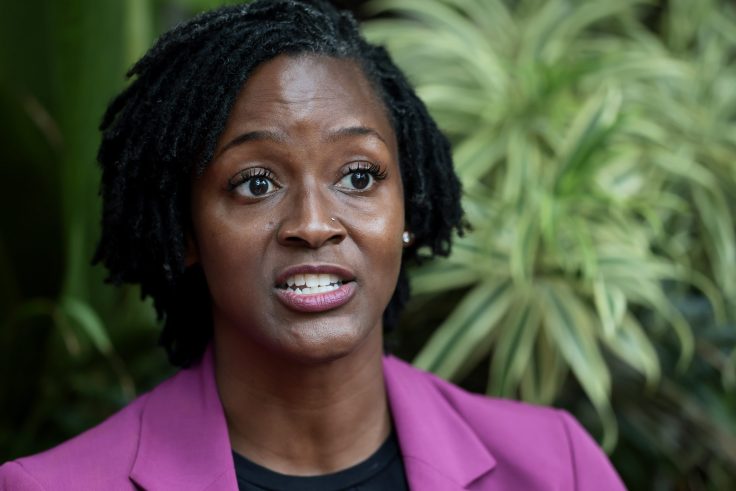
Florida's top Senate contest has taken a new twist after a review of property‑tax records showed Democratic nominee Angie Nixon is receiving the very homestead exemption she opposed while serving in the Florida House of Representatives.
The exemption in question reduces a homeowner's taxable value by $25,000. In February 2024 the House voted 86‑29 along party lines to amend the state constitution so that the exemption would be adjusted for inflation each year. Nixon joined the Democratic minority in trying to stop the amendment, a move that was rejected by her colleagues. Voters later approved the change in the November 2024 ballot with 66 percent in favor.
Duval County records indicate that Nixon's primary residence will see its assessed value lowered by an additional $722 in 2025 and $1,411 in 2026 because of the amendment. The savings are applied automatically to homeowners who have filed for the homestead exemption and are projected to rise as inflation erodes the dollar's purchasing power.
Those numbers have become a focal point in Nixon's Senate campaign, which is built around a platform that calls the state's housing market "unaffordable" for millions of residents. On her website she blames high insurance premiums for pushing homeownership out of reach, a claim that aligns with her broader push for Medicare for All, free childcare and a national rent freeze.
In December 2025, a month before announcing her Senate bid, Nixon opposed a separate bill that would have offered a tax break to homeowners burdened by the nation's highest insurance premiums. She told CBS News the proposal "somewhat incentivizes these insurance companies" and argued it would benefit insurers rather than working‑class families.
The contrast between her legislative record and her campaign messaging has drawn criticism from Republican opponents and some moderate Democrats. Senate incumbent Ashley Moody, who leads most polls in the race, has highlighted the discrepancy as evidence that Nixon's "talk does not match her actions."
Moody's advantage is reinforced by Florida's recent voting trends, which have favored Republicans in statewide contests for more than a decade. The Senate seat was previously held by a Republican, and the state's partisan lean has made it difficult for Democratic challengers to close the gap even in presidential election years.
Nixon's primary victory in August was unexpected. She defeated establishment Democrat Alex Vindman, a former impeachment witness, despite being outspent roughly sixteen to one. Her win was driven by a grassroots network that emphasized her socialist credentials and her stance on affordability, resonating with younger voters in urban districts.
Beyond tax policy, Nixon has attracted national attention for her foreign‑policy positions. In 2023, shortly after the October 7 attacks, she introduced a resolution calling for a "de‑escalation and ceasefire in the state of Israel and occupied Palestine." The measure was rejected by a 104‑2 vote after many colleagues labeled it antisemitic.
In 2024 she opened a storefront called "Cafe Resistance," which doubles as a bookstore and community space. The venue displays a memorial wall honoring members of the Black Panther Party and the Black Liberation Army, including Assata Shakur, who was convicted of murdering a New Jersey state trooper in 1973. Nixon praised Shakur as a "freedom fighter" during fundraising events for the Council on American‑Islamic Relations, an organization that has been described by critics as pro‑Hamas.
At a rally held at Cafe Resistance on August 26, Nixon linked her affordability agenda to broader economic concerns. "Health care funding cuts don't care if you are a Republican or a Democrat. The light bill doesn't care what gender you are. Those gas prices don't care what color you are. Those grocery costs don't care about whether or if you have a college degree," she said. "At the end of the day, we are all in a struggle together while the ultra‑rich at the top create fear and division between us about our very few differences so that they can make a profit. That ends today."
The campaign has not responded to requests for comment on the tax‑exemption issue. Political analysts say the story could become a talking point for Moody's campaign as the election approaches, especially if it gains traction on social media and among independent voters who are skeptical of self‑dealing.
Florida's homestead exemption system has long been a tool for reducing property taxes for long‑term residents. The 2024 amendment that ties the exemption to inflation was promoted as a way to preserve the benefit as costs rise. Critics argue that the automatic adjustment could erode local government revenue, forcing counties to raise other taxes or cut services.
For voters in the Sunshine State, the debate touches on two core concerns: the affordability of homeownership and the fiscal health of local governments. As the Senate race tightens, the question of whether a candidate can separate personal benefit from public policy will likely be a recurring theme in debates and advertisements.
Nationally, the outcome of the Florida Senate race will affect the balance of power in the U.S. Senate, where Republicans currently hold a slim majority. A win for Nixon would add a progressive voice to a chamber that has struggled to pass sweeping social‑policy legislation, while a Moody victory would preserve the status quo and keep the Senate's composition unchanged.
Regardless of the final tally, the juxtaposition of Nixon's personal tax advantage and her public stance on affordability illustrates the complexities that candidates face when their legislative histories intersect with personal finances. Voters will have to weigh whether the tax break is a minor perk or a sign of deeper contradictions in her platform.