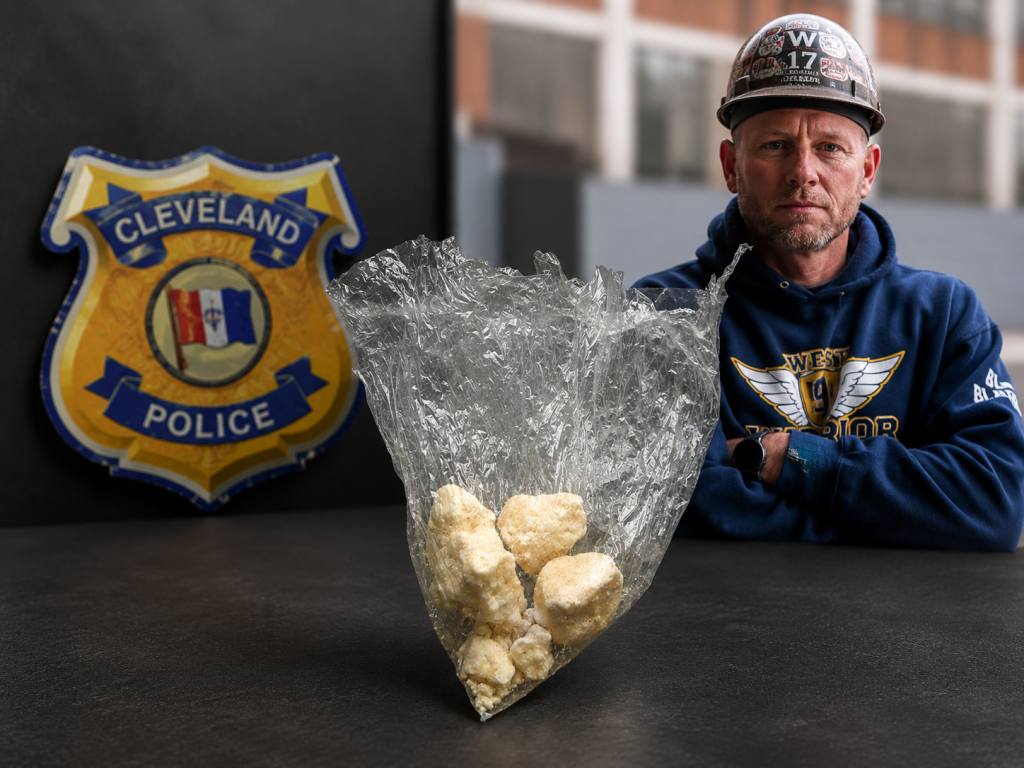
Police records obtained by the Washington Free Beacon show that Brian Poindexter, a city councilman from Cleveland and former union organizer, was taken into custody for allegedly trying to swallow a rock of crack cocaine during a traffic stop and for slapping a stranger at a Cleveland Indians game. The arrests come as Poindexter seeks the Democratic nomination to challenge Republican Rep. Max Miller in Ohio's 7th Congressional District.
Poindexter's public service résumé includes three terms on the Cleveland City Council and a decade of work organizing labor contracts. The candidate's campaign material highlights his work on affordable housing and public transit, but the police files reveal a criminal history that stretches back to his teenage years.
According to a 1998 police report, officers stopped an 18‑year‑old Poindexter on a street corner known for drug activity. The report states that Poindexter removed small objects from his coat pocket, placed them in his mouth and began to swallow them. An officer attempted to retrieve the items, leading to a brief struggle that ended with the officer recovering a "rock of suspected crack cocaine." Poindexter was then arrested on a charge of drug abuse.
The report does not indicate whether Poindexter was later prosecuted or convicted for the 1998 incident. When asked for comment, the Cleveland police department did not respond. A spokesperson for Poindexter's campaign dismissed the allegation, saying "any implication that Brian has used hard drugs is false. Any suggestion otherwise is bullshit."
The second incident occurred on August 10, 2013, when Poindexter, then 34, was removed from a Cleveland Indians game after police said he slapped a 55‑year‑old fan without provocation. The victim, Bob Rzepka, told the Free Beacon that he and his son had watched Poindexter swallow an entire "dollar dog" in a single bite before the altercation.
Rzepka recounted that he approached Poindexter to comment on the hot‑dog stunt and offered to buy him another. Poindexter allegedly responded with a question about insinuation, then struck Rzepka across the face. Two officers nearby intervened, escorted Poindexter out of the stadium, and placed him on the field's outer fence where he continued to shout insults at the victim and his son.
Police asked Rzepka whether he wanted to press charges, but he declined. He later expressed surprise upon learning that the man who slapped him was now a congressional candidate, saying, "The guy who slapped me at a baseball game is running for Congress? I wouldn't want him representing me."
The revelations arrive as Rep. Max Miller, the incumbent Republican, faces his own legal challenges, including accusations of assaulting his ex‑wife and allegations of threatening behavior. Miller's legal troubles have already become a focal point of the campaign, and Poindexter's arrests add another layer of controversy to a race that has drawn national attention.
Ohio's 7th District stretches from the eastern suburbs of Cleveland to the western part of the state, encompassing a mix of industrial towns and suburban neighborhoods. The district has voted Republican in the last three congressional cycles, but it remains competitive because it includes a sizable number of swing voters in the Cleveland suburbs. Ohio holds its primary elections in March of even‑numbered years, and the 7th District Democratic primary is scheduled for March 2024. Ohio uses a closed primary system, meaning only voters registered with the Democratic Party may cast a ballot in the Democratic contest.
In Ohio, the primary winner receives the party's nomination and then appears on the November general‑election ballot. The state party does not formally endorse a candidate until after the primary, but it can provide resources such as voter outreach and fundraising assistance. Historically, personal‑conduct scandals have swayed voter sentiment in Ohio, especially in districts where the partisan balance is narrow. Voters in such districts often weigh character as heavily as policy positions, and a candidate's past legal troubles can become a decisive factor.
For the Democratic Party, Poindexter's candidacy represents a potential foothold in a district that has leaned Republican in recent cycles. However, fundraising reports filed with the Federal Election Commission show that the campaign has struggled to attract major donors since the police records became public. In the first quarter of the filing year, the Poindexter campaign reported contributions of just over $150,000, a figure modest compared with the six‑figure war chests typical of competitive Ohio congressional races.
The state Democratic Party has not issued a formal statement about Poindexter's legal history. Party officials typically evaluate the electability of candidates after primary results are known, but the timing of the arrests could prompt an early reassessment. If Poindexter fails to secure the nomination, the party may turn to a less controversial figure to compete against Miller, a strategy that has been employed in past Ohio races when a nominee's viability was called into question.
Legal experts say that the 1998 drug charge, if never adjudicated, may not result in a conviction that appears on a modern background check, but the public record of the arrest could still be used by opponents in campaign ads. In Ohio, candidates for federal office must file a financial disclosure form that includes any pending criminal matters, and the 2013 assault incident, while not resulting in prosecution, provides a documented instance of violent behavior that could be highlighted in voter guides and media coverage.
Background‑check procedures for federal candidates involve a fingerprint submission to the FBI, which returns a record of convictions but not arrests that did not lead to a conviction. Because the 1998 incident appears only as an arrest, it would not automatically appear on the FBI's criminal history summary. Nevertheless, the existence of a police report creates a paper trail that journalists and political opponents can cite, and the Ohio Secretary of State's office makes such public records available upon request.
As the primary approaches, both campaigns are likely to intensify their messaging. Miller's team may seek to portray Poindexter as unfit for office, using the two incidents to question his judgment and temperament. Poindexter's supporters will need to counter that narrative by emphasizing his legislative experience, his record on affordable housing, and the fact that neither incident resulted in a conviction. They may also argue that the 2013 incident was resolved without charges and that the 1998 arrest occurred when Poindexter was a teenager.
Political analysts note that Democratic voters in the 7th District may be reluctant to support a candidate whose past includes drug‑related arrests and a violent episode in a public venue. In a district where the margin of victory in recent elections has been less than five percentage points, even a small shift in voter perception can alter the outcome. The race therefore serves as a microcosm of how personal conduct issues intersect with policy debates in contemporary American politics.
Voters in the 7th District will ultimately decide whether the candidate's past actions outweigh his legislative experience. The outcome will also signal how Ohio's electorate responds to a broader national conversation about criminal‑justice reform, personal accountability, and the standards to which public officials are held.