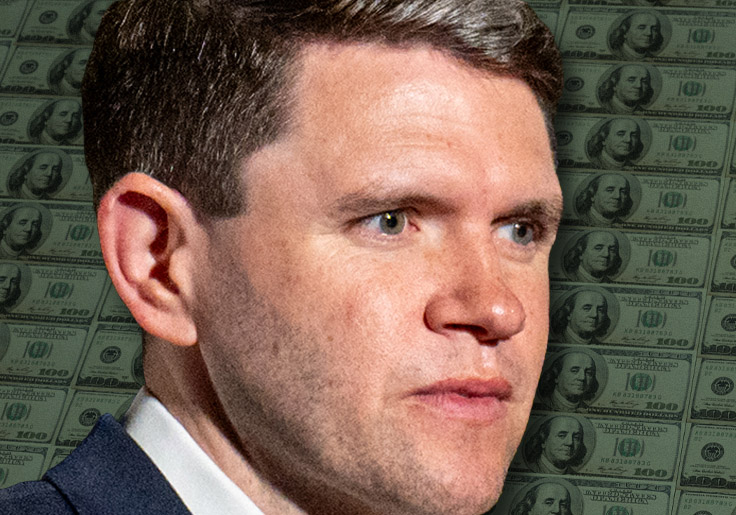
James Talarico, the 37‑year‑old Democratic nominee for the U.S. Senate seat in Texas, filed an updated personal financial disclosure in August that places his only checking account, jointly held with his mother, between $1,000 and $15,000. The same account was previously reported in a range of $15,001 to $50,000, indicating a decline of up to $48,999 over roughly eight months.
Federal law requires candidates for federal office to disclose assets in broad brackets rather than exact amounts, a practice intended to protect privacy while providing voters a snapshot of a candidate's financial footing. Because the ranges are wide, analysts cannot determine the precise change, but the filing does confirm that the balance is now at the lower end of the spectrum.
The disclosure also lists $84,831 in earned income for the reporting year, a sum that combines Talarico's salary as a Texas state representative with earnings from a side gig as an "equitable education" consultant. In that role he designs diversity, equity and inclusion programs for Texas public schools, a sector that has become a flashpoint in state politics as lawmakers debate curriculum standards and funding.
In September 2025, Talarico registered a limited liability company called Nine Banded LLC. The filing names him as the managing member and lists Austin‑based accountant Eric Pierre as the registered agent. Pierre is known for advising high net worth individuals on tax planning and was highlighted in a recent Washington Free Beacon report for helping clients employ "advanced tax strategies" to reduce federal tax liabilities.
The LLC is described as "inactive" and "no value" in the filing, but its timing, just a week after Talarico launched his Senate campaign, has drawn scrutiny. Observers note that a similar structure could be used to channel income from his forthcoming book deal with HarperCollins, which was announced in March but has yet to generate payments. By routing royalties through a separate entity, a candidate could potentially lower the effective tax rate on that income.
Tax‑advantaged arrangements of this sort are not new in political circles. Abdul El‑Sayed, the Democratic Senate candidate in Michigan, has previously used an LLC to handle speaking and consulting fees, a practice that drew attention during his campaign. Critics argue that such structures allow candidates to benefit from the very tax policies they publicly oppose.
Talarico's own policy platform includes higher taxes on the wealthiest Americans, a stance that appears at odds with his partnership with Pierre, who has written a 2024 book titled "The Great Tax Escape: Why Making More Money Doesn't Mean You Have to Pay More." In the book, Pierre dismisses the notion that minimizing taxes is greedy, calling it "potentially harmful … to society as a whole."
Family financial support has also featured in Talarico's political history. His mother, Tamara Talarico, and adoptive father, retired engineer Mark Talarico, have contributed thousands of dollars to his campaigns over the years. In 2021, while running for the Texas House, he reported an in‑kind contribution from his parents for moving expenses valued at $1,438. The following year he purchased a $400,000 home in Austin, though public records do not reveal whether his parents helped fund the purchase.
The Texas Senate race is shaping up as a high‑stakes contest. The incumbent, Republican John Cornyn, is seeking a fifth term, and Democrats see the seat as a potential pickup in a year when national turnout could favor the party. Financial transparency is a recurring theme in the campaign, with both parties accusing each other of hiding wealth or relying on opaque funding sources.
Campaign finance rules for Senate candidates require quarterly disclosures of assets, liabilities, income and debts. The Federal Election Commission (FEC) enforces these rules, but enforcement is often limited to audits and complaints. Analysts say that the broad reporting ranges make it difficult for voters to assess a candidate's true net worth, especially when joint accounts or family contributions are involved.
For Texas voters, the relevance of Talarico's financial moves extends beyond personal wealth. His consulting work on DEI programs ties directly to ongoing debates over school curricula, while the potential tax advantages of his LLC could influence public perception of his commitment to the tax reforms he advocates. Moreover, the HarperCollins book deal, if it materializes, could raise his profile nationally and provide additional campaign resources.
Looking ahead, the FEC will review Talarico's filings for compliance, and any challenges could be raised by political opponents or watchdog groups. The next scheduled disclosure is due in November, when the final quarter of the campaign will be underway. Voters and analysts will be watching to see whether the checking account balance stabilizes, whether Nine Banded LLC remains inactive, and whether the book royalties, if any, are reported as personal income or through the LLC.
In a race where fiscal policy is a central issue, the contrast between Talarico's public calls for higher taxes on the affluent and his private financial arrangements offers a tangible example of the complexities candidates face when personal finance intersects with political messaging.