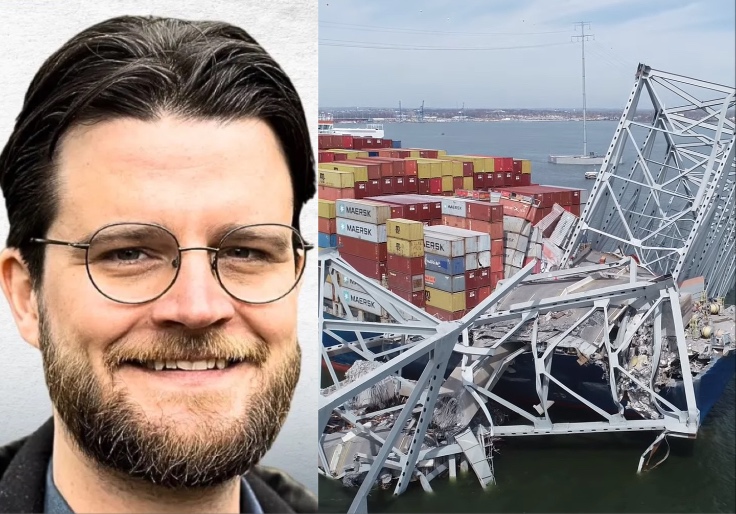
During an August 2024 episode of his "Hegemonicon" podcast, Michigan House hopeful William Lawrence described the fatal collapse of the Francis Scott Key Bridge in Baltimore as an ideal scenario for climate activists because it halted coal shipments from one of the nation's busiest ports.
Lawrence, a former Democratic Socialist and co‑founder of the Sunrise Movement, made the remarks on a program produced by Convergence, a publication that bills itself as a "magazine for radical insights." In the segment titled "Flows and Chokepoints," he imagined an "economic protest against fossil power" that would "block 2.5 million tons of coal exports for weeks and weeks and weeks on end," he said, laughing as he spoke.
The bridge collapse on March 26, 2024 occurred after the 984‑foot container ship Dali struck a supporting column. Six construction workers, immigrants from Central America and Mexico, died while repairing the structure. The incident shut down the Port of Baltimore, idling thousands of dockworkers, longshoremen and truck drivers, and delayed the movement of automobiles, agricultural products and other cargo. A replacement span is projected to cost about $5 billion and is not expected to be finished until late 2030.
Lawrence's comments have quickly become a focal point in the race for Michigan's Seventh Congressional District, a seat currently held by Republican Tom Barrett. The district, which voted for Donald Trump in two of the last three presidential elections, is considered a toss‑up in 2024. Republicans are likely to use Lawrence's remarks, along with his ties to the Sunrise Movement and the Democratic Socialists of America, to argue that he is too radical for a swing district.
The Sunrise Movement, founded in 2017, campaigns for a rapid transition away from fossil fuels, calling for net‑zero emissions by 2030. In recent years the group has broadened its agenda to include police reform and immigration policy, and it faced accusations of antisemitism in 2021 after withdrawing from a Washington, D.C., statehood rally over the participation of three Jewish organizations.
Lawrence also drew attention earlier in the year for praising left‑wing streamer Hasan Piker, a figure who has made inflammatory statements about the United States. At a campaign event Lawrence told Piker, "You're the man. I'd love to get on the stream sometime." The exchange was widely shared on social media and has been cited by critics as evidence of Lawrence's alignment with fringe media personalities.
Beyond the bridge comments, Lawrence appeared to endorse the actions of the Iran‑backed Houthi movement in the Red Sea. In the same podcast episode he called the Houthi attacks on commercial shipping a "blockade" intended to stop what he described as Israel's "genocide in Gaza." The Houthis have seized or damaged nearly 200 vessels since late 2023, killing at least seven sailors and disrupting global trade routes that carry everything from diapers to fertilizer.
Lawrence's guest, Tim Sahay, a climate policy researcher at Johns Hopkins University, echoed the sentiment, saying the Houthis were trying to prevent a genocide and that their disruption of the Suez Canal and surrounding shipping lanes was a strategic move against Israel and Egypt.
The candidate's campaign declined to comment when asked for a response to the podcast excerpts.
Lawrence's remarks raise several political calculations for the upcoming November election. First, the bridge collapse highlighted the vulnerability of U.S. supply chains that rely on single points of entry. The Port of Baltimore handles a significant share of U.S. coal exports, and its shutdown forced shippers to reroute cargo through ports in Virginia and North Carolina, raising freight costs for manufacturers and potentially affecting Canadian exporters that depend on the East Coast for market access.
Second, the incident revived debate over the nation's reliance on coal and other fossil fuels. While the Biden administration has pursued a clean‑energy agenda, coal still accounts for about 15 percent of U.S. electricity generation, and the industry remains a source of jobs in states such as West Virginia and Kentucky. Lawrence's framing of the bridge collapse as a "dream" for climate activists could be leveraged by opponents to argue that his policies would jeopardize energy security and labor livelihoods.
Third, the Houthi endorsement touches on U.S. foreign‑policy considerations. The United States has designated the Houthis as a terrorist organization and has conducted naval operations to protect commercial shipping in the Red Sea. By praising the group's actions, Lawrence risks alienating voters who view national security and support for allies in the region as paramount.
Michigan's Seventh District includes parts of Lansing, the state capital, and a mix of suburban and rural communities. The area has a modest manufacturing base and a growing number of college‑educated voters who have shown openness to progressive climate proposals. However, the district also contains a sizable population of older, white voters who have leaned Republican in recent cycles. How much weight the bridge comments will carry depends on whether the narrative of "radical" versus "moderate" can dominate local media coverage and campaign advertising.
Historically, the Sunrise Movement has been a catalyst for progressive climate legislation at the state level, helping to pass clean‑energy standards in states such as New York and Washington. Its influence in Michigan has been limited, though the group has supported the state's recent push to increase renewable‑energy capacity. Lawrence's candidacy could be the first time a Sunrise co‑founder seeks federal office in the Midwest, a development that may attract national attention and fundraising from progressive donors.
On the procedural side, the primary election for the Democratic nomination is scheduled for August 27. If Lawrence secures the nomination, he will face Barrett in a November general election that will be watched for its potential to signal voter attitudes toward climate policy and foreign‑policy stances ahead of the 2024 presidential contest.
For now, the controversy surrounding Lawrence's podcast remarks adds a new layer to an already competitive race. Voters in Michigan's Seventh District will have to weigh his environmental enthusiasm against the human cost of the Baltimore tragedy and his apparent support for a militant group operating in a volatile region.