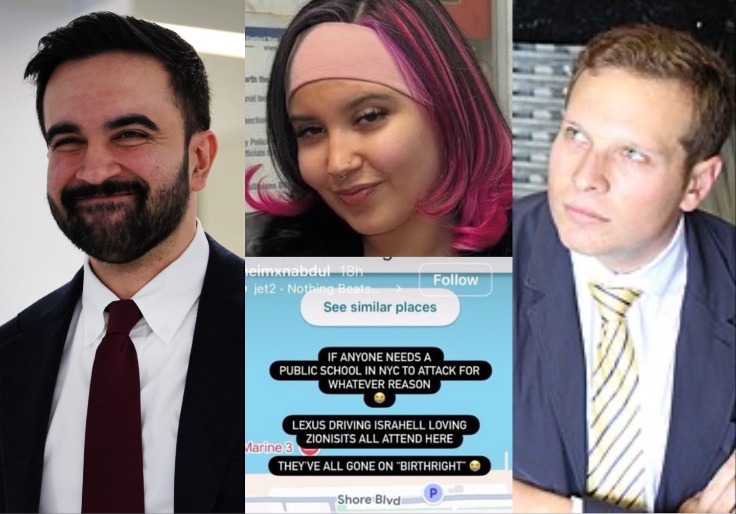
New York City officials are facing renewed attention after a staff member hired by mayor‑elect Zohran Mamdani during a 2018 State Senate campaign was arrested for a threat that targeted Jewish students. The incident, reported by the Washington Free Beacon and the New York Post, has prompted calls for greater vetting of campaign personnel and sparked debate within progressive circles.
Iman Abdul, who was paid $540 as a canvasser for the 2018 campaign of journalist Ross Barkan, posted a screenshot of a Google Maps view of Leon M Goldstein High School for the Sciences in Manhattan Beach, Brooklyn. In the caption she wrote, "If anyone needs a public school in NYC to attack for whatever reason … Lexus driving Israhell loving Zionists all attend here." The post was later deleted, but the image and caption were captured by police investigators.
New York City police arrested Abdul in August 2025 and charged her with making a terroristic threat, acting in a manner injurious to a child, aggravated harassment and making a threat of mass harm. The charges reflect New York's statutes that treat threats of violence against a protected class as both a criminal act and a hate crime. Abdul pleaded guilty earlier this month to aggravated harassment as a hate crime, a felony under state law.
Brooklyn District Attorney Eric Gonzalez, a Democrat, offered Abdul a plea that reduced the felony to a misdemeanor in exchange for completing twenty counseling sessions. The arrangement avoided jail time, a decision that has drawn criticism from community leaders who argue that the punishment does not match the seriousness of the threat.
Abdul's employment history extends beyond the Barkan campaign. After the 2018 election, she worked as a youth organizer for Rep. Alexandria Ocasio‑Cortez, a prominent figure in the progressive wing of the Democratic Party. The New York Post noted her involvement in the AOC office but did not highlight her earlier connection to Barkan and Mamdani, a gap that some observers say concealed a pattern of hiring staff with extremist sympathies.
Ross Barkan, the journalist whose failed State Senate bid in Brooklyn's 22nd district ended in defeat to Andrew Gounardes, has been a controversial figure. Barkan's recent plagiarism scandal, which led to the cancellation of his forthcoming biography of Mamdani, has further tarnished his reputation. In a brief statement posted to X, Barkan expressed remorse, saying, "I truly am sorry for the mistakes I made. None of them, genuinely, were willful or intentional."
Zohran Mamdani, who secured the mayoral office in the 2023 New York City election, oversaw the field operation for Barkan's campaign. According to political operative Michael Lange, Mamdani "assembled Barkan's field program from the ground up." Lange, who is preparing a book on Mamdani's rise, argues that the hiring decision reflects a broader pattern of aligning with individuals who have expressed radical or anti‑Jewish sentiments.
Critics point to Mamdani's broader network of allies. His chief counsel, Ramzi Kassem, has previously represented individuals linked to al Qaeda. Mamdani has also promoted Tamika Mallory, a former Women's March organizer who has faced accusations of antisemitic remarks and of defending the Nation of Islam. In addition, Catherine Almonte Da Costa, Mamdani's first director of appointments, left the administration after old X posts surfaced in which she complained about "money hungry Jews."
The school at the center of Abdul's threat, Leon M Goldstein High School for the Sciences, serves a diverse student body. City data show that sixty‑three percent of its students are people of color and sixty‑six percent are classified as economically disadvantaged. The neighborhood also hosts several private Jewish schools, making the public school a focal point for community tension.
Legal experts note that New York's "terroristic threat" statute is applied when a person threatens violence that could cause public panic or endanger a specific group. The inclusion of aggravated harassment as a hate crime adds a layer of civil rights enforcement, allowing prosecutors to pursue enhanced penalties. However, the plea deal offered by the district attorney's office illustrates the discretion prosecutors have in balancing punitive measures with rehabilitative options.
The episode arrives at a moment when progressive politicians are under heightened scrutiny for the backgrounds of their staff. AOC's office has previously faced questions about the vetting of volunteers and interns, and the New York Post's coverage of Abdul's role in her campaign has reignited those concerns. While AOC has not commented directly on Abdul's case, her team has emphasized a commitment to inclusive hiring practices.
For voters in the United States and Canada, the story underscores how local hiring decisions can have national repercussions. In the United States, similar debates have emerged over staff members with extremist ties in congressional offices, prompting calls for stricter background checks. In Canada, the federal government has introduced guidelines for political parties to disclose staff affiliations that could pose security risks, a policy that may serve as a reference point for New York officials.
Looking ahead, the mayor's office has announced an internal review of all campaign hires from the past decade. The review will examine whether any other staff members have engaged in conduct that could be classified as hate‑motivated or extremist. City officials say the findings will be made public and could lead to policy changes regarding staff recruitment.
Meanwhile, community groups in Brooklyn have organized town hall meetings to discuss safety at public schools and to address the broader issue of online hate. Leaders from the local Jewish community have called for stronger enforcement of hate‑crime laws, while civil‑rights advocates argue that counseling and restorative justice should remain part of the response.
The case also raises questions about the role of district attorneys in plea negotiations. Eric Gonzalez, who has positioned himself as a reform‑oriented prosecutor, faces pressure from both victims' advocates and progressive activists who view the deal as too lenient. The outcome may influence future prosecutorial decisions in hate‑crime cases across the state.
As New York continues to grapple with the intersection of progressive politics and public safety, the Abdul incident serves as a reminder that campaign staffing choices can have far‑reaching consequences. The city's response will likely shape how political organizations balance ideological commitment with the responsibility to protect vulnerable communities.