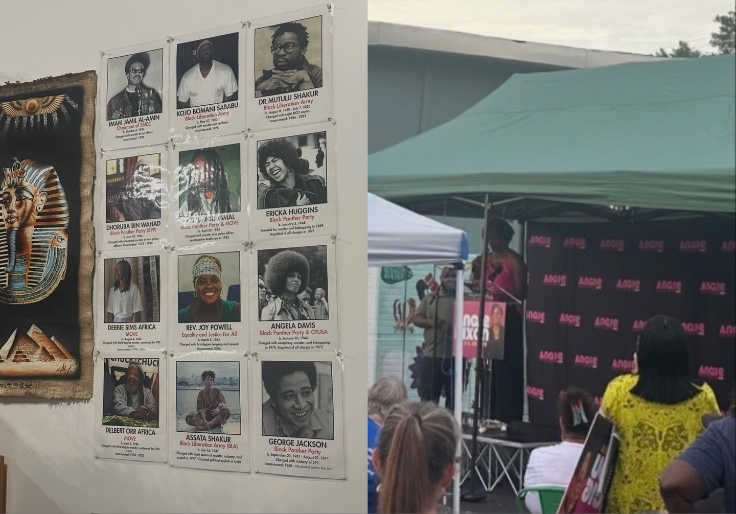
Angie Nixon, the Democratic challenger for Florida's Class III U.S. Senate seat, opened a small bookstore in Jacksonville that displays a wall honoring a series of Black militants convicted of murder, robbery and other violent offenses. The wall, photographed by the Washington Free Beacon during a recent visit, lists individuals linked to the Black Panther Party and the Black Liberation Army, including four men sentenced for killing police officers.
Nixon, who identifies as a socialist and has been outspoken on Israel‑Palestine issues, secured the Democratic nomination in August after a primary that pitted her against a more centrist opponent. Her victory came despite being outspent by establishment candidate Adam Hattersley, who raised more than twice as much money. The Senate race pits Nixon against incumbent Republican Senator Ashley Moody, a former state attorney who enjoys the endorsement of the Florida Police Benevolent Association and the backing of Governor Ron DeSantis.
"Cafe Resistance" opened in June 2024 with the stated purpose of providing a community space for Black empowerment and political organizing. In a short video posted to the shop's Instagram account, Nixon explained that the venue was meant to counter what she described as attacks on civil liberties, referencing recent Florida legislation that limits the distribution of sexually explicit material in schools. She added that the café would be a place where "everyone can feel welcome, and where we can organize and build power."
The memorial wall sits between aisles labeled "spiritual emotional empowerment" and "civil rights justice." Each plaque features a photograph, a brief label of the individual's organizational affiliation, and a short description of the crimes for which they were convicted. The wall appears to be a recent addition; earlier photos and videos shared by visitors do not show it, and it is absent from the shop's official social‑media feeds.
Among those commemorated are Jamil Al‑Amin, better known as H. Rap Brown, who died in federal prison while serving a life sentence for the murder of a sheriff's deputy in 1990. The plaque notes his role as a vocal figure in the 1960s Black Power movement and quotes his claim that "violence is as American as cherry pie." Also listed is Mumia Abu‑Jamal, a former Black Panther who was convicted of killing a Philadelphia police officer in 1981. After decades of legal battles and a Nobel Peace Prize nomination, his death sentence was overturned, and he now serves a life term without parole.
The wall further honors Assata Shakur, a former Black Liberation Army member convicted of killing a New Jersey state trooper in 1973. After a 1979 prison break orchestrated by armed BLA operatives, Shakur fled to Cuba, where she lived until her death last year. Other names include Kojo Bomani Sababu, convicted of murdering a drug dealer and aiding a Puerto Rican radical's escape, and Mutulu Shakur, the stepfather of rapper Tupac Shakur, who participated in a 1981 robbery‑murder carried out by a BLA‑affiliated group.
George Jackson, a Black Panther "field marshal" who was killed during a 1971 prison escape attempt, is also featured. The plaque for Jackson merely states that he was "charged with a $71 robbery" and was "murdered within the jail," omitting the broader context of the violent confrontation that left multiple guards and inmates dead.
The presence of the wall has drawn criticism from law‑enforcement groups and moderate Democrats who argue that honoring individuals convicted of killing police officers is politically risky in a state where public safety is a dominant campaign theme. The Florida Police Benevolent Association, which endorsed Senator Moody, issued a statement saying the wall "glorifies violence against those who protect our communities."
In response, Nixon has emphasized a broader message of unity. Speaking at a rally held inside the café, she told attendees that "health‑care funding cuts don't care if you are a Republican or a Democrat" and that "the light bill doesn't care what gender you are." She framed the wall as part of a larger narrative about "building power together" against "ultra‑rich interests that profit from division."
Her campaign platform, outlined on the official website under a "Support Human Dignity" section, calls for ending mass incarceration, demilitarizing police forces, abolishing ICE, and cutting U.S. military aid to Israel. Nixon first gained statewide attention in 2023 when she introduced a resolution in the Florida House urging a cease‑fire in Israel‑Palestine, a measure that was defeated 104‑2.
The bookstore's inventory reflects its activist orientation. Shelves are stocked with titles on Black history, empowerment and social justice, including "The Real Hoosiers," which recounts the story of the all‑Black Crispus Attucks High School basketball team, and a children's picture book titled "The Brown Unicorn," which addresses colorism. The shop also provides free feminine hygiene products, condoms, pregnancy tests and emergency contraception, and hosts community events ranging from spoken‑word nights to tenant‑union meetings.
Florida's political environment adds another layer of relevance. The state's Senate seat is one of the most valuable in the nation, with the incumbent party holding a 50‑50 split in the U.S. Senate after the 2022 midterms. A Democratic pickup would shift the balance of power in Washington, making the race a focal point for national donors and political operatives. However, Florida's voter registration data shows a sizable Republican advantage, and Governor DeSantis's popularity remains high, despite recent controversies over education policy and election laws.
Campaign finance reports filed with the Federal Election Commission indicate that Nixon's campaign has raised roughly $3 million, compared with Moody's $12 million war chest. The disparity reflects the broader challenge faced by progressive candidates in red‑leaning states, where fundraising networks tend to favor establishment figures. Nixon's reliance on grassroots donations and small‑donor events mirrors the strategy of other left‑leaning candidates who have sought to offset institutional funding gaps.
Legal scholars note that the wall could become a flashpoint in any future litigation over free‑speech rights. While private businesses generally have discretion over displayed content, Florida's "Stop Social Media Censorship" law and recent attempts to regulate "extremist" speech could create a contested legal environment if a complaint were filed. No formal complaint has been lodged, but the issue may attract attention from civil‑rights groups monitoring the intersection of political expression and public safety.
Looking ahead, the Senate race will feature a series of televised debates scheduled for October, where Nixon is expected to face questions about the wall and her broader policy proposals. Political analysts suggest that the controversy could force her to temper her rhetoric in order to appeal to swing voters in central Florida, a region that has historically decided statewide elections.
For now, "Cafe Resistance" remains both a community hub and a symbol of the ideological divide that defines the Florida Senate contest. As the campaign enters its final stretch, the wall's presence will likely continue to shape narratives on both sides of the political aisle, illustrating how local cultural spaces can become battlegrounds in national elections.