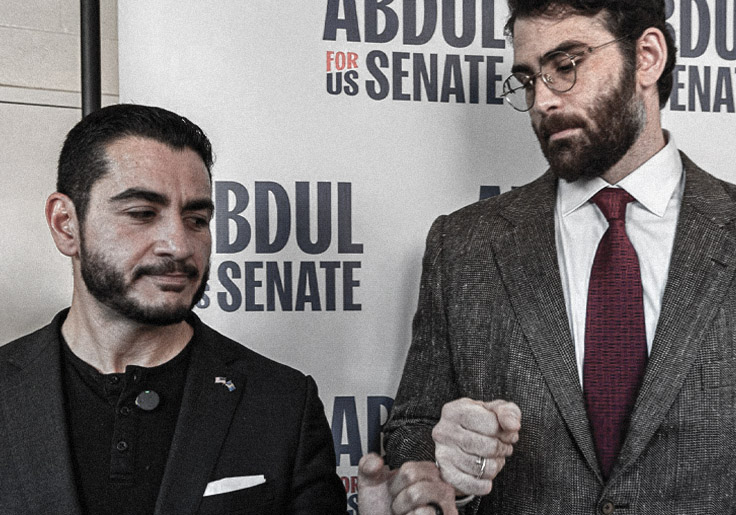
Abdul El Sayed, a former Michigan gubernatorial contender and public‑health professor, has placed the issue of mass jail releases at the center of his Senate campaign. In a series of public statements and writings, he argues that the United States must dramatically reduce its prison population and scrap cash bail, which he says perpetuates racial inequities.
El Sayed first outlined his "de‑jailing" plan in a March 2021 post on his Substack newsletter. He wrote that eliminating cash bail would save lives and reduce the disproportionate impact of the criminal‑justice system on Black communities. The post framed the bail system as a mechanism that "targets Black people in our structurally racist society."
He expanded on the idea during an October 2024 episode of his own podcast, asking listeners to imagine prisons not as protection against crime but as a tool of state‑directed counterinsurgency. "What if we understood prisons weren't meant to protect people from evil‑doers, but were designed as a form of warfare waged by the state?" he asked.
The call for sweeping decarceration gained national attention after the death of George Floyd in 2020. Activists and some elected officials began to label the United States as a "carceral state," arguing that the country's incarceration rates, especially for Black men, are a modern extension of historic oppression. That rhetoric helped fuel the "defund the police" movement, the cancellation of the television series Cops, and a wave of local reforms aimed at reducing jail populations.
El Sayed's public‑health background informs his stance. In April 2021 he co‑authored a study in The Lancet that linked county jail incarceration to higher rates of cause‑specific mortality. The paper concluded that "disinvestment from carceral systems" should be considered a key public‑health intervention.
During the early months of the COVID‑19 pandemic, El Sayed warned that jails could become "death traps" if left unchanged. A May 2020 article he authored, titled "The CDC Must Adopt Decarceration as a Matter of Public Health," claimed that up to 100,000 inmates could die without swift releases. The piece cited a letter signed by 117 organizations and nearly 600 public‑health professionals that called for the early release of anyone within 18 months of their scheduled release date and for the automatic release of all people serving misdemeanor sentences. The letter has since been removed from public view.
El Sayed reiterated his position on the Decarceration Nation podcast on April 6, 2020, telling host Joshua Hoe that "we really need to think about what it looks like to do decarceration at scale right now." Hoe, a former University of Michigan debate coach, was later convicted in 2010 of soliciting a minor for sexual activity, a fact reported by the Washington Free Beacon.
In 2020, El Sayed participated in a webinar titled "I Don't Want To Die In Prison." The event was organized by groups that use the hashtag #FreeThemAll and featured a report on the impact of the pandemic on Michigan prisons. During the discussion, El Sayed said, "Any and all efforts to get people out of jails and prisons and to keep people out of jails and prisons is policy that we need to be investing in particularly now." He added that the effort should continue even after the pandemic subsides.
The webinar panel included individuals with controversial backgrounds. One was Martin Vargas, a registered sex offender convicted of raping a 17‑year‑old girl. Another was LaWanda Hollister, who spent 34 years in prison for second‑degree murder. Their presence drew criticism from opponents who questioned El Sayed's judgment in sharing a platform with people who have committed serious crimes.
El Sayed's stance on decarceration contrasts with the trajectory of many other progressive politicians, who have softened or reversed similar positions as public opinion shifted. While some former supporters of "defund the police" have now advocated for reform rather than abolition, El Sayed has not publicly altered his language on mass releases or cash bail.
The issue is now a central theme in the race for Michigan's open Senate seat. The seat will be vacated by Democrat Gary Peters, who is retiring after three terms. El Sayed faces former Republican congressman Mike Rogers, a veteran of the House who previously served on the Ways and Means Committee. Both candidates view the contest as crucial for determining which party will control the Senate in the upcoming midterm elections.
Michigan's political landscape adds layers of complexity. The state has a long history of criminal‑justice reform, dating back to the 1970s when it pioneered the "no‑knock" warrant ban and later adopted a "ban the box" policy for public‑sector hiring. However, Michigan also has one of the nation's highest per‑capita incarceration rates, a factor that fuels both reformist enthusiasm and concerns about public safety.
Cash bail remains a contentious issue in the state. In 2021, Michigan lawmakers passed a bill that limited the use of cash bail for low‑level offenses, but the law left many judges with discretion to set bail amounts. Critics argue that the partial reform does not go far enough, while opponents warn that eliminating cash bail could lead to higher rates of pre‑trial detention and strain on law‑enforcement resources.
El Sayed's proposals would require legislative action at both the state and federal levels. Ending cash bail nationwide would likely need a federal law or a Supreme Court decision interpreting the Eighth Amendment's prohibition on excessive bail. Mass releases, on the other hand, could be pursued through executive clemency, parole board reforms, or state‑level sentencing changes.
Political analysts note that the Senate race could become a referendum on criminal‑justice policy in the Midwest. If El Sayed wins, he may push for a federal initiative to reduce the prison population, potentially leveraging his public‑health credentials to argue that overcrowded facilities pose a pandemic risk. Conversely, Rogers has signaled support for "law‑and‑order" policies and may argue that public safety outweighs the perceived benefits of large‑scale releases.
Voters in Michigan's suburban counties, where the Senate race is expected to be decided, have expressed mixed feelings. A poll conducted by the Michigan Survey Center in August 2024 showed that 48 percent of likely voters consider public safety a top priority, while 42 percent said criminal‑justice reform is equally important. The same poll indicated that 35 percent of respondents support eliminating cash bail, compared with 28 percent who oppose it.
Nationally, the debate over decarceration intersects with broader conversations about racial equity, public‑health preparedness, and fiscal responsibility. The United States incarcerates roughly 2.1 million people, a figure that far exceeds that of any other developed nation. Proponents of reform argue that reducing the prison population would save billions in correctional costs and improve community health outcomes. Opponents contend that releasing large numbers of inmates could increase crime rates and undermine deterrence.
El Sayed's campaign has already raised questions about the feasibility of his proposals. Legal scholars point out that the Constitution grants states primary authority over criminal sentencing, limiting the federal government's ability to impose blanket release orders. Moreover, the logistics of releasing tens of thousands of inmates, such as providing housing, employment assistance, and mental‑health services, pose significant challenges.
Regardless of the outcome, the Senate race is likely to keep the issue of mass jail releases and cash bail in the public eye throughout the 2024 election cycle. As the campaign heads into the final weeks before the November ballot, both candidates will need to articulate how their criminal‑justice visions align with the concerns of Michigan voters and the broader national debate.