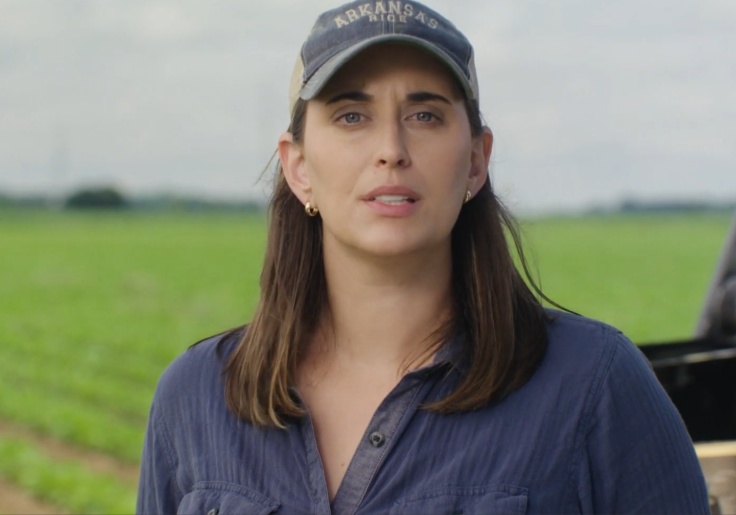
Hallie Shoffner, the Democratic challenger to Republican incumbent Tom Cotton in the 2024 U.S. Senate race, filed a financial disclosure in May that lists assets ranging from $3 million to $3.3 million. The filing shows she holds roughly $1.55 million in individual stocks, about $670 000 in retirement and education accounts, and up to $1.1 million in business interests. After accounting for a Merrill Lynch line of credit valued between $250 000 and $500 000, her net worth could be as high as $3.065 million.
Shoffner's campaign has built its core message around the image of a "6th‑generation farmer" forced to shut down her family's operation in 2025 because of "rising costs, bad markets, new tariffs and no meaningful Farm Bill relief." She has repeatedly told voters that she "lived the farm crisis" and that the decision to close the farm was "the hardest decision of her life." The new numbers, however, place her wealth far above the median household net worth in Arkansas, which the Federal Reserve reports at $62 500, the lowest of any state.
The discrepancy matters because federal candidates are required to disclose only the range in which each asset or liability falls, not the exact amount. This reporting method, mandated by the Federal Election Commission, makes it difficult for the public to pinpoint a precise net worth, but the upper bounds in Shoffner's filing still suggest a level of wealth that runs counter to her "working‑family" narrative.
Beyond the numbers, the disclosure reveals that Shoffner serves as a trustee of the Michael Sullivan and Hallie Shoffner Joint Revocable Trust. The trust's value is not listed, but the existence of a revocable trust is a common estate‑planning tool that can hold a variety of assets, including the business interests reported in the filing. Property records show that the land once farmed by the Shoffner family remains owned by a separate entity, the John L. and Wendy A. Shoffner Revocable Trust, which is held by her parents.
While Shoffner's parents retain ownership of the farm acreage, she does not live on the property. In 2020 she and her husband, Michael Sullivan, bought a historic home in Little Rock that was added to the National Register of Historic Places in 2023. The residence, described by the Northwest Arkansas Democrat‑Gazette as a large Italianate‑style house, is roughly a 90‑minute drive from the family farm in eastern Arkansas. Voter registration records list the Little Rock address as her primary residence, underscoring the physical distance between her daily life and the farm she says she lost.
Campaign manager Anna‑Lee Pittman defended the filing, saying, "Hallie filed the required financial disclosure, and it speaks for itself. Hallie and her husband own their own successful business." The statement also reiterated Shoffner's claim that she was "forced to close the family farming operation amid the economic crisis squeezing farmers and working families across our state." The manager added that Shoffner is "raising her family here, helping care for aging parents, and traveling the state listening to Arkansans."
Critics argue that the narrative of a lifelong farmer is at odds with Shoffner's professional history. After graduating from Vanderbilt University in 2009, she spent time abroad in India, then earned a master's degree from the Clinton School of Public Service at the University of Arkansas. During that period she worked on projects in the Peruvian Amazon, including a partnership with Minga Peru that focuses on women's health and rights. Public records also show she was involved with PROMSEX, a Soros‑funded organization that supported Lima's pride parade, and later served as executive director of Seis Puentes, a nonprofit that assists undocumented immigrants with navigating U.S. government services.
Following a stint as deputy campaign manager for a failed mayoral bid by former state Rep. Tracy Steele, Shoffner joined Advantage Communications, a full‑service marketing firm owned by Steele's brother. She did not return to farming until 2016, when she was 29, and subsequently hired a marketing firm to craft a "new brand" called "FarmHerHallie." The brand produced blog posts on topics ranging from climate anxiety to agricultural policy, positioning her as a modern farmer with a progressive outlook.
The contrast between Shoffner's recent farming experience and her earlier career in activism and nonprofit work has become a focal point for Cotton's campaign. In a recent television ad, Cotton's team highlighted the financial disclosure, asking voters whether a candidate who "talks about farm loss" can truly "understand the everyday struggles of Arkansan families." The ad also points to the fact that Cotton, a former Army officer and long‑time senator, has voted on Farm Bill provisions that affect commodity prices and crop insurance, framing the race as a choice between two very different approaches to agricultural policy.
For Arkansas voters, the issue touches on more than personal wealth. The state's agricultural sector accounts for roughly 12 percent of its gross state product, and recent commodity price volatility has left many small‑scale producers in a precarious position. The 2022 Farm Bill, which expired at the end of 2023, is slated for renewal in 2024, and both candidates have pledged to push for higher price supports and expanded crop insurance. However, the credibility of those pledges may be judged against each candidate's own relationship to farming.
Financial disclosures are a routine part of federal campaigns, but they can become political ammunition when a candidate's public persona appears at odds with reported wealth. The Federal Election Commission requires candidates to file a Statement of Financial Interests (Form SF‑278) each year, listing assets and liabilities in broad ranges. While the system is designed to provide transparency without exposing exact figures, opponents often use the upper ends of those ranges to argue that a candidate is out of touch with ordinary voters.
Arkansas's political landscape adds another layer of complexity. The state has voted Republican in every presidential election since 2000 and has a Republican‑controlled state legislature. Yet Democrats have occasionally won statewide races, most recently in the 2018 Senate contest when Democrat John Boozman narrowly lost to Cotton. The 2024 race is expected to be one of the most closely watched Senate contests, with national parties pouring resources into both campaigns.
Looking ahead, the next filing deadline for campaign finance reports is in October, when Shoffner will be required to update her disclosure for the final quarter of the election year. Observers will be watching to see whether any new assets or liabilities appear, especially as the Farm Bill debate intensifies and the agricultural community responds to the upcoming legislation.
For voters, the key question may be whether Shoffner's personal financial situation undermines her claim to represent "working families" on the farm. While her net worth places her well above the average Arkansan household, her opponents argue that wealth does not preclude empathy for struggling farmers. Supporters counter that her direct experience running a farm, even for a brief period, gives her a unique perspective that a career politician like Cotton lacks.
Regardless of the political calculus, the disclosure underscores the importance of transparency in a race that could determine the balance of power in the Senate. As the election draws nearer, both campaigns are likely to continue mining the financial record for points that resonate with voters who are watching closely how personal wealth aligns, or conflicts, with policy promises.