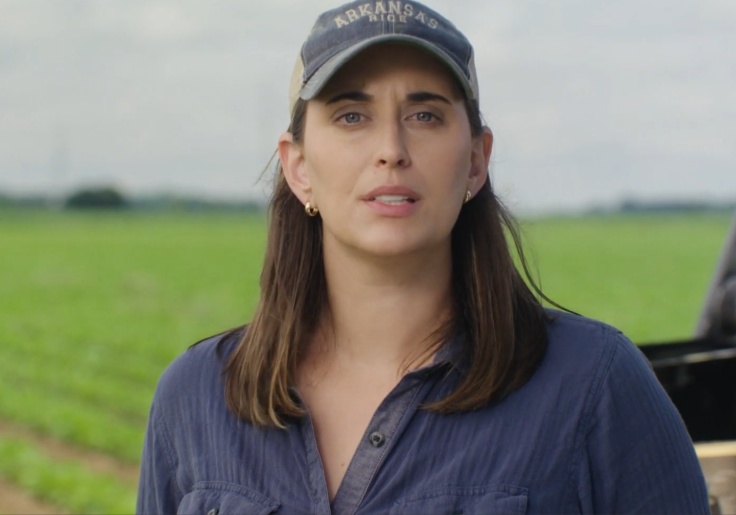
During the summer of 2020 Hallie Shoffner, then a farmer and small‑business owner, helped raise money for the Little Rock Freedom Fund, a bail organization founded by activist Brittany Dawn Jeffrey. The fund later became the focus of a criminal case after Jeffrey was sentenced to 17 months in prison for her role in a series of firebomb attacks on police cars in Little Rock and North Little Rock.
According to a June 22 2020 Facebook post by Bella Vita Jewelry, the store's owner cut flowers on Shoffner's farm and sold bouquets to support the bail fund. The post said the bouquets generated $1 285 for the Little Rock Freedom Fund with one week of sales remaining. Shoffner and the family farming company she ran at the time, SFR Seed, were credited with providing the flowers.
In late August and early September 2020 a group of rioters attacked empty police vehicles, breaking windows, slashing tires, throwing Molotov cocktails and spray‑painting the cars. The U.S. Attorney's Office for the Eastern District of Arkansas linked the attacks to the Little Rock Freedom Fund's founder. In December 2020 four individuals, including Jeffrey, were charged. Jeffrey later pleaded guilty, admitting that the Molotov cocktails were assembled at her home using liquor bottles, bedsheets and gasoline. She received time served in December 2022 after spending 17 months in pre‑trial detention.
While Jeffrey was in custody the Freedom Fund sold T‑shirts bearing her photograph and a quote from Assata Shakur, a convicted cop killer. The left‑wing Arkansas Worker reported the merchandise at the time. The fund's website describes itself as a "black‑led movement organization" founded amid the 2020 "Summer of Resistance." It says its work focuses on "pre‑trial detention, unmitigated trauma, and voter disenfranchisement." The site also calls for "LANDBACK and Reparations" and has issued statements accusing Israel of genocide following the Oct. 7 2023 Hamas attack.
Shoffner's involvement with the fund is part of a broader activist record that she has tried to downplay as she campaigns to unseat incumbent Republican Senator Tom Cotton. Cotton, a former Army lieutenant colonel, won re‑election in 2018 and is seeking a third term in a state that gave President Donald Trump a margin of more than 30 points in 2024. Shoffner's campaign portrays her as a lifelong farmer who never intended to run for office. Her website states, "She is not a politician, she is not much for political parties, and she has never run for office in her life."
Nevertheless, the Washington Free Beacon notes that Shoffner spent years working for organizations such as PROMSEX, a Soros‑funded social‑justice nonprofit in Peru, and Seis Puentes, an Arkansas group that assists undocumented immigrants with government paperwork. Financial disclosures filed for the 2024 race show Shoffner's net worth could be as high as $3.1 million, held in a family trust.
A Shoffner campaign spokesperson defended the 2020 donation, saying the candidate "let a woman who owns a small business cut some flowers from her field" and that the flowers were sold "to donate to a nonprofit that helped non‑violent protesters in Little Rock with bail." The spokesperson added that Shoffner never met Jeffrey and that the activist "was appropriately charged and sentenced." The statement also shifted focus to Cotton, asking, "If you are digging into how candidates spent their time five years ago, does the Free Beacon plan to point out that in June 2020 Tom Cotton authored an op‑ed in the New York Times titled 'Send in the Troops' that called for the military to use violence against lawful protesters as they do in China and Iran?"
Cotton's op‑ed, published in June 2020, urged the deployment of the U.S. military to quell rioting that had "smashed and emptied hundreds of businesses" in an "orgy of violence." The piece sparked controversy, prompting the resignation of New York Times editorial page editor James Bennet and drawing criticism from constitutional scholars who said the proposal violated the First Amendment and the Posse Comitatus Act. A June 2020 Ipsos poll found a majority of Americans supported using the military to address such unrest.
The controversy surrounding Shoffner's 2020 donation raises questions about the transparency of bail funds that operate in the United States. Bail‑fund organizations have become a common way for activists to raise money to secure the release of individuals arrested during protests. Critics argue that some funds may assist people charged with violent offenses, while supporters contend that bail is a constitutional right and that the funds help prevent pre‑trial detention from becoming a de‑facto punishment for the poor.
Little Rock Freedom Fund does not publicly disclose the names of individuals it bails out. In June 2021 the group announced it was raising money to free "people across Arkansas," a period that extended beyond the height of the 2020 Black Lives Matter protests. One of the people the fund posted bail for was identified by the Faulkner County Sheriff's Office as Broderick Fourte, who was arrested "in reference to a disturbance possibly involving a weapon." The report noted that Fourte was found in a field carrying a folding knife, two lighters and a glass pipe with burnt residue.
For Arkansas voters, the revelation about Shoffner's past donation could influence perceptions of her stance on law‑and‑order issues, a theme that has resonated with Republican candidates in the South. Cotton's campaign has repeatedly emphasized his military background and his willingness to take a hard line on protest‑related crime. In a state where the Republican Party controls both congressional seats and the governorship, a Democratic challenger must navigate a political environment that is hostile to progressive activism.
From a broader North American perspective, the story illustrates how past activist fundraising can become a weapon in contemporary campaigns. In the United States, the intersection of bail reform, protest policing and electoral politics is already shaping legislative debates in several states. Canadian observers have noted similar tensions, as bail‑fund initiatives in major cities such as Toronto and Vancouver have faced scrutiny over the alleged release of individuals accused of violent conduct. While the legal frameworks differ, the underlying question of how societies balance civil liberties with public safety is shared across the border.
Looking ahead, Shoffner's campaign will need to address the bail‑fund connection while articulating a broader policy platform that includes agricultural concerns, health care and education, issues that matter to Arkansas's rural electorate. Cotton, meanwhile, is likely to continue highlighting Shoffner's activist past as evidence of a radical agenda. The race is expected to be one of the few competitive Senate contests in a state that has voted heavily Republican in recent presidential elections.
The outcome could have implications for the Senate's balance of power. If Shoffner were to win, she would join a small Democratic caucus that has been fighting for legislation on voting rights, climate action and health care reform. Conversely, a Cotton victory would preserve the current Republican super‑majority, allowing the party to advance its agenda on tax cuts, border security and judicial appointments.
For now, the focus remains on how each candidate frames the 2020 incident. Shoffner's team argues that the donation was a modest, pandemic‑era act of community support, while Cotton's supporters point to the founder's criminal conviction as evidence of a dangerous radical network. Voters in Arkansas will have to weigh those narratives against the broader policy choices each candidate offers.