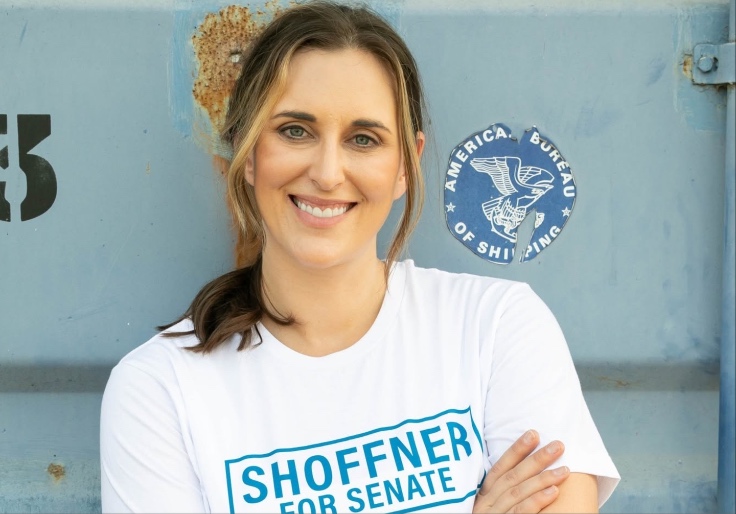
Hallie Shoffner, the Democratic nominee for the U.S. Senate seat from Arkansas, told reporters on Sunday that she does not favor defunding Immigration and Customs Enforcement (ICE). Her statement comes after a June interview in which she said she would "vote to defund ICE as it exists right now" and would not spend "one more dime on ICE."
In the original interview, Shoffner was responding to a question about how she would serve the immigrant and undocumented communities. She answered that she "doesn't care whether these are folks that have documents or not," and added that she would vote to defund ICE. The Washington Free Beacon published those remarks in early July, prompting a wave of criticism from Republican opponents and conservative media.
Since then, Shoffner has taken a different tone. During a live interview with a Little Rock news anchor, she denied ever making the defund claim, stating simply, "No, I have not said that. What I have called for when it comes to immigration is reform." She later posted a comment on Sen. Tom Cotton's Facebook page, writing, "I don't want to defund ICE. I want to reform it."
At a town‑hall meeting in Saline County on July 27, Shoffner reiterated that she would not pursue the elimination of any law‑enforcement agency. "I want to be clear that I don't want to defund any law enforcement agency," she said. "I do not believe in thoughtlessly eliminating any government agency, whether it's ICE or USAID." She acknowledged the $170 billion that Congress has allocated to ICE, arguing that the agency's current approach has resulted in "dead Americans, legal residents, and thousands of innocent people harmed."
Despite the strong language, Shoffner said she still supports securing the border and deporting violent criminals. "We need to fix a system that is incredibly bureaucratic and backlogged," she told the audience. "I want to bring Arkansans to the table to craft an efficient immigration system that meets our state's needs."
Campaign manager Anna‑Lee Pittman defended the candidate's record, writing that the statements are not contradictory. "I reject the premise that these statements are somehow contradictory," Pittman said in an email. "Shoffner believes the United States must have a safe and secure border, but that is not the end of the answer. We must also fix an immigration system that has been broken from years of partisan gridlock."
The controversy arrives in a Senate race that is heavily tilted toward the incumbent Republican, Sen. Tom Cotton. Arkansas voted for former President Donald Trump by more than 30 percentage points in the 2024 presidential election, and the Cook Political Report rates the contest as "Solid R." A February poll showed Cotton leading Shoffner by 22 points, though the race has received limited media attention and few recent surveys.
Immigration has not been a centerpiece of Shoffner's campaign platform, but her background includes work with the nonprofit Seis Puentes, which assists undocumented migrants in understanding U.S. systems. The organization's mission aligns with a broader progressive push for humane immigration policies, a stance that can be politically risky in a state where the electorate leans strongly Republican on border issues.
Arkansas's political environment offers a case study in how Democratic candidates navigate national policy debates in deep‑red states. The state's two‑senator delegation has been Republican for decades, and the GOP holds supermajorities in both the state House and Senate. For a Democrat to win a statewide race, the campaign typically must distance itself from polarizing national topics while highlighting local concerns such as agriculture, health care, and infrastructure.
In Shoffner's case, the "FarmHerHallie" branding effort, designed by a marketing firm to present her as a lifelong farmer, aims to connect with rural voters. She has emphasized "fairness for everyone who works hard" and has positioned herself as a moderate on economic issues. However, her past testimony before the Arkansas House State Agencies and Governmental Affairs Committee in March, where she opposed a bill prohibiting discrimination based on race in state agencies and schools, resurfaced during the campaign. Critics argue that her stance on that bill, combined with the ICE comments, paints a picture of a candidate whose positions are at odds with the conservative values of many Arkansan voters.
The ICE episode also reflects a broader national debate that has implications beyond Arkansas. Since 2020, a segment of the Democratic Party has called for "defunding" or "reforming" ICE, arguing that the agency's enforcement practices have been overly aggressive and have contributed to family separations at the border. Republicans, including Sen. Cotton, have repeatedly framed any discussion of ICE reform as a threat to public safety, using it as a rallying point in their campaigns.
For voters in neighboring states such as Texas and Oklahoma, the Arkansas race offers a glimpse of how the ICE issue may play out in other Southern contests. In the United States, Senate seats control the confirmation of federal judges, the approval of treaties, and the passage of major legislation, making each race a potential lever for national policy direction. While the Arkansas seat is unlikely to flip, the way candidates discuss immigration can influence the broader narrative that shapes legislative priorities in Washington.
From a Canadian perspective, the discussion of ICE reform touches on cross‑border security concerns that affect both countries. Canada's own immigration enforcement agency, Immigration, Refugees and Citizenship Canada (IRCC), coordinates with U.S. authorities on border management. Any shift in U.S. enforcement policy could alter the flow of people and goods across the shared border, a factor that Canadian policymakers monitor closely.
Looking ahead, Shoffner's campaign will need to clarify its immigration stance before the November election. The candidate has scheduled additional town‑hall events in rural counties and plans to release a detailed policy paper on border security and immigration reform. Whether those efforts can overcome the entrenched Republican advantage in Arkansas remains uncertain, but the ICE controversy will likely remain a talking point for Cotton's campaign as it seeks to portray Shoffner as out of step with the state's voters.
In the final weeks of the race, both campaigns are expected to increase advertising spend. Cotton's campaign has already aired television spots linking Shoffner to "radical" immigration policies, while the Democratic side is focusing on economic issues such as farm subsidies and broadband expansion. The ICE debate may thus become a secondary issue, but it illustrates the challenges Democratic candidates face when national policy positions intersect with local political realities.
For Arkansans who prioritize border security, Shoffner's recent statements may provide reassurance that she does not intend to dismantle ICE. For voters who view any reform as a step toward weakening law enforcement, the earlier comments could reinforce skepticism. As the election draws near, the candidate's ability to maintain a consistent message will be a key factor in a race that, while heavily weighted toward the Republican incumbent, still offers a platform for national policy discussions to reach a deeply conservative electorate.