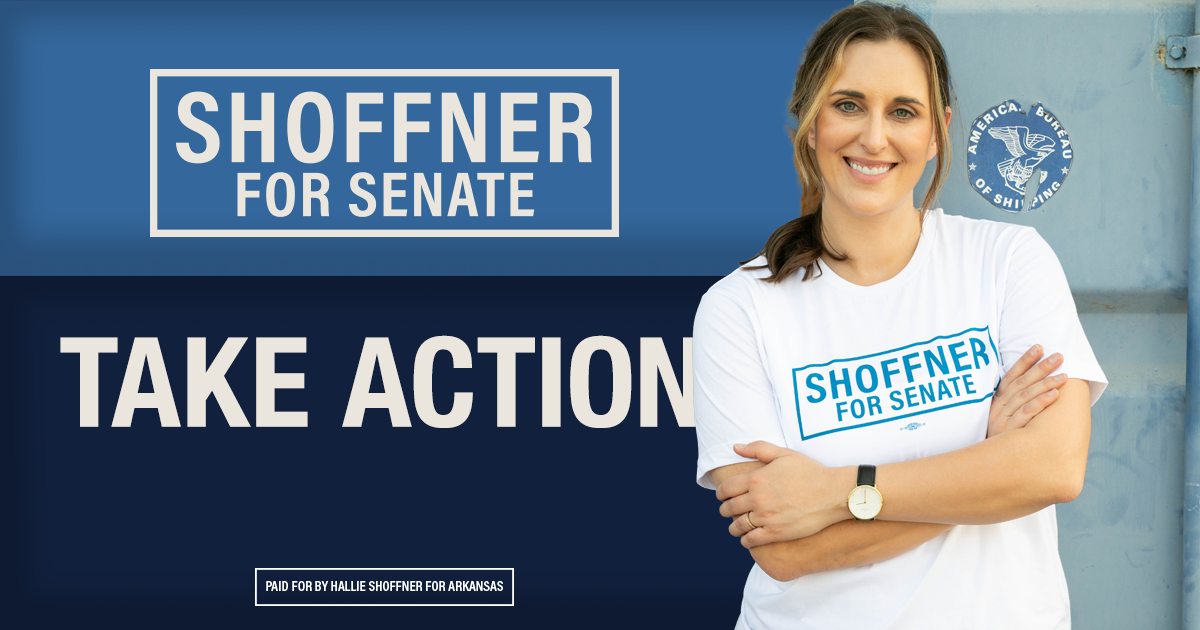
Hallie Shoffner, the Democratic nominee for the U.S. Senate seat from Arkansas, said she will "redirect" the "considerable resources of the federal government" away from "punishment" and toward "treatment and compassion." The remarks were captured on video at a Progressive Democrats candidate forum in Little Rock and reviewed by the Washington Free Beacon.
The forum, held in February 2026, featured Shoffner and her primary opponent Ethan Dunbar. When the moderator asked Shoffner to explain her position on for‑profit prisons, she answered that she opposes them and then broadened the discussion to the nation's overall spending patterns on criminal justice.
"One of the most important jobs of our elected officials is to make sure that our resources are spent appropriately, that we direct our resources to support our communities in an equitable fashion, and that we level the playing field for everybody who works hard, who deserves success," Shoffner said. "And one of the things that we do is pump tons of money into punishment instead of rehabilitation and treatment."
She added, "We imprison so many people as punishment for addiction when what they need is treatment and compassion and support for their families." Shoffner promised that, if elected, she would ensure the federal government "treats people with compassion and lifts them up instead of punishing them."
Shoffner's statements echo a long‑standing activist record. She testified in favor of race‑based hiring and admissions policies in Arkansas and has publicly called for a review of Immigration and Customs Enforcement, saying she wants to "take a second look at ICE." While some critics have labeled her a "defund ICE" advocate, her campaign has clarified that she seeks reform rather than elimination of the agency.
In a 2024 interview with a Little Rock news anchor, Shoffner was asked to explain the basis for defunding ICE. She did not dispute the premise of the question and replied, "I think we should definitely take a second look at ICE." The phrasing has been used by opponents to portray her as radical, though her campaign maintains that her goal is to make the agency more accountable.
The practical mechanics of moving federal dollars from prisons to treatment remain unclear. Advocates of the "defund police" and "defund prisons" movements argue that money spent on law‑enforcement personnel, facilities, and contracts could be reallocated to social services such as mental‑health care, housing assistance, and substance‑abuse programs. Federal budgeting, however, involves a complex appropriations process in which Congress determines the levels of funding for the Department of Justice, the Federal Bureau of Prisons, and health‑related agencies.
On Shoffner's campaign website, the "Keeping Arkansas Safe" section calls for support of local law‑enforcement and first responders, emphasizing training, staffing, mental‑health support, and strong unions. A separate "Addressing the Addiction Crisis" section urges expansion of treatment and recovery services and frames addiction as a health issue rather than a criminal one. The site does not contain a specific plan for diverting correctional spending to these programs.
Born on a family farm in Arkansas, Shoffner later attended the University of Arkansas's Clinton School of Public Service. She has worked with PROMSEX, a nonprofit in Peru that receives funding from the Open Society Foundations, and with Seis Puentes, an Arkansas organization that assists undocumented immigrants in navigating government services. Early campaign materials described her as a lifelong rice and soybean farmer, a claim later softened after the phrase "the only thing Hallie ever wanted to do was farm" was removed from the website.
During the summer of 2020, Shoffner helped raise more than $1,285 for a bail fund founded by activist Brittany Dawn Jeffrey. Jeffrey was later sentenced to 17 months in prison for involvement in a series of fire‑bomb attacks on police vehicles. The bail fund, called the Little Rock Freedom Fund, has issued statements describing the United States as "stolen lands built by stolen hands" and has called for "landback and reparations." It has also criticized Israel's actions in Gaza following the October 7, 2023 attacks.
Shoffner's candidacy pits her against incumbent Republican Senator Tom Cotton, a former Army lieutenant colonel who has served three terms. Cotton won re‑election in 2022 with more than 60 % of the vote, a margin that mirrored President Donald Trump's 30‑point victory in Arkansas in 2020. The state's electorate has trended heavily Republican in federal contests for more than a decade, making any Democratic challenge an uphill battle.
The primary that produced Shoffner as the Democratic nominee was closely watched by national party operatives, who see Arkansas as a potential testing ground for progressive messaging on criminal‑justice reform. While Shoffner's focus on redirecting funds may energize a base of voters concerned with addiction and mass incarceration, it also provides ammunition for Cotton's campaign, which is likely to portray her proposals as fiscally reckless and soft on crime.
The general election is scheduled for November 2026. If Shoffner secures the Senate seat, she would join a small Democratic caucus that has been pushing for broader criminal‑justice reforms at the federal level. The practical impact of her proposals will depend on whether she can influence the appropriations process in the House and Senate, and whether she can build a coalition of lawmakers willing to re‑examine funding for prisons and law‑enforcement agencies.
For now, Shoffner's campaign has not responded to requests for additional details on how the redirection of taxpayer dollars would be achieved. As the race moves toward the fall, voters in Arkansas and observers in Washington will be watching to see whether her rhetoric translates into concrete policy proposals or remains a campaign slogan.