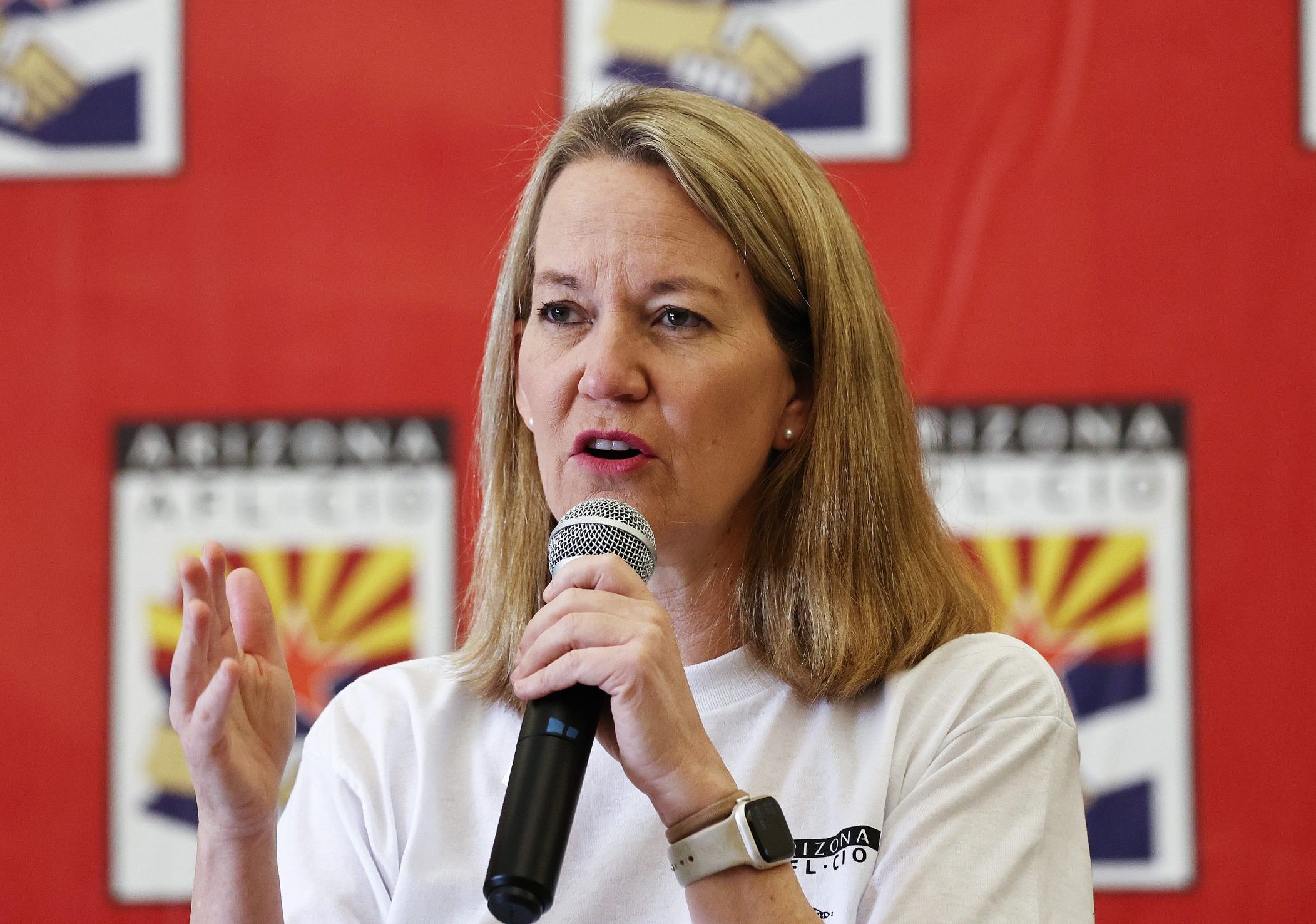
Arizona Attorney General Kris Mayes, a Democrat, engaged in a series of private communications with the activist organization Living United for Change in Arizona (LUCHA) as she publicly denounced the Secure the Border Act, a proposal that later became Proposition 314 and was approved by roughly 62 percent of voters in November 2024.
The email trail, obtained by the Washington Free Beacon through a public‑records request, begins on May 6, 2024. A LUCHA lobbyist warned Mayes's office that state Republicans were preparing to introduce the Secure the Border Act, a bill modeled on legislation championed by Texas lawmakers. The bill would require proof of immigration status for certain public benefits and would empower state and local police to arrest individuals suspected of illegal entry into Arizona.
In the same message, the lobbyist asked whether Mayes would oppose the measure and issue a statement, arguing that "this policy and policies like them are not a sincere effort to address the humanitarian crisis at the border." The lobbyist added that "public pressure like this helps make it possible" to defeat the bill.
Three days after Republicans in the state legislature moved the bill forward, Mayes released a statement calling the proposal "a political distraction that will sow seeds of bias and fear without fixing the issues it claims to address." The language echoed her long‑standing criticism of federal immigration enforcement, even as she positioned herself as a partner of law‑enforcement agencies that have seized large quantities of fentanyl and arrested cartel members.
Contact between Mayes's office and LUCHA continued. In June, LUCHA political director Chris Gilfillan emailed Mayes's communications director Richie Taylor to request a call about "how AG Mayes is thinking about" the Secure the Border Act from a prosecutorial standpoint. Gilfillan wrote that "there's a really strong narrative she could seize, but also understand it could be inherently political." Taylor replied that he was "happy to chat" and supplied his phone number.
By September, Gilfillan reached out again, this time asking Mayes to sign a Democratic AG letter that criticized Texas's immigration policies. Taylor confirmed that his team would "be on the lookout" and later reported that Mayes had indeed signed the letter.
These exchanges illustrate a close relationship between the state's top law‑enforcement official and a group that has called for the abolition of both Immigration and Customs Enforcement (ICE) and Customs and Border Protection (CBP). LUCHA, founded in 2018, has been a vocal participant in the national "defund the police" movement and has organized rallies demanding that city budgets be redirected from police departments to community services.
In June 2020, LUCHA staged a protest outside the Phoenix City Council chambers as council members voted on the municipal budget. The group's Facebook post described Phoenix as having "one of the deadliest police forces in the country" and urged councilors to "defund police." The organization's platform continues to call for the complete dismantling of ICE and CBP, a stance that places it at the far left of the immigration debate.
Arizona's Secure the Border Act advanced through the legislature and was placed on the ballot as Proposition 314, a legislatively referred statute. Unlike a bill that requires the governor's signature, a legislatively referred statute is sent directly to voters for approval or rejection. In the November 2024 election, Proposition 314 received about 62 percent support, signaling strong voter backing for stricter immigration verification and enforcement measures.
LUCHA subsequently filed lawsuits challenging the constitutionality of Proposition 314, arguing that the law infringes on federal authority over immigration. Those suits have so far been unsuccessful, and the measure remains in force.
The revelations about Mayes's coordination with LUCHA emerge as she campaigns for a second term as Arizona's attorney general. She faces Republican Senate President Warren Petersen in a race that, according to a recent Noble Predictive Insights poll, shows Mayes with a six‑point lead but with more than 30 percent of voters still undecided. Mayes's 2022 victory was razor‑thin, she won by just 280 votes, making the current contest one of the most closely watched AG races in the country.
Mayes's own statements on immigration have drawn criticism. In January 2024, she suggested that Arizonans might be allowed to shoot masked ICE agents under the state's Stand Your Ground law. Speaking to 12News, she said that "if you reasonably believe that your life is in danger … you can defend yourself with lethal force." When pressed on whether she was encouraging citizens to shoot peace officers, she replied, "Well, no, but, again, if you're being attacked by someone who is not identified as a peace officer, how do you know?"
The Arizona Police Association condemned the remarks as "reckless, irresponsible, and dangerous." The association warned that elected officials' words can inspire individuals to act violently against law‑enforcement officers.
Two days after the police association's statement, Mayes issued a videotaped apology, blaming "right‑wing media" for the controversy and reaffirming her "support and appreciation" for Arizona's law‑enforcement community.
The episode highlights the tension between state‑level immigration initiatives and the broader national debate over border security. Arizona shares a 360‑mile border with Mexico, and its policies can affect cross‑border trade, tourism, and the flow of goods between the United States and Canada. While the Secure the Border Act focuses on verification of benefits and local enforcement, critics argue that such measures may strain resources and complicate cooperation with federal agencies.
For American voters, the case underscores how state officials can influence immigration enforcement in ways that differ from federal policy. In Canada, similar discussions about provincial involvement in immigration have arisen, especially in provinces that border the United States. The Arizona experience may serve as a reference point for Canadian policymakers considering how to balance local concerns with national immigration frameworks.
Legally, the Secure the Border Act's passage as a voter‑approved statute limits the governor's ability to veto the measure, placing the law firmly in the hands of the electorate. However, ongoing litigation by groups like LUCHA could bring the law before federal courts, where judges may weigh state authority against the Supremacy Clause, which reserves immigration regulation for the federal government.
As the November 2024 election approaches, Mayes's ties to LUCHA could become a focal point for both supporters and opponents. Republicans may use the connection to argue that she is aligned with extremist groups, while Democrats could emphasize her willingness to engage with community activists on immigration reform. The outcome of the AG race will determine who oversees the enforcement of Proposition 314 and how Arizona navigates the complex intersection of state‑level immigration policy, federal authority, and public safety.
Neither Mayes's office nor LUCHA responded to requests for comment on the email records or the ongoing lawsuits.