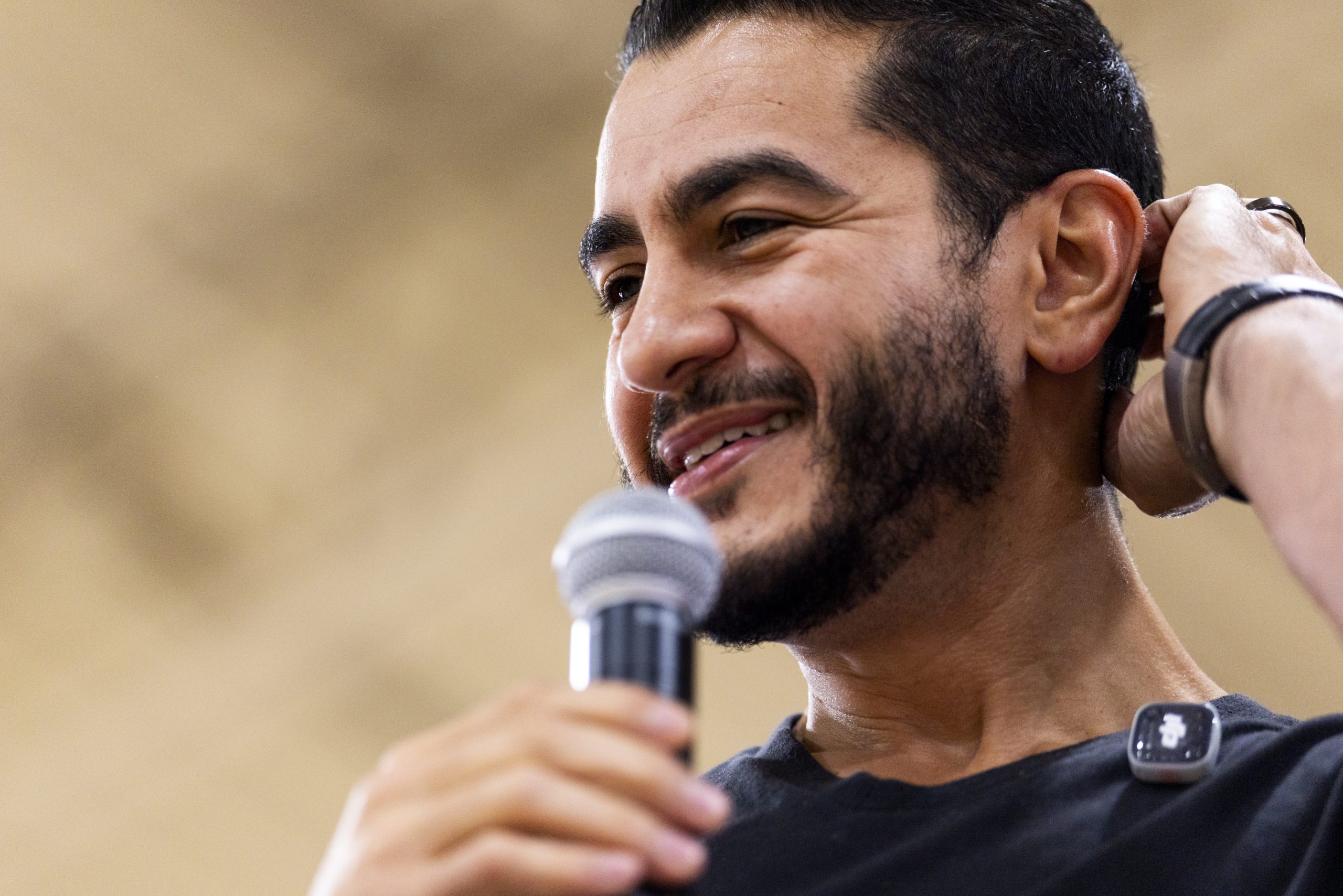
Michigan's Democratic nominee for the U.S. Senate, Abdul El‑Sayed, took the stage on Saturday at the Islamic Society of North America's annual convention in Detroit after a video montage that featured a fire‑brand imam declaring "America is going down" and a cleric accusing members of Congress who supported an anti‑semitism definition of "treason."
The Islamic Society of North America (ISNA) began the second day of its three‑day gathering with a compilation of clips from previous speakers. Among them was a segment of Imam Siraj Wahhaj, who was listed in a 1993 indictment as an unindicted co‑conspirator in the World Trade Center bombing. In the undated excerpt Wahhaj says, "I am ashamed of what America has become. Look at the newspaper every day, how America is going down."
The montage also replayed a short excerpt of El‑Sayed himself describing his childhood after the September 11 attacks, calling himself "a kid with a funny name and an olive complexion." The final slide displayed a photograph of El‑Sayed fist‑bumping left‑wing influencer Hasan Piker, who has previously suggested that "America deserved 9/11."
When El‑Sayed took the podium minutes later, he delivered a conventional campaign address focused on rising living costs and his experience as a Muslim American. "Muslim Americans, they want to tell us that we don't belong. They want to tell us that this country's not ours, that because of our names or how we pray we are somehow less than," he said.
Following El‑Sayed, New Jersey‑based cleric Zaid Shakir and media personality Cenk Uygur of The Young Turks addressed the audience. Shakir, who has a history of controversial statements about the 1993 World Trade Center bombing, accused the United States government of betraying constitutional principles by supporting what he called "a genocidal, rapacious, nefarious foreign country." He singled out a congressional vote that adopted the International Holocaust Remembrance Alliance's definition of anti‑semitism, declaring that "when the United States Congress passes laws on behalf of a genocidal, rapacious, nefarious foreign country to deny us the freedom of speech … that is a domestic enemy of the Constitution of the United States. And as such, they are guilty of treason."
Both Shakir and Uygur have publicly entertained conspiracy theories surrounding the September 11 attacks. In February, Uygur told followers that he no longer believes the official 9/11 story and promoted the "dancing Israelis" myth, which alleges that Israeli agents filmed the attacks for celebratory purposes. Shakir has urged his listeners to read the work of David Ray Griffin, a prominent 9/11 conspiracy author, and has called for an "examination" of what he describes as "glaring weaknesses and inconsistencies" in the government's account.
The convention's timing, six days before the 25th anniversary of the September 11 attacks, added to the controversy. Republican Senate candidate Mike Rogers publicly demanded that El‑Sayed withdraw, saying, "Abdul, stop platforming 9/11 and Holocaust deniers and withdraw from this conference immediately." Rogers cited a Washington Free Beacon report that linked the event to known 9/11 truthers and Holocaust deniers, including Texas‑based Imam Yasir Qadhi, who has referred to the Holocaust as a "hoax."
ISNA, founded in 1963, is the largest Muslim organization in North America, with a membership that spans more than 200 mosques and community centers. The group's annual convention draws thousands of attendees, ranging from religious scholars to community activists. While ISNA has historically positioned itself as a bridge between Muslim communities and broader American society, it has faced criticism in the past for providing a platform to speakers with extremist views. In 2006, the New York Times reported that a pamphlet authored by Shakir was found in the apartment of a suspect in the 1993 World Trade Center bombing.
El‑Sayed's participation comes at a pivotal moment in the Michigan Senate race. The seat, currently held by retiring Democrat Debbie Stabenow, is expected to be one of the most competitive contests in the 2024 election cycle. El‑Sayed, a former health commissioner and public‑health professor, has positioned himself as a progressive alternative to the moderate wing of the Democratic Party. His campaign has emphasized universal health care, climate action, and a $15 minimum wage, themes that resonate with the state's urban electorate but have drawn skepticism from some suburban voters.
Republican challenger Mike Rogers, a former U.S. Representative from Michigan's 8th district, has framed the race as a referendum on "extreme" Democratic policies and cultural issues. Rogers' criticism of El‑Sayed's appearance at the ISNA event is part of a broader strategy to portray his opponent as aligned with fringe elements. In a recent campaign ad, Rogers warned that "the left is inviting radical voices into the mainstream, and that threatens the safety of our communities."
The controversy also touches on a national debate over the International Holocaust Remembrance Alliance (IHRA) definition of anti‑semitism. The definition, adopted by the U.S. House of Representatives in 2023, expands the scope of anti‑semitic behavior to include certain criticisms of Israel. Critics, including some Muslim advocacy groups, argue that the definition could be used to stifle legitimate political discourse. Shakir's remarks at the convention reflect that tension, as he linked the congressional vote to what he described as "treason."
Legal scholars note that the IHRA definition does not carry the force of law but serves as a policy guideline for federal agencies. Nonetheless, its adoption has sparked legislative battles in several states, where lawmakers have introduced bills either endorsing or rejecting the definition. The Michigan Senate race may become a testing ground for how voters respond to these cultural flashpoints.
For Muslim American voters, the episode raises questions about representation and political strategy. According to a 2022 Pew Research Center survey, about 15 percent of U.S. adults identify as Muslim, and they tend to vote Democratic at higher rates than the national average. However, the community is not monolithic; opinions on foreign policy, Israel‑Palestine issues, and the role of religious leaders in politics vary widely. El‑Sayed's decision to speak at the convention could be seen as an effort to engage a key constituency, but the presence of extremist rhetoric may alienate moderate supporters.
Election analysts suggest that the fallout from the Detroit event is unlikely to shift the overall dynamics of the Michigan Senate race, but it could influence fundraising and media coverage in the weeks ahead. The Democratic National Committee has not issued a formal statement, while the Michigan Democratic Party issued a brief comment noting that "candidates are free to attend events that align with their values, and we trust Senator‑elect El‑Sayed to represent all Michiganders."
Looking forward, the Michigan primary is scheduled for August 6, with a general election slated for November 5. Both campaigns will have ample time to address the controversy, either by doubling down on their respective narratives or by seeking to move the conversation toward policy issues such as health care, jobs, and infrastructure. For now, the ISNA convention remains a flashpoint that highlights the challenges candidates face when navigating the intersection of faith, free speech, and electoral politics.