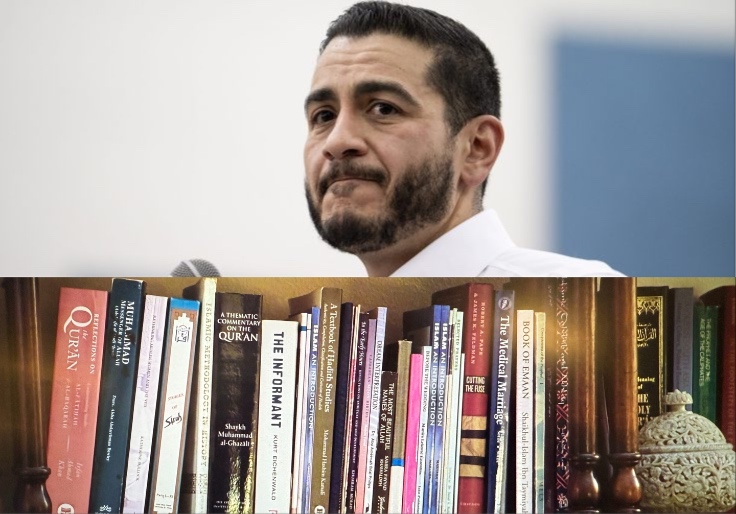
Footage from the 2018 documentary How to Fix a Primary shows Michigan Democratic Senate nominee Abdul El‑Sayed pointing to a bookshelf in his living room and asking the crew to keep the items out of the frame. The filmmakers ignored the request and captured a close‑up that displayed a Quran beside roughly three dozen other volumes, several of which are authored by individuals linked to extremist Islamist movements.
Among the titles is Dream Interpretation According to the Qur'an by Dr. Abu Ameenah Bilal Philips. The Counter Extremism Project identifies Philips as an unindicted co‑conspirator in the 1993 World Trade Center bombing. Philips, a Jamaican‑born scholar, has been barred from entry to the United States, the United Kingdom, Australia, Germany and Denmark for statements that praise suicide bombers, condemn homosexuality as "evil and dangerous," and endorse the beating of wives under the guise of "light" discipline.
Philips now lives in Qatar after a series of deportations and bans in the late 2000s and early 2010s. His writings have been cited by extremist groups as theological justification for violence. The presence of his work on El‑Sayed's shelf has drawn attention because the candidate has repeatedly emphasized his commitment to the separation of church and state.
Another visible volume is Reflections on the Qur'an by the late Irfan Ahmad Khan, a former member of Jamaat‑e‑Islami. Founded in British India in 1941, the movement seeks a state governed entirely by Sharia law. India banned the organization twice, first in the 1970s and again in 1992, though the bans were later overturned by the Indian Supreme Court. The book's inclusion suggests El‑Sayed has explored literature from groups that advocate the implementation of Islamic law in all aspects of public life.
The shelf also holds A Thematic Commentary on the Qur'an by Sheikh Mohammed al‑Ghazali, a noted Muslim Brotherhood figure who testified in a 1993 Egyptian trial defending terrorists who murdered a professor advocating secularism. Al‑Ghazali has described the refusal to implement Sharia as apostasy, a stance that aligns with the Brotherhood's broader goal of establishing an Islamic state.
El‑Sayed's own record on Sharia is mixed. In a 2009 interview with the New York Times he said he felt a "sacred obligation" to follow Sharia in all aspects of his life. During his 2018 gubernatorial campaign he later denied ever living a "Sharia‑compliant" life when asked about the remark. The campaign's latest statement to the Washington Free Beacon asserts that El‑Sayed "believes in the separation of church and state and opposes any effort by any religious community to write their faith laws into the laws of our country."
When pressed about the bookshelf, campaign spokeswoman Roxie Richner told the Free Beacon that the shelf "was not Abdul's" and that "a book appearing in the background of documentary footage is not an endorsement of its content nor a reflection of his beliefs." Richner did not clarify whose collection the books belong to or whether El‑Sayed has read the extremist titles.
The revelation arrives as El‑Sayed battles former Republican Governor Gretchen Whitmer for Michigan's open Senate seat. The race is viewed as a bellwether for the 2024 national contests, with both parties hoping to flip the seat. Voters in the Great Lakes state have been attentive to issues of public safety, education funding and health care, but the bookshelf controversy adds a cultural dimension that could mobilize both progressive and conservative constituencies.
Political operatives on both sides have a history of using a candidate's reading list to question loyalty or judgment. In 2020, a New York congressional candidate faced attacks after a photo showed a copy of a Marxist text on his desk. Those incidents illustrate how personal libraries can become campaign fodder, especially when the material is linked to extremist ideology.
El‑Sayed's past comments on Sharia bans also surface in the debate. In 2022 he likened a 2010 Michigan ballot measure that would have prohibited the enforcement of Sharia law to historic tragedies such as the Trail of Tears and the Oklahoma City bombing. Critics argue that such comparisons trivialize genuine historical suffering while inflaming cultural tensions.
Across the border, Canadian politicians have grappled with similar questions about religious freedom and extremist literature. In 2021, a federal committee examined whether public libraries should flag books that promote extremist views, a discussion that resurfaced after a Quebec school board removed a novel deemed to glorify jihad. While Canada's legal framework places a higher threshold on restricting speech, the debate underscores how North American societies balance free expression with security concerns.
Legal experts note that the United States Constitution protects the right to read and possess books, even those espousing extremist ideas, unless the material is directly linked to criminal conduct. State bans on Sharia law, such as those passed in Idaho and Oklahoma, have been challenged in courts on First Amendment grounds. The outcomes of those cases could influence how voters interpret El‑Sayed's alleged association with radical authors.
As the November election approaches, El‑Sayed's campaign must navigate the optics of the bookshelf while continuing to promote its policy platform on health care expansion, climate action and infrastructure investment. Whether the controversy will sway undecided voters in Michigan's swing counties remains to be seen, but it has already drawn national attention and prompted a flurry of statements from both parties.
For voters in the United States and Canada, the episode highlights the growing scrutiny of personal reading habits in political contests and raises questions about how far opponents should go in probing a candidate's intellectual curiosities. The final impact on the Michigan Senate race will depend on how the electorate weighs the presence of extremist titles against the candidate's stated positions on governance, religious liberty and public policy.