Caroline Hallemann's new volume, The Kennedys and the Windsors: The Story of Two Dynasties, One Born, One Made, arrives at a moment when both American and Canadian voters are re‑examining the role of historic families in contemporary politics. Published by G.P. Putnam's Sons, the 372‑page book attempts to trace the personal and political connections between the Kennedys, often described as an American "royal" family, and the British monarchy, whose head of state remains a constitutional figure in Canada.
Hallemann, a writer with a background in cultural history, structures the narrative around moments when the two families literally crossed paths. She opens with Joseph P. Kennedy's 1938 appointment as U.S. ambassador to the United Kingdom, a posting that placed the patriarch of the Kennedys at the heart of the British royal household. The author quotes Kennedy's own reaction to Windsor Castle: "Rose, this is a helluva long way from East Boston," a line that underscores the cultural shock felt by the Boston‑born family when they entered the world of British aristocracy.
The book's premise rests on the observation that both dynasties have been marked by public fascination, scandal, and a series of personal tragedies that have been amplified by the media. Hallemann notes that Joseph Kennedy's isolationist stance during the early months of World War II led to his removal from the ambassadorship after an interview in which he declared, "Democracy is finished in England." The quote, taken from a 1940 Boston Sunday Globe piece, illustrates how Kennedy's political miscalculations clashed with the expectations of a nation on the brink of war.
Beyond the anecdotal, Hallemann draws parallels between the Kennedys' political ambitions and the Windsors' constitutional role. The Kennedys, beginning with Joseph Kennedy's business empire and culminating in the presidential tenure of John F. Kennedy, shaped mid‑century American policy on civil rights, Cold War strategy, and space exploration. The Windsors, meanwhile, have navigated a constitutional framework that limits direct political power but grants symbolic authority across the Commonwealth, including Canada, where the monarch remains the head of state.
For Canadian readers, the book's relevance is immediate. The ongoing debate over whether Canada should retain the British monarch as its ceremonial head has resurfaced in provincial legislatures and federal discussions. By juxtaposing the Kennedys' democratic influence with the Windsors' hereditary symbolism, Hallemann indirectly invites readers to consider how legacy and legitimacy function in two very different political systems.
Hallemann does not shy away from the darker chapters that have haunted both families. She recounts the assassinations of President John F. Kennedy and his brother Senator Robert F. Kennedy, while also detailing the premature deaths of four of Joseph Kennedy's nine children, two in shootings and two in plane crashes. The author adds that the Kennedys' eldest daughter, Rose, was lobotomized after a "behaviour that was deemed embarrassing," a fact that illustrates the extent to which the family's public image was managed.
Parallel misfortunes are highlighted on the Windsor side. King George VI's death at age 56 from coronary thrombosis and Princess Margaret's turbulent life after being denied permission to marry Peter Townsend are presented as the royal equivalents of the Kennedys' tragedies. Hallemann's narrative suggests that both families have been "cursed" by a series of personal losses that have shaped public perception for generations.
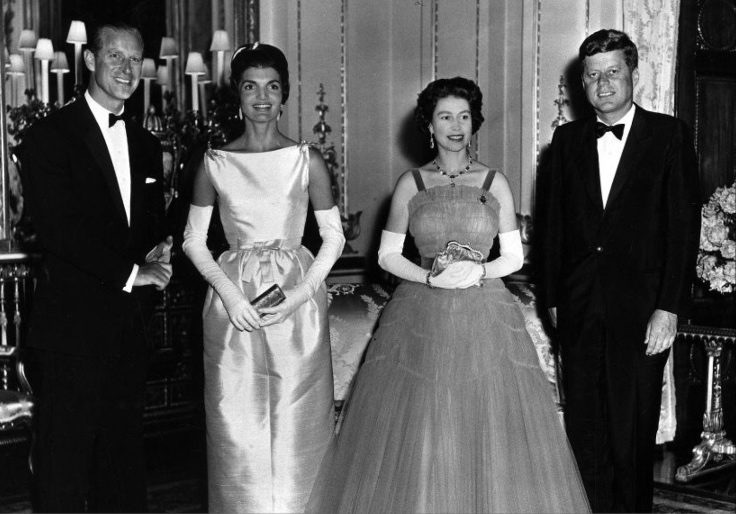
The book also explores moments of diplomatic and cultural exchange that have become part of the shared lore. The 1961 state dinner at Buckingham Palace, where President Kennedy and First Lady Jacqueline Kennedy met Queen Elizabeth II and Prince Philip, is described as a high‑point of transatlantic camaraderie. Conversely, a 1995 secret meeting at New York's Carlyle Hotel between John F. Kennedy Jr. and Princess Diana is portrayed as a "slightly bizarre" encounter that could have sparked tabloid frenzy had it been made public.
Hallemann's treatment of Jacqueline Kennedy's evolving view of the British monarchy adds a personal dimension to the political analysis. The author cites a conversation in which the former First Lady, speaking to author Gore Vidal, remarked that she felt "absolutely no relationship between them" after observing the dynamics between Queen Elizabeth II and Prince Philip. This anecdote underscores how personal impressions can influence diplomatic tone, even when the individuals involved hold no formal power.
From a political journalism perspective, the book's timing is noteworthy. In the United States, the Kennedy name has resurfaced in the 2024 election cycle as Robert F. Kennedy Jr. seeks a cabinet post, while in the United Kingdom the monarchy continues to navigate public scrutiny after the death of Prince Philip and the recent controversies surrounding Prince Harry's memoirs. In Canada, Prime Minister Justin Trudeau's government has faced pressure from provincial leaders to reconsider the role of the Crown, a conversation that may be informed by the historical parallels Hallemann draws.
Critics of the book have pointed out that the depth of research varies between the two families. Reviewers note that the Kennedy sections benefit from a wealth of American archival material, whereas the Windsor chapters sometimes rely on secondary sources that feel "well‑worn." Nonetheless, the author's commitment to factual detail is evident in the extensive footnotes that accompany each chapter, a feature that distinguishes the work from more sensationalist treatments of royal and political gossip.
Beyond its narrative, the book raises questions about how dynastic legacies influence contemporary policy. The Kennedys' advocacy for civil rights and space policy still echoes in current legislative debates, while the Windsors' role in Commonwealth affairs continues to affect trade agreements and diplomatic protocols that involve Canada, the United States, and other former British colonies.
For readers interested in the intersection of history, politics, and culture, Hallemann's work offers a fresh lens through which to view two of the most scrutinized families on the planet. While the book may not deliver groundbreaking revelations for seasoned scholars, it provides a cohesive account that links personal drama with the broader political currents that have shaped the United States, the United Kingdom, and Canada over the past century.
In a media environment saturated with quick takes and viral soundbites, a measured historical comparison such as The Kennedys and the Windsors serves as a reminder that the personal lives of public figures can have lasting political consequences. Whether the book will shift public opinion on the monarchy in Canada or influence how Americans view the Kennedy legacy remains to be seen, but its release adds a nuanced voice to ongoing conversations about power, heritage, and the role of historic families in modern governance.