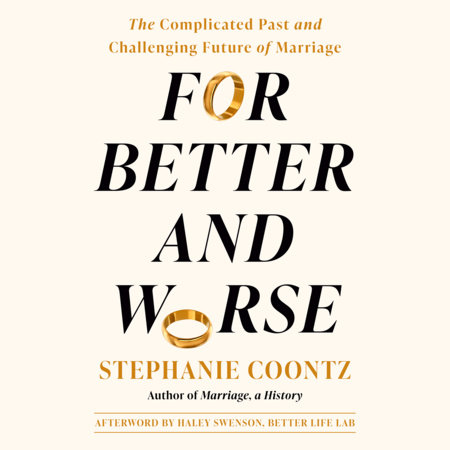
Historian Stephanie Coontz's new volume, For Better and Worse: The Complicated Past and Challenging Future of Marriage, challenges the popular belief that the post‑war era represented a golden age of marital stability. Coontz, a leading scholar of family history, contends that the nostalgia for 1950s "family values" rests on a selective reading of history and that the social arrangements of that decade were sustained by government policies rather than by any timeless cultural virtue.
Coontz opens her narrative by pointing to a "revival of the more pernicious form of nostalgia" that seeks to recreate a bygone way of life rather than a specific pleasant memory. She warns that such longing can obscure the complex forces that shaped marriage over millennia. While she admits that "there is no way of knowing for sure the interpersonal dynamics of marriage and male‑female relationships among our ancient ancestors," she notes that anthropologists and archaeologists have found no evidence in band‑level societies of systematic oppression of women or punitive treatment of children born outside of marriage.
Drawing on ethnographic studies of contemporary hunter‑gatherer groups such as the Hadza of Tanzania and the !Kung of the Kalahari, Coontz highlights that many of these societies accepted premarital sex for both genders, frowned upon wife‑beating, allowed women to leave a partner, and provided children born outside of formal unions with access to communal resources. She argues that the shift toward patriarchal marriage coincided with the advent of agriculture, when surplus production made property ownership possible and, in her view, "begat inequality."
According to Coontz, the rise of private property created a need to control female sexuality in order to protect patrilineal inheritance. She cites diaries from Jesuit missionaries in 17th‑century Canada as evidence that indigenous bands began to monitor women's sexual behavior once they adopted concepts of land tenure. While some scholars have pointed out that many Indigenous groups maintained sophisticated notions of territorial use and stewardship, the broader pattern of property‑related gender control is well documented in the legal histories of both the United States and Canada.
In the United States, the doctrine of coverture, which persisted into the mid‑19th century, legally subsumed a married woman's identity under that of her husband, effectively treating her as property. Canada's common‑law marriage system, until the 1980s, similarly granted husbands control over wives' earnings and property. Both jurisdictions only began to dismantle these structures through a series of reforms: the Married Women's Property Acts in the United States, the 1964 Family Law Act in Canada, and later criminalization of marital rape. These legal changes illustrate the point Coontz makes about the link between property rights and marital power dynamics.
Coontz also turns her attention to the role of Christianity in shaping modern marriage. She argues that the Church's authority to sanctify or annul unions and to label children as legitimate or illegitimate reinforced a system that disadvantaged women. Yet she distinguishes this institutional influence from the teachings of Jesus, suggesting that biblical passages indicate "that Jesus endorsed an understanding of social obligations close to that of our hunting‑and‑gathering ancestors." This theological reading is meant to counter contemporary political rhetoric that invokes "family values" as a monolithic Christian mandate.
The economic dimension of Coontz's argument focuses on the post‑World War II boom. She contends that the prosperity of the 1950s was not the product of "free enterprise" alone but resulted from a combination of government‑funded job creation, stricter regulation of banks, higher tax rates on the wealthy, and robust consumer protections. In the United States, programs such as the GI Bill, the expansion of Social Security, and the Federal Housing Administration helped create a middle class capable of supporting a single‑income household. Canada's similar post‑war policies, including the creation of universal health care and the expansion of public education, produced comparable outcomes.
Coontz warns that any attempt to revive a one‑income family model would require a return to those expansive government programs, a prospect she deems unlikely in the current political climate. She further argues that "wealthy individuals and politicians who want to deregulate Wall Street and repeal restrictions on corporate and billionaire entitlements forged alliances with groups wanting to re‑regulate women's bodies and reimpose restrictions on people's sexual and marital choices." In this framing, the modern conservative coalition is portrayed as a partnership of economic and social conservatives.
The book's critique of contemporary family policy has immediate relevance to ongoing political debates. In the United States, proposals to expand the child tax credit, to increase paid family leave, and to strengthen the Earned Income Tax Credit are being discussed as ways to support families without reverting to a single‑breadwinner model. In Canada, the Liberal government's recent budget includes measures to improve affordable childcare, a policy area that directly impacts marital and cohabitation decisions.
Coontz's analysis of marriage rates also draws attention. She notes that marriage has become less common overall and that research linking marriage to economic success is largely correlational. While she dismisses economist Melissa Kearney's findings that two‑parent households enjoy measurable financial advantages, she does acknowledge that historically Black Americans had higher marriage rates in the early 20th century. Coontz attributes the current decline among Black couples to "America's distinctive racist traditions" that have generated a cascade of economic and social stressors.
Demographers confirm that the marriage gap between Black and White households has widened since the 1970s, a trend that scholars link to factors such as mass incarceration, employment discrimination, and wealth disparities. The U.S. Census Bureau reports that in 2022, 30 percent of Black adults were married, compared with 48 percent of White adults. These figures underscore the intersection of race, economics and family formation that Coontz highlights.
Critics of Coontz's work point to the breadth of scholarship that documents both the benefits and the challenges of marriage. Studies from the National Marriage Project show that married couples, on average, report higher levels of personal happiness and better health outcomes, though causality remains debated. Moreover, the legalization of same‑sex marriage in the United States in 2015 and in Canada in 2005 has expanded the definition of marriage, a development Coontz frames as part of the broader "most free and open society" the continent now enjoys.
The book also revisits the 1974 Boldt decision, which affirmed Indigenous fishing rights in the Pacific Northwest. Judge George Boldt's opinion highlighted that "individual Indians had primary use rights in the territory where they resided and permissive use rights in the natal territory," a principle that reflects a nuanced view of property among Native bands. Coontz uses this case to illustrate that Indigenous societies were not uniformly egalitarian but did possess complex concepts of land use that pre‑date European legal systems.
As the United States prepares for the 2024 midterm elections and Canada heads toward its next federal campaign, the themes raised in Coontz's book are likely to surface in policy debates. Conservative candidates may invoke "family values" to argue for tax reforms that favor traditional households, while progressive platforms may emphasize universal childcare and paid leave as ways to decouple economic security from marital status.
Whether readers agree with Coontz's assessment or view her conclusions as overreaching, her book forces a reconsideration of how history, religion, economics and law have intertwined to shape the institution of marriage. By challenging the myth of the 1950s as a universal model, Coontz invites policymakers and voters alike to examine the actual foundations of family life in North America.