Independent reporting on American politics
STATE BEACON

Founders With Feet of Clay

In December 1818, an 83-year-old John Adams—slow of step and weak of sight—was ushered into Boston’s Faneuil Hall to behold John Trumbull’s now-legendary painting of the presentation of the Declaration of Independence. The former president was said to have given "his warm approval." He was probably lying.

By Troy Senik·
Founders With Feet of Clay

In December 1818, an 83-year-old John Adams—slow of step and weak of sight—was ushered into Boston’s Faneuil Hall to behold John Trumbull’s now-legendary painting of the presentation of the Declaration of Independence. The former president was said to have given "his warm approval." He was probably lying.

Adams distrusted art that portrayed human events on an Olympian scale. In a letter to Trumbull, the former president suggested that an accurate rendering of the revolution would have depicted legislative debates so prosaic they likely wouldn’t have inspired anyone to pick up a brush.

Thomas Jefferson’s conception of the Founding was not so modest. As revolution churned in France in 1789, he wrote to James Madison that the French view of America’s Founding documents was "like that of the Bible, open to explanation but not to question." That he was the author of one of those documents invites the question of whether he left the analogy unfinished.

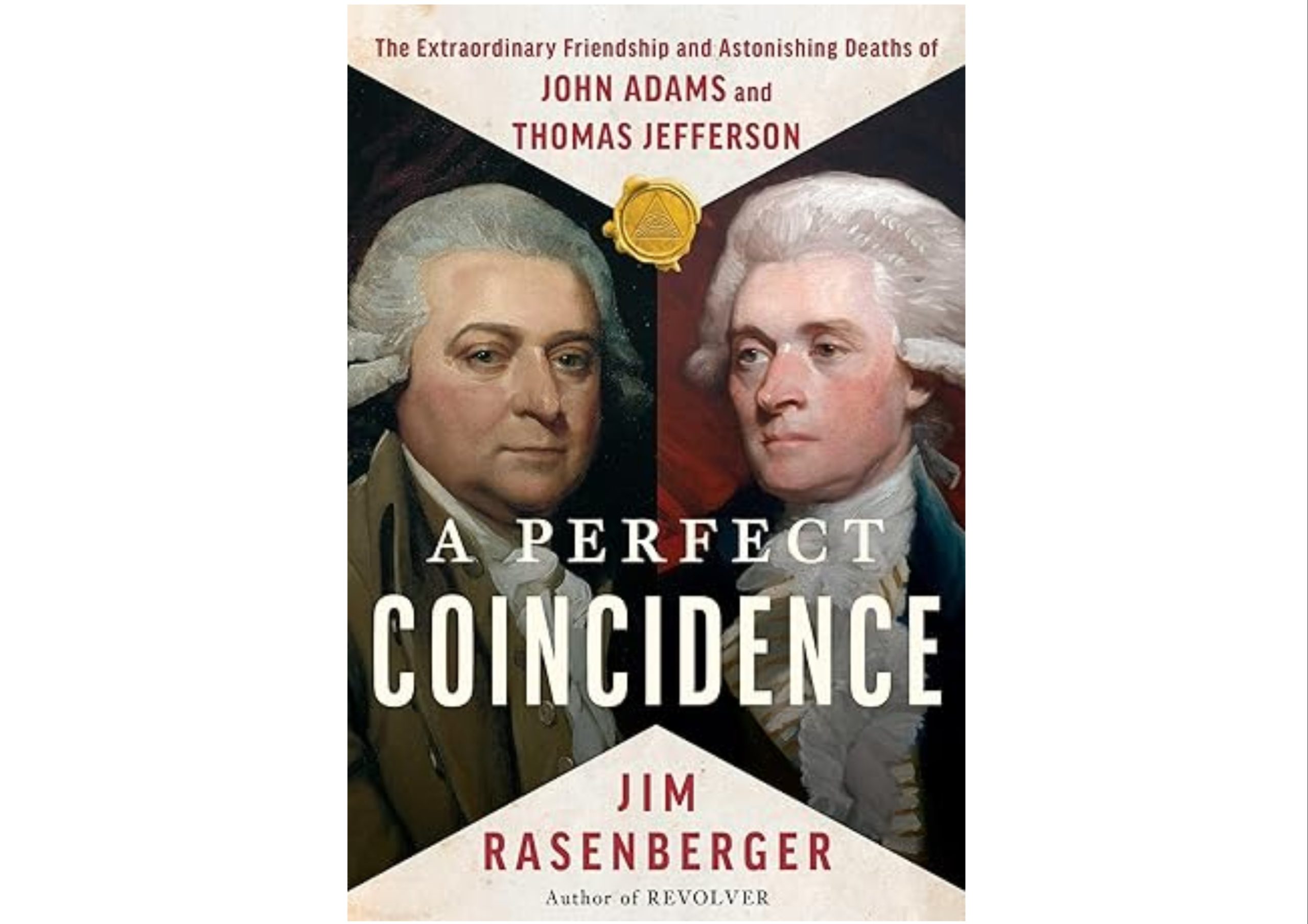
These contrasting views of America’s Founding—one attributing it to the halting, tortuous work of imperfect men; one sensing a whiff of the divine in the proceedings—are the central preoccupation of Jim Rasenberger’s new book, A Perfect Coincidence: The Extraordinary Friendship and Astonishing Deaths of John Adams and Thomas Jefferson.

As Rasenberger notes, the fact that Adams and Jefferson died within hours of each other on July 4, 1826—the 50th anniversary of the Declaration of Independence—was interpreted by many Americans of the day as a sign that divine providence had been at work in the Founding project. The effect on the country was so pronounced, he tells us, that it lodged a previously uncommon word—"coincidence"—permanently in the American vocabulary.

The book is less concerned, however, with whether the public saw the hand of fate guiding the proceedings than with whether Adams and Jefferson did. And thanks to the extensive correspondence they left behind, we know the answer to that question: On this, as on so many points, they disagreed.

It is de rigueur in accounts of the decades-long (and often contentious) friendship between these two men to note that they were a study in contrasts: Adams a short, squat, irascible New England Federalist with an inborn fatalism; Jefferson a tall, trim, taciturn Virginia Republican with a deep romantic streak. Where Rasenberger shines is in picking at these superficial differences to reveal the deeper divide for which they were a proxy: These were two men with fundamentally different conceptions of human nature.

Jefferson wrote that man’s "mind is perfectible to a degree of which we cannot yet form any conception." Adams approvingly quoted Machiavelli that "whoever would found a state … must presume that all men are bad by nature." Nearly every salient difference between the two flowed from those headwaters. Jefferson was impatient for the coming apotheosis of mankind. Adams was simply grateful for every day that society resisted the entropic descent into anarchy.

Rasenberger goes to great lengths to dispassionately adjudicate between the two views. He does not fully succeed, for the simple reason that it may be an impossible task.

To remain neutral in the debates between Adams and Jefferson is to remain neutral on the foundational questions of political life. You either thrill to the grandeur of Jefferson’s poetics or nod along to the horse sense of Adams’s often heavy-footed prose. You either drift toward the Burkean caution of Adams or the revolutionary zest of Jefferson. You either sniff at Jefferson as a bacillus of Jacobinism or wave away Adams as the Eeyore of the Founding generation.

Rasenberger tilts toward Adams, as becomes clear with the litany of disclaimers he adds in an attempt to give Jefferson a fair hearing. Noting how the self-styled Virginia rustic professed to disdain Europe while living the high life in Paris, the author gently notes that "truth with Jefferson was always complicated." In trying to weigh the sincerity of his views that Adams and Alexander Hamilton were crypto-monarchists, the author stipulates that "for Jefferson biographers, the challenge that always comes up sooner or later is figuring out whether their man meant what he said." Noting Jefferson’s confident assertion that the French Revolution would be bloodless—and the glib indifference he displayed when it turned out not to be—we are told, "For all his genius as a visionary, he was often blind to developments close at hand."

These asides are not as tendentious as they sound. While Jefferson’s biographers often portray him as inscrutable (Joseph Ellis titled his Jefferson biography American Sphinx), a simpler interpretation is that he was something like an exceptional undergraduate: brilliant, romantic, florid, and largely unconcerned with either consistency or the practical implications of his views. Rasenberger provides damning evidence to this effect when he notes that Jefferson’s famous thought experiment proposing that the Constitution and all laws should reset every 19 years was written in a letter to Madison, "who had just spent three years of his life crafting and fighting for the passage of the U.S. Constitution."

If Jefferson was prone to flights of fancy, however, it’s hard to deny that we’re all better off for it. When Americans celebrate the country’s 250th anniversary this weekend, the winged prose with which he suffused the Declaration of Independence will be inescapable. John Adams, who also served on the document’s drafting committee, referred to the finished product as a "theatrical show"—a bit of necessary razzle-dazzle, but not especially serious business. Adams concerned himself with the libretto. He simply could not hear the music.

It is unsurprising that someone this literal-minded dismissed the notion of a providential fate for America with the judgment, "Miracles will not be wrought for us. We don’t deserve them. If we will have government, we must use human and natural means." The closest Adams could get to optimism was his frequent refrain, "We shall blunder through!" Like so much of the second president’s thought, it’s mildly depressing, rough around the edges, and entirely correct.

To understand American independence as a foreordained triumph is to misunderstand the sense of contingency the Founders themselves felt. Trumbull’s painting may cast the signing of the Declaration in a heroic light, but Rasenberger quotes Benjamin Rush’s testimony that the actual event happened in "pensive and awful silence." These were not men who knew they were steering a course set by the gods. These were men who knew they were potentially signing their own death warrants. We call it providence only because we know how the story ends.

A Perfect Coincidence earns its keep by illuminating the real dynamics at work rather than settling for the just-so story. Jefferson’s America would never have been possible without the realism of John Adams tethering it to the ground. Adams’s America would never have been possible without Jefferson’s idealism urging it toward the horizon. Both would have been insufficient unleavened by the respective geniuses of Franklin, Hamilton, Madison, Washington, and countless others. At the remove of 250 years, that convergence seems more remarkable than ever.

A miracle? No. Something more.

A Perfect Coincidence: The Extraordinary Friendship and Astonishing Deaths of John Adams and Thomas Jefferson
by Jim Rasenberger
Scribner, 496 pp., $31

Troy Senik is a former presidential speechwriter and the author of A Man of Iron: The Turbulent Life and Improbable Presidency of Grover Cleveland.