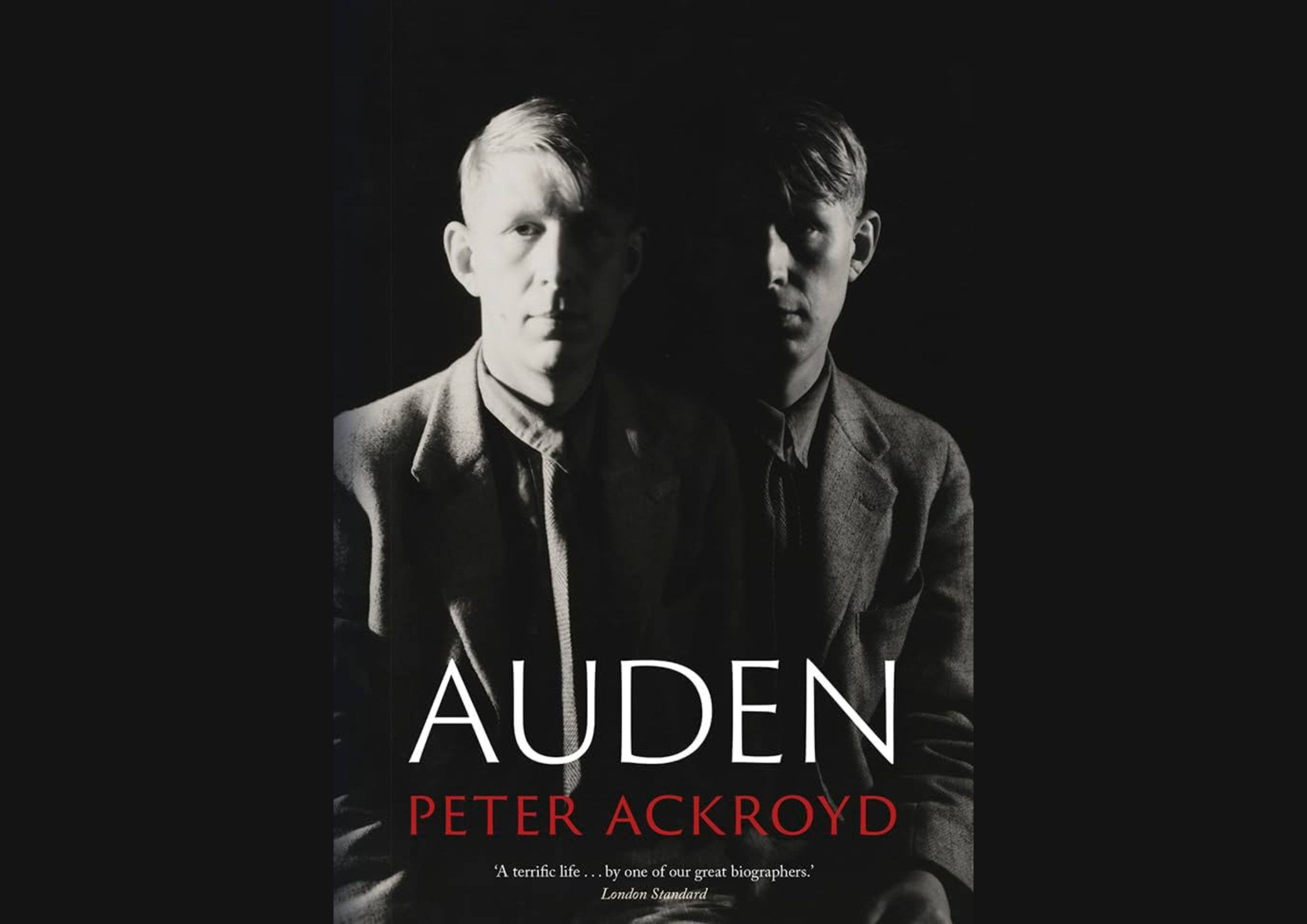
Reaktion Books released a 400‑page study of the English poet W.H. Auden on Tuesday, adding another voice to the long line of scholarship on one of the twentieth‑century's most politically engaged writers. The book, titled simply Auden, is the latest effort by prolific biographer Peter Ackroyd to map the intersections of literature, ideology and private desire.
Auden's career began in the mid‑1930s when, as a young schoolmaster, he produced a flood of rhymed, metered poems that tackled subjects most critics had deemed "unpoetic." From fascism to airplanes, from oncology to the looming threat of world war, his verses turned contemporary anxieties into formal lyricism. That blend of modern content and traditional form set him apart from earlier modernists such as Ezra Pound and T.S. Eliot, who tended to mock or repudiate the new world.
"He was at home in the twentieth century," Ackroyd writes, noting Auden's willingness to read Freud, drive a car, and even watch television on rare occasions. The poet's later work would reference the partition of India and the Apollo moon landing, showing a lifelong habit of turning headline events into poetic material. One line from his 1939 poem "September 1, 1939" was later recalled by President George H.W. Bush in a speech about "a thousand points of light," a reminder that Auden's language still surfaces in American political rhetoric.
For readers of the new biography, the most striking claim is Ackroyd's skepticism about Auden's early output. When Auden was 22, T.S. Eliot praised him as "about the best poet that I have discovered in several years." Ackroyd argues that Eliot's enthusiasm was premature, describing Auden's first poems as "highly contrived" and "deliberately obscure." He suggests that the poet's true breakthrough arrived with the "Letter to Lord Byron" (1936), a seven‑line rhyme‑royal sequence written in Iceland that freed Auden from the pressure to be overtly political or oratorical.
The biography places Auden's political development in the broader context of British left‑wing intellectual life. As a young man he identified with socialist ideas but never joined the Communist Party. His early poems, while charged with anti‑fascist sentiment, lacked the doctrinal clarity of contemporaries who embraced Marxist orthodoxy. By the time he emigrated to the United States in 1939, Auden had already begun to distance himself from the more doctrinaire currents of British leftism, a shift that would shape his later teaching career at institutions such as Swarthmore College.
In the United States Auden became a fixture of the East Village literary scene and later a professor at the University of Michigan in Ann Arbor. His presence in American academia contributed to a post‑war cultural climate that prized intellectual rigor combined with artistic freedom. Scholars note that his lectures on "Romanticism from Rousseau to Hitler" blended literary analysis with psychological insight, encouraging students to dissect poetic form through the lens of contemporary politics. "It is harder for the guilty to admit guilt, and accept forgiveness, than for the innocent to forgive," he told a class, a line that resonated with the moral debates of the early Cold War era.
Auden's political relevance extended beyond the classroom. His poems were frequently cited by liberal politicians and activists during the 1960s civil‑rights movement, and his anti‑war sonnets provided a lyrical counterpoint to the Vietnam debate. While he never held public office, his work helped shape the cultural vocabulary of left‑leaning discourse in both the United Kingdom and the United States.
Ackroyd also delves into Auden's religious journey, noting that he was the grandson of two clergymen and retained a lingering Anglican faith throughout his life. In his thirties he embraced high Anglicanism, a form of Anglo‑Catholicism that informed much of his later poetry. This religious turn, combined with his left‑wing politics, placed Auden in a unique position among his peers, many of whom either rejected organized religion outright or adhered to secular humanism.
The biography does not shy away from Auden's personal life, particularly his long‑standing relationship with the poet Chester Kallman. The two met shortly after Auden's arrival in New York and remained partners until Auden's death in 1973. Ackroyd portrays the relationship as both a source of stability and a site of continual tension, noting Kallman's "roving eye" and Auden's occasional reliance on paid companionship. While the book offers vivid details about their private encounters, it also situates these experiences within the broader social climate of mid‑century America, when homosexuality was still criminalized in many states and subject to intense public scrutiny.
Critics of the biography have pointed out occasional factual slips, such as Ackroyd's mistaken belief that Montreal lies on the U.S. border and that Indiana University sits 200 miles north of Chicago. Nonetheless, reviewers agree that his handling of Auden's sexuality is thorough and well‑researched, drawing on letters, diaries and contemporaneous accounts to illustrate how the poet navigated a world that often forced gay men into secrecy.
Beyond the personal, Ackroyd highlights Auden's influence on American cultural policy. During the 1950s the poet served as a consultant for the United States Information Agency, helping to craft broadcasts that presented a sophisticated, humanist image of the United States abroad. His involvement illustrates how literary figures were sometimes enlisted to support diplomatic objectives during the ideological contest with the Soviet Union.
Peter Ackroyd, a novelist, historian and former biographer of figures such as Charles Dickens and William Shakespeare, brings his trademark narrative flair to the project. While his earlier biography of Auden's contemporary Louis MacNeice was praised for its depth, some reviewers argue that Ackroyd's treatment of Auden's early poems lacks the scholarly rigor found in Edward Mendelson's two‑volume study. Nonetheless, the new book offers a fresh perspective by emphasizing Auden's political consciousness and the ways his formal mastery served as a vehicle for social commentary.
For readers interested in the intersection of literature and politics, Ackroyd's work arrives at a moment when cultural debates are once again foregrounding the role of artists in public life. As American and Canadian legislators grapple with questions of free expression, funding for the arts, and the place of historical memory in curricula, Auden's legacy provides a case study of how a poet can influence political discourse without ever holding elected office.
The book is priced at $30 and is available in hardcover and ebook formats. Its release is likely to spark renewed discussion in literary circles and among scholars of political culture, offering a reminder that the boundaries between poetry and politics remain porous.