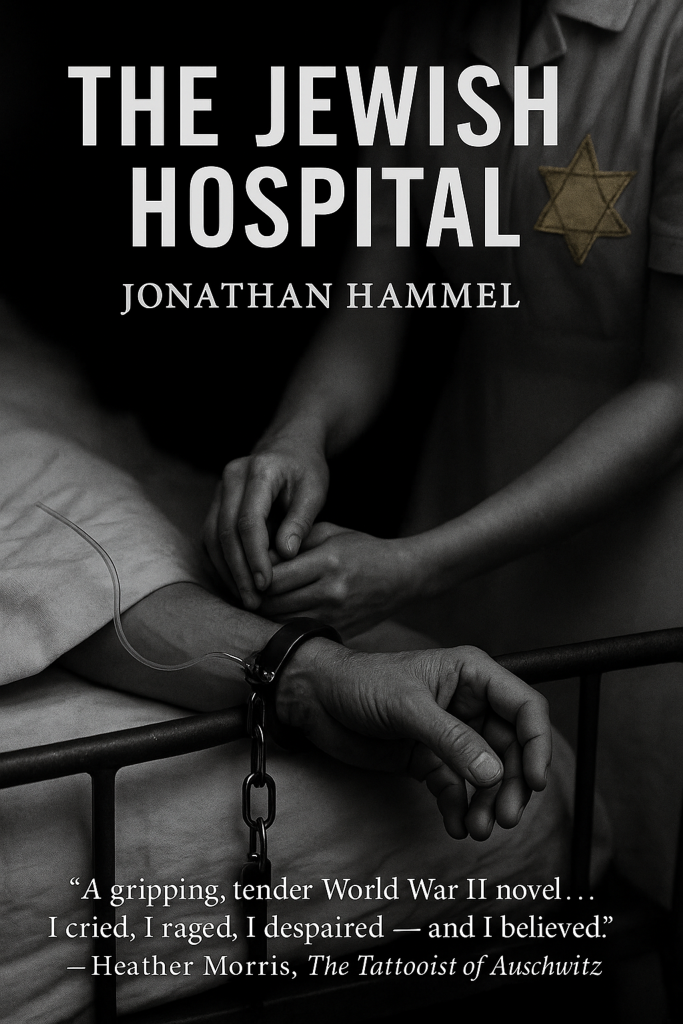
Jonathan Hammel's latest work, The Jewish Hospital, tells the story of a Berlin medical facility that remained open for Jews from the early days of Nazi rule until the war's end. The novel, published by Skyhorse, follows the experiences of the author's grandmother, Gerda Schild Haas, who worked as a nurse in the institution. By weaving personal narrative with documented events, Hammel adds a new chapter to the roughly 200,000 books Yad Vashem estimates have been written about the Holocaust.
Hammel's decision to write another Holocaust book may seem redundant, but the hospital's existence defies the logic of the Nazi extermination machine. The novel is set in March 1943, a full year after the Wannsee Conference where Reinhard Heydrich and fifteen senior officials formalized the "Final Solution." By that point, emigration schemes for European Jews had collapsed, and the Nazis were accelerating deportations to labor and death camps.
According to the narrative, Nazi officials believed that the 70,000 Jews living in Berlin needed to be kept in good health before being shipped to places like Sachsenhausen, where the average survival time was about two weeks, or Auschwitz, where most perished within hours. The hospital therefore became a paradoxical instrument of the regime: a place where pregnant women could give birth before their infants were sent to the same death transports.
Hammel uses pseudonyms for many characters, but some retain their historical names. Dr. Walter Lustig, the head physician, appears under his real name. Lustig had lost his medical license under the Nuremberg Laws yet managed to negotiate with the Gestapo and the SS to keep the hospital running. His cooperation illustrates the desperate compromises some Jewish professionals made to survive.
Other figures, such as the fictional Lena Schild (based on Gerda Schild Haas) and Stella Goldschlag (a stand‑in for the real collaborator Stella Goldschlag), highlight the moral ambiguities forced upon Jews. Goldschlag, coerced into spying on fellow Jews after brutal torture, embodies the painful betrayals that occurred under Nazi pressure. The novel shows how some hospital staff were recruited as informants, tasked with exposing Jews who lived under false identities in Berlin.
Historical personalities like Adolf Eichmann and Alois Brunner also appear, overseeing the hospital's bureaucratic paperwork. Their presence underscores how the institution fit into the larger machinery of genocide, even as it temporarily shielded a handful of lives.
The novel's depiction of the hospital's psychiatric ward raises questions that historians still debate. Why would the Nazis allow a mental‑health unit to operate when the extermination program was in full swing? Some scholars argue that the ward served as a propaganda tool, presenting a façade of "Jewish relocation" to foreign observers. Others suggest it was a pragmatic compromise: keeping the hospital functional reduced the administrative burden of deporting every patient.
In reality, the Jewish Hospital of Berlin survived the war and continues to function as a medical center today. Its endurance offers a tangible link between the past and present, reminding readers that institutions can outlast even the most extreme attempts to erase them.
For North American readers, Hammel's book arrives at a moment when Holocaust remembrance is increasingly politicized. In the United States, the 2022 bipartisan bill that expanded funding for Holocaust education in public schools reflects a growing consensus that teaching this history can counter rising anti‑semitic incidents. Canada's federal government, meanwhile, has allocated millions of dollars to support museums and memorials, and several provinces have passed legislation criminalizing Holocaust denial.
Both countries have witnessed a spike in hate crimes targeting Jewish communities over the past five years. The Anti‑Defamation League reported a 30 percent increase in anti‑Jewish incidents in the United States during 2023, while the Canadian Centre for Hate Studies documented a similar upward trend. Policymakers argue that accurate historical narratives, such as those found in Hammel's novel, are essential tools in combating misinformation and extremist rhetoric.
Critics, however, caution against turning literature into a substitute for rigorous scholarship. Historian Nikolaus Wachsmann, whose comprehensive history of the Holocaust is frequently cited, emphasizes that fictional accounts must be clearly distinguished from archival research. Hammel's blend of fact and imagination, while compelling, could blur the line for readers unfamiliar with the primary sources.
The novel also touches on the role of medical professionals in Nazi Germany, a subject that has informed contemporary debates about medical ethics. The United States Senate's Health, Education, Labor, and Pensions Committee recently held a hearing on "Medical Ethics in Times of Conflict," referencing the complicity of physicians like Dr. Lustig. In Canada, the Royal College of Physicians and Surgeons has launched a curriculum module on the "Medical Profession under Totalitarian Regimes," using the Berlin hospital as a case study.
Beyond academic circles, the book has sparked conversation among advocacy groups. The American Jewish Committee released a statement praising the novel for "humanizing the victims while exposing the bureaucratic absurdities that enabled genocide." In Toronto, the Centre for Israel and Jewish Affairs organized a panel discussion featuring Hammel, scholars, and survivors' families to explore how personal narratives can inform public policy.
Financially, the novel's release comes at a time when the publishing industry is reassessing the market for Holocaust literature. Skyhorse, the imprint behind Hammel's book, reported a 12 percent increase in sales of titles dealing with World War II in the first quarter of 2024. This uptick suggests that readers are seeking new perspectives on a well‑documented era, perhaps driven by the current climate of political polarization.
One footnote in the book's back matter mentions Stanley Goldfarb, an emeritus professor of medicine at the University of Pennsylvania and father of Washington Free Beacon chairman Michael Goldfarb. While the connection is peripheral, it illustrates how personal histories intersect with broader political networks, a reminder that the legacy of the Holocaust continues to shape contemporary discourse.
As the United States and Canada grapple with legislation aimed at curbing hate speech and preserving historical truth, works like The Jewish Hospital serve as cultural touchstones. They provide a narrative bridge between scholarly research and public understanding, reinforcing the argument that remembrance is a political act as much as a moral one.
Hammel's storytelling has been described as "effective" and "deeply satisfying" by early reviewers, who note that the novel's climax offers a cathartic resolution after a harrowing immersion in the lives of Berlin's Jewish residents. Whether readers view the book as a historical account or a work of fiction, its contribution to the ongoing conversation about how societies remember and learn from the Holocaust is undeniable.
In a world where misinformation spreads rapidly across digital platforms, the detailed portrait of a single hospital's survival offers a reminder that even the most oppressive regimes contain cracks. For policymakers, educators, and citizens in the United States and Canada, Hammel's novel underscores the importance of preserving institutional memory and ensuring that the lessons of the past inform the choices of today.