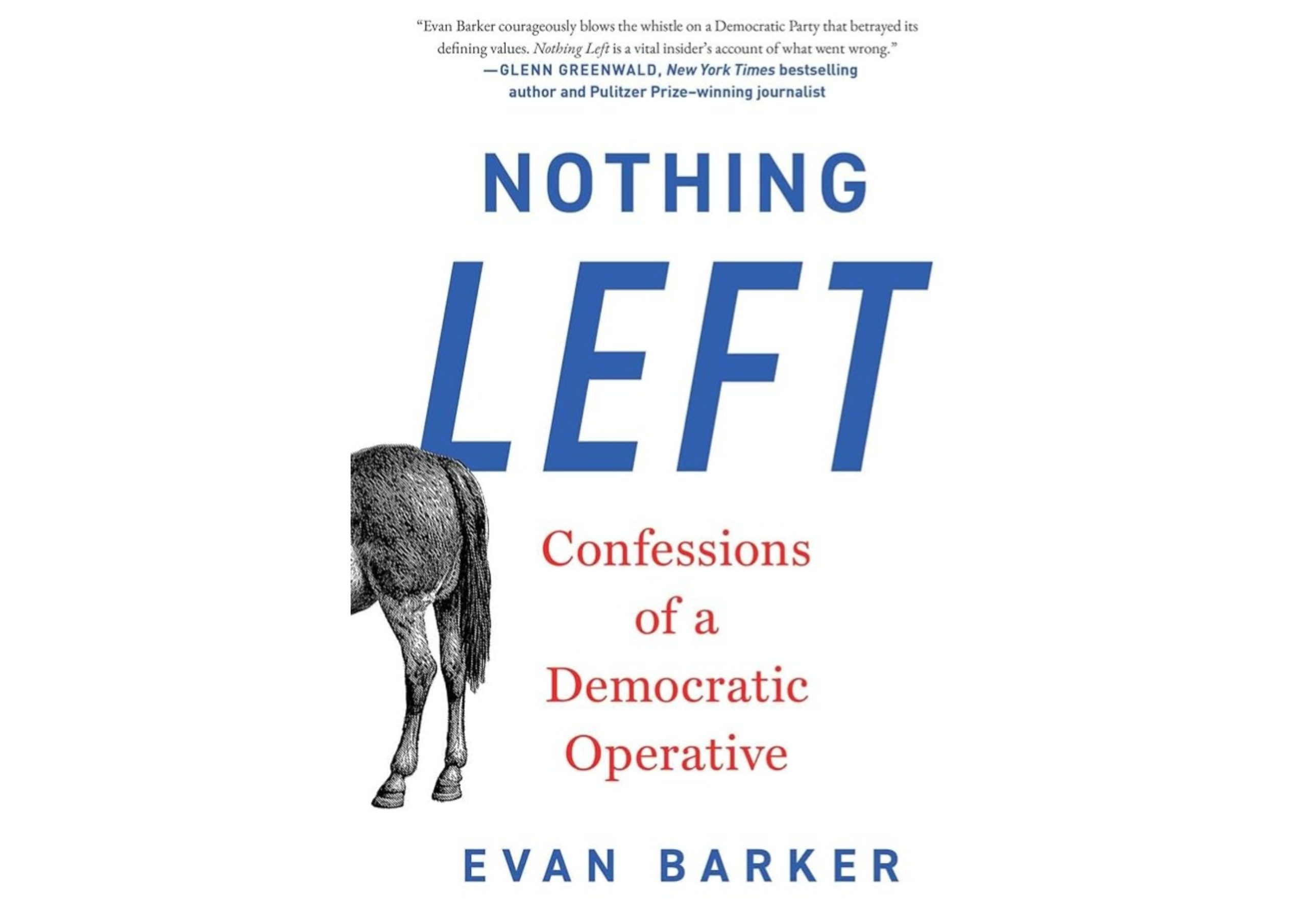
Former Democratic operative Evan Barker released a memoir titled Nothing Left: Confessions of a Democratic Operative that lays bare the inner workings of progressive campaign finance and the cultural shift she says has pushed the party away from its working‑class roots. The 268‑page volume, published by Threshold, arrives as the Democratic National Convention approaches and as the party wrestles with its identity ahead of the 2024 presidential contest.
Barker's story begins in 2008, when she was still a teenager in Missouri. She volunteered for Barack Obama's presidential campaign and turned 18 just in time to cast a ballot for the future president. She later recalled that the night Obama secured victory was "one of the happiest moments of my life."
Born into a modest family and battling a severe lung disease, Barker's path to a college degree was arduous. She said her mother "sold all six of her wedding rings to pay for one semester of tuition," yet she still graduated from the University of Kansas with $30,000 in outstanding loans. By the 2016 election cycle she was earning $3,000 a month on the Hillary Clinton campaign in western Kansas. The morning after Donald Trump's surprise win, she wrote that she "lay in bed, sick to my stomach, racked with nausea and fear."
After the 2016 election Barker moved to New York City and briefly worked on a northern New Jersey Democratic primary for "an empty, out‑of‑touch housewife who was trying to buy herself a seat in Congress." Disillusioned, she returned to the Midwest and joined a progressive lawyer's congressional bid against an establishment‑backed Native American lesbian candidate. The campaign attracted a visit from Bernie Sanders in July 2018, and Barker was present when a newly elected New York congresswoman, Alexandria Ocasio‑Cortez, met the Vermont socialist for the first time.
While Ocasio‑Cortez's victory "changed what we knew to be possible" for insurgent progressives, Barker described her in person as "a quiet introvert" and "timid," despite being "an attractive young woman" with "star power." Over time Barker concluded that AOC "could become the first woman president… I would never underestimate her." By contrast, she found Sanders "standoffish and uninterested in speaking to most of the people around him," and a senior Sanders aide later told her the senator "doesn't care about people as individuals; he only cares about them as concepts."
The 2018 campaign taught Barker the brutal realities of "call time," a fundraising technique that involves cold‑calling donors' cell phones. She described the process as "a brutal, soul‑sucking process" that candidates "hate most about being a politician." A call‑time manager told her, "Make the hard ask! If you gave the donor a specific dollar amount, you'd always get more money than if you left it open‑ended. If I let a donor get off the phone without processing their donation myself, my chances of getting the money were cut in half." The experience opened a professional door: in 2019 Barker was hired by Left Rising, a national fundraising consultancy that has worked with many of the Democratic left's most successful congressional challengers.
At Left Rising Barker earned what she called "the best fundraising consultant job possible in progressive politics," describing the firm as "the secret weapon behind many insurgent campaigns." She took pride in being "a ruthless fundraiser who taught progressive politicians how to raise money," and she warned that "if voters saw what politicians really do behind closed doors, they'd be sickened and demand change to our campaign finance laws." Barker argued that most Americans do not realize "how much influence donors have over politicians," and she observed that wealthy donors tend to be "more comfortable with a focus on cultural rather than economic issues," a trend she said runs counter to Bernie Sanders's populist agenda.
As Barker rose through the fundraising ranks, she grew increasingly uneasy about the direction of the progressive movement. She wrote that "progressives were not interested in building a movement to fight for economic populism" but instead became "champions of identity politics and racialism." In her view, AOC "became a loyal lapdog for the establishment," a shift she linked to Speaker Nancy Pelosi's embrace of the most divisive aspects of progressive rhetoric. Barker highlighted the influence of a handful of behind‑the‑scenes figures, noting that "billionaire heiress" Leah Hunt‑Hendrix "was the primary organizer of all the big money behind the Left's signature causes" and that her importance "cannot be overstated." She also praised Alexandra Rojas, head of Justice Democrats, as "possibly the most underrated and unknown key player" who is "quietly leading the movement to take over the Democrats from within."
Reflecting on the role of celebrity in Democratic politics, Barker said that even in 2008 she saw "how prominent celebrities were on Democratic campaigns," but she later concluded that "if anything, celebrities are a liability." She argued that candidates "just want to be around famous people" because "the only reason Democrats bring celebrities around is because it's a way for them to feel cool."
The 2020‑21 election cycle, according to Barker, intensified the party's focus on identity over economic issues. She described "the pressure from donors to place identity over everything was completely overwhelming" and recounted "the professional pressure from outside our firm to discriminate against white men was unreal." By late 2021 she said a "culture of fear and paranoia permeated the progressive movement."
Beyond fundraising, Barker's memoir offers data that she says illustrate the party's shift. She cited research showing that "Democrats now win 65 percent of Americans making over $500,000 a year," a statistic she interprets as evidence that the party has become more aligned with affluent voters than with its historic working‑class base. She also reflected on her personal experience with the Affordable Care Act, noting that "the Affordable Care Act saved my life," yet she criticized the law for lacking a public option, calling it "a giveaway to the insurance companies" that left "the structural problems of the American health care system intact." She summed up her disappointment with former President Obama's legacy, saying "Obama promised that so much about America would change, but not much did."
In the summer of 2024 Barker attended the Democratic National Convention in Chicago, hoping to reconnect with the party she once championed. She entered the convention aware that, as early as 2017, then‑senator Kamala Harris had "a reputation among insiders for being difficult to work with and emotionally abusive to staff." At the convention she concluded that Harris was "an empty vessel of a candidate," and she left before the event ended, declaring, "There is nothing left."
Looking ahead, Barker proposes a hybrid approach that blends elements of former President Donald Trump's economic populism with Bernie Sanders's progressive agenda. She wrote, "Democrats should take the best parts of MAGA and the best parts of Bernie and marry them. The way forward is genuine economic populism, coupled with cultural moderation." Her prescription includes breaking up monopolies such as "the big