On Independence Day the Theodore Roosevelt Presidential Library opened its doors in the small town of Medora, North Dakota, marking the first presidential library built without direct federal funding. The $450 million complex sits on 93 acres of prairie near the Badlands and offers a mix of historic artifacts, interactive technology and sweeping views of the surrounding canyons.
Medora, a community of roughly 800 residents located 25 miles from the Montana border and about 250 miles north of the Mount Rushmore sculpture, has long marketed itself as a gateway to the legacy of the 26th president. The town's tourism board, the Theodore Roosevelt Medora Foundation, has overseen the development of hotels, restaurants and souvenir shops that reference Roosevelt's Rough Rider image. The new library adds a centerpiece to that strategy, promising to increase annual visitor numbers by as much as 30 percent, according to a study commissioned by the foundation.
Unlike the Obama, Clinton and Bush libraries that are administered by the National Archives and Records Administration, the Roosevelt library is a privately financed venture. Its donors include a coalition of philanthropists, corporate sponsors and local businesses that contributed cash and in‑kind support. The decision to forgo federal appropriations reflects a broader trend among newer presidential sites to rely on private capital, a move that has drawn both praise and criticism from historians and policymakers.
Supporters argue that private funding shields the project from partisan battles over the use of taxpayer dollars. "When a community can raise the money it needs, there is less reason for Congress to intervene," said a spokesperson for the Medora Foundation. Critics counter that the reliance on private money may skew the narrative presented within the museum. "Donors often have a vested interest in portraying a particular version of history," noted a professor of public history at the University of North Dakota.
The library's design incorporates a low‑profile central building that appears to rise from the grasslands, a roof that visitors can walk across and a loop trail that offers panoramic vistas of the Badlands. Inside, the exhibition follows a chronological path that begins with Roosevelt's childhood in New York, moves through his tenure as a New York police commissioner, his service in the Spanish‑American War, the presidency that followed McKinley's assassination, and his post‑presidential adventures as "Colonel Roosevelt." Original letters, diaries and personal items sit alongside high‑resolution reproductions, giving guests a tactile sense of the era.
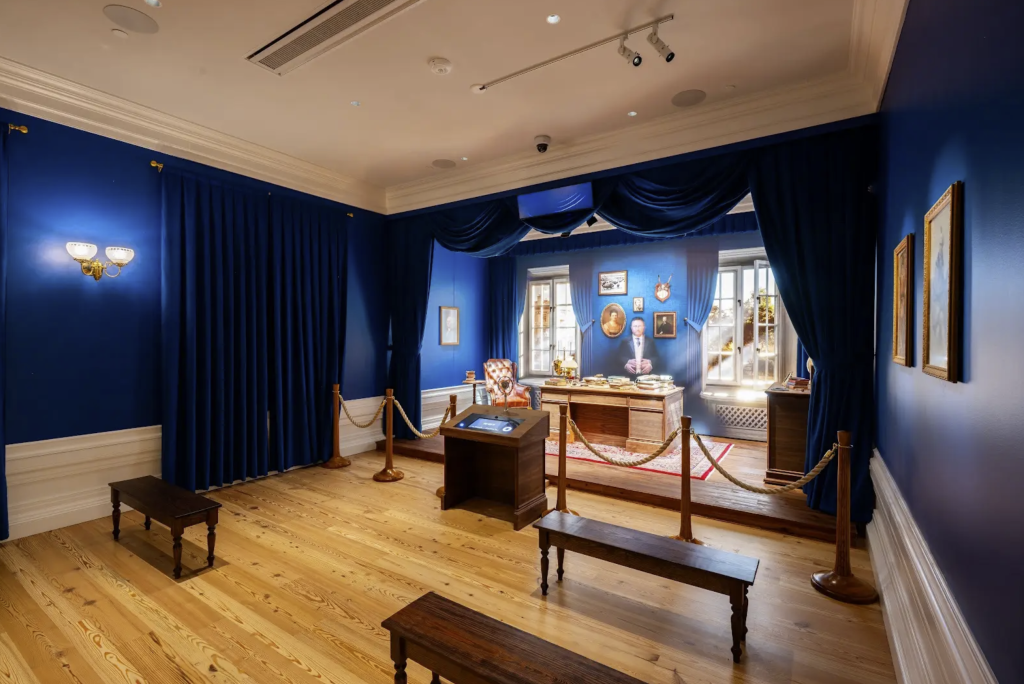
One of the most talked‑about features is a holographic Roosevelt who answers audience questions in real time, powered by a large language model. Visitors receive a small electronic bracelet at the entrance, which they tap at various stations to trigger AI‑generated photos of themselves as early‑20th‑century figures. The technology has been described as "kitschy" by some reviewers, but it has proven popular with younger guests, who spent considerable time at the interactive displays.
The inclusion of modern digital experiences raises questions about how presidential museums balance education with entertainment. "Museums have to meet the expectations of a generation that grew up with smartphones," said a curator at the Smithsonian Institution. "The challenge is to use technology to deepen understanding rather than distract from it." The Roosevelt library's designers appear to have taken that advice to heart, pairing the hologram with a dedicated room that showcases the full text of Roosevelt's "Man in the Arena" speech and a collection of his most cited quotations.
Roosevelt's political legacy continues to be a point of contention in contemporary debates. Conservatives often celebrate his trust‑busting actions and his advocacy for a strong national defense, while progressives highlight his pioneering conservation efforts that established the United States Forest Service and protected millions of acres of public land. The library's exhibits devote space to both strands, presenting his 1902 Newlands Reclamation Act alongside the 1905 creation of the National Park Service.
Environmentalists have noted the library's proximity to the Theodore Roosevelt National Park, a protected area that spans more than 70,000 acres of prairie and badlands. The park, which straddles the North Dakota border with Canada, is home to a thriving bison herd that migrates across the international boundary each spring. The library's opening may boost funding for cross‑border wildlife management, a topic of interest to both U.S. and Canadian officials who coordinate on species conservation.
Economically, the library is expected to generate a modest but meaningful boost to Medora's tax base. Local businesses reported a surge in reservations during the opening weekend, and the town's hotel occupancy rate climbed to 92 percent, according to data from the North Dakota Tourism Board. The Medora Foundation projects that the library will create 150 permanent jobs over the next five years, ranging from curatorial staff to hospitality workers.
Politically, the library's inauguration arrives as the Republican Party grapples with its historical roots. Some lawmakers have invoked Roosevelt's "Square Deal" as a model for modern regulatory reform, while others point to his "big government" initiatives as a cautionary tale. In a recent interview, a senior Republican strategist said, "Roosevelt's legacy offers both a blueprint and a warning for today's policy debates." The library's presence may therefore serve as a physical reminder of the ideological battles that shaped the early 20th century and continue to echo in Capitol Hill.
In Washington, the National Archives has expressed interest in collaborating on future digitization projects that could make the Roosevelt collection accessible to researchers nationwide. Such a partnership would align the privately run library with the federal system that preserves presidential records, potentially easing concerns about the museum's independence from public oversight.
As the summer season progresses, the library plans to host a series of public programs, including lectures on conservation policy, reenactments of the Rough Riders' charge at San Juan Hill and a symposium on the evolution of the Bull Moose Party. These events aim to attract not only tourists but also scholars and civic leaders who seek to explore how Roosevelt's ideas intersect with current policy challenges.
For visitors like Michael M. Rosen, an attorney and writer who toured the museum with his teenage son, the experience blended nostalgia with modern storytelling. "The library captures the spirit of a man who loved the outdoors and believed in active government," he said. "It also shows how technology can bring history to life for a new generation."
Theodore Roosevelt's name continues to appear on debates ranging from antitrust enforcement to climate change. The opening of his presidential library in Medora adds a new venue for those conversations, while also providing a boost to a small town that has built its identity around the former president's larger‑than‑life persona.