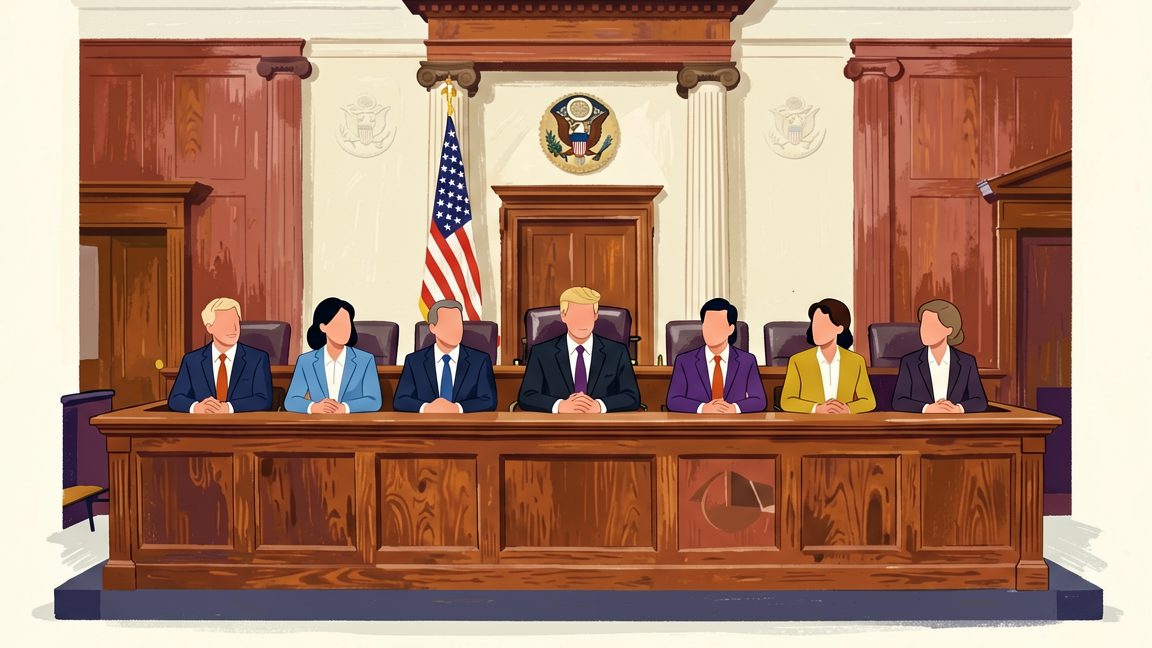
The Supreme Court's decision to strike down President Donald Trump's tariffs has sent shockwaves through the political establishment, with many hailing it as a major victory for the constitutional system and a significant defeat for the president. The 6-3 opinion, written by Justice Neil Gorsuch, held that Trump's use of the International Emergency Economic Powers Act of 1977 to impose the tariffs was unlawful, as it exceeded the authority granted to the president by Congress.
The ruling has sparked a heated debate about the limits of executive power and the role of Congress in trade policy, with many arguing that it is a significant blow to Trump's agenda and a major victory for the legislative branch. The decision has also been seen as a rebuke to the president's claims of absolute authority, with many pointing out that it undermines his assertions of being a strong leader who can unilaterally impose his will on the country.
The International Emergency Economic Powers Act of 1977 is a federal law that grants the president the authority to impose economic sanctions on foreign countries in response to an unusual and extraordinary threat to the national security, foreign policy, or economy of the United States. However, the law also requires the president to consult with Congress and to report to Congress on the use of the authority. In this case, the Supreme Court found that Trump's use of the law to impose tariffs on China exceeded the authority granted to the president by Congress, as it was not in response to an unusual and extraordinary threat, but rather as a means of coercing China into changing its trade practices.
The ruling has significant implications for the US economy and trade relations with China. The tariffs imposed by Trump were intended to protect American industries and workers from unfair trade practices by China, but they also led to retaliatory tariffs by China, which harmed American businesses and workers. The Supreme Court's decision may lead to a reduction in tariffs and an improvement in trade relations between the two countries, but it may also lead to a loss of leverage for the US in its trade negotiations with China.
The reaction from Congress has been mixed, with some lawmakers expressing support for Trump's trade policies and others criticizing the president's approach. Senator Bernie Moreno, a Republican from Ohio, has called for immediate action to pass the Restoring Trade Fairness Act, which would repeal permanent normal trade relations with China and impose tariffs of 35 to 100 percent depending on whether a product is critical to national security. On the other hand, some lawmakers have expressed skepticism about the wisdom of Trump's trade policies, pointing out that they could lead to a trade war with China and harm American workers and businesses.
The Treasury secretary, Scott Bessent, has estimated that the use of Section 122 authority, combined with potentially enhanced Section 232 and Section 301 tariffs, will result in virtually unchanged tariff revenue in 2026. This suggests that the Supreme Court's decision may not have a significant impact on the US economy in the short term, but it may have a significant impact on the US trade policy and the balance of power between the executive and legislative branches.
The Supreme Court's decision has also sparked a debate about the role of the judiciary in checking the power of the executive branch. Some have argued that the ruling is a significant victory for the rule of law and the constitutional system, while others have criticized the court for overstepping its authority and undermining the president's ability to conduct foreign policy. The debate highlights the importance of the constitutional system of checks and balances, and the need for the different branches of government to work together to achieve the nation's goals.
As the debate continues, one thing is clear: the Supreme Court's decision has significant implications for the US economy, trade relations with China, and the balance of power between the executive and legislative branches. The ruling has also highlighted the importance of the constitutional system of checks and balances, and the need for the different branches of government to work together to achieve the nation's goals.
In the end, the Supreme Court's decision is a reminder that the US system of government is designed to prevent any one branch or individual from dominating the others, and that the Constitution is the ultimate authority that guides the actions of all branches of government. As Justice Gorsuch wrote in his concurring opinion, 'The legislative process helps ensure each of us has a stake in the laws that govern us and in the Nation's future. For some today, the weight of those virtues is apparent. For others, it may not seem so obvious. But if history is any guide, the tables will turn and the day will come when those disappointed by today's result will appreciate the legislative process for the bulwark of liberty it is.'
The decision is also a reminder of the importance of the separation of powers in the US system of government. The Constitution divides power between the legislative, executive, and judicial branches, and each branch has its own distinct role and responsibilities. The Supreme Court's decision highlights the importance of the judicial branch in checking the power of the executive branch and ensuring that the president does not exceed his authority.
For American readers, the decision has significant implications for the US economy and trade relations with China. The tariffs imposed by Trump were intended to protect American industries and workers from unfair trade practices by China, but they also led to retaliatory tariffs by China, which harmed American businesses and workers. The Supreme Court's decision may lead to a reduction in tariffs and an improvement in trade relations between the two countries, but it may also lead to a loss of leverage for the US in its trade negotiations with China.
For Canadian readers, the decision has significant implications for trade relations between the US and Canada. The US and Canada have a long-standing trade relationship, and the tariffs imposed by Trump had a significant impact on Canadian businesses and workers. The Supreme Court's decision may lead to a reduction in tariffs and an improvement in trade relations between the two countries, but it may also lead to a loss of leverage for the US in its trade negotiations with Canada.
In conclusion, the Supreme Court's decision to strike down Trump's tariffs is a significant victory for the constitutional system and a major defeat for the president. The ruling has sparked a heated debate about the limits of executive power and the role of Congress in trade policy, and it has significant implications for the US economy, trade relations with China, and the balance of power between the executive and legislative branches. As the debate continues, one thing is clear: the Supreme Court's decision is a reminder that the US system of government is designed to prevent any one branch or individual from dominating the others, and that the Constitution is the ultimate authority that guides the actions of all branches of government.