On August 25 the White House released a press statement titled "President Trump Is Finally Ending Canada's Free Ride." In that document the president singled out Canada and, for the first time, the People's Republic of China as the only two nations he accused of choosing retaliation over negotiation. The release quoted Trump saying, "The record of Canadian abuse is clear and deliberate: FACT: Canada is joined only by the People's Republic of China in choosing retaliation over negotiation."
That same day the president posted on social media that the United States was "seriously considering changing the name of Lake Ontario to Lake America" and added, "we don't expect to doing much business with Ontario any longer. Thank you for your attention to this matter! President DONALD J. TRUMP." The remark, posted with a typographical error, was widely reported as part of a broader effort to pressure Ottawa over a dispute that began with U.S. steel and aluminum duties.
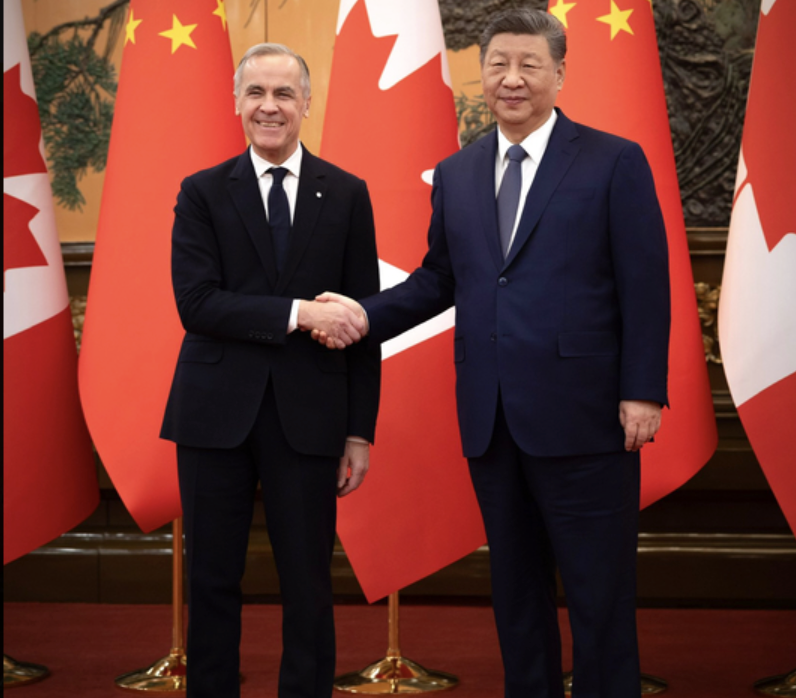
Canada's response arrived in a dramatically different direction. Prime Minister Mark Carney, who served on Harvard's governing Board of Overseers from 2021 to March 2025 and recognized a state of Palestine in September 2025, travelled to Beijing in January 2026. After the visit, Chinese and Canadian officials issued a joint statement declaring that "the two sides committed to advancing the Canada‑China new Strategic Partnership" and pledged to "strengthen the economic and trade partnership between Canada and China."
The Palestinian issue, which Carney highlighted in his earlier recognition of statehood, has become a recurring theme in Beijing's outreach to allies of the United States. Jordan's King Abdullah II visited Beijing on August 24, and President Xi Jinping reportedly lectured the monarch, stating, "The Palestinian question is the core of the Middle East issue." Chinese diplomats have framed support for Palestine as a way to expose fissures between Washington and its traditional partners.
Speculation has grown about a possible visit by President Xi to Canada in September, a trip that would coincide with a scheduled visit by the Chinese premier to the United States. Earlier in the year, China's foreign minister Wang Yi, a member of the Communist Party's political bureau, traveled to Canada in May and later met Canadian foreign minister Anita Anand in Manila in July. The Chinese foreign ministry's summary of the Manila meeting noted that "in the first half of this year, bilateral trade volume grew by 16 percent year‑on‑year, with Canadian exports to China increasing by 23.3 percent in particular. Canadian agricultural products such as canola and beef have returned to the Chinese market, and Chinese electric vehicles have entered the Canadian market … Anita Anand stated that the relationship with China is one of Canada's most valued bilateral relationships."
Anand echoed that sentiment on social media, writing, "China's Minister of Foreign Affairs Wang Yi and I met in Manila to advance work toward a new Strategic Partnership between our two countries." The post underscored Ottawa's view that deepening ties with Beijing are a matter of economic diversification rather than a geopolitical realignment.
Washington's alarm over the emerging Canada‑China alignment was voiced by Mary Kissel, a Hudson Institute fellow who served in the State Department during the first Trump administration. In an August 24 social‑media post she wrote, "Remarkable to watch media / financial analysts talk about the U.S.-Canada trade spat. No acknowledgment that Canada is siding with a totalitarian regime that's actively helping Iran & Russia target Americans & our allies. Seems like a pretty big part of the story to me." Kissel's comment referenced an editorial in the Wall Street Journal that dismissed the dispute as "the dumbest trade war" that "makes no political or economic sense."
U.S. officials have also warned that Chinese‑origin steel and aluminum could be routed through Canada or Mexico to qualify for regional content rules that protect American defense contracts. Fox Business reporter Amanda Macias cited concerns that "U.S. officials fear steel and aluminum made in China or elsewhere could be processed in Canada or Mexico and then enter the United States as regional content." If Canadian imports of such metal are effectively Chinese, the United States could lose a safeguard against supply disruptions from Beijing.
In retaliation, Canada announced on August 25 that it would impose tariffs of 15 percent, 25 percent and 50 percent on a range of U.S. goods, with the measures taking effect on September 8. Analysts noted that the new duties could make Chinese products relatively cheaper for Canadian consumers, potentially shifting demand away from American manufacturers.
Carney's background adds another layer to the diplomatic calculus. Before entering politics he worked at Goldman Sachs, served as governor of the Bank of England, and acted as the United Nations special envoy on climate action and finance. Speaking at the Davos forum in January 2026, Carney said that while "American hegemony, in particular, helped provide public goods, open sea lanes, a stable financial system, collective security and support for frameworks for resolving disputes," the "bargain no longer works." He added, "Canada was amongst the first to hear the wake‑up call, leading us to fundamentally shift our strategic posture. We are rapidly diversifying abroad… we've concluded new strategic partnerships with China and Qatar."
From the perspective of Washington, a NATO ally forging a "strategic partnership" with Beijing appears as a betrayal of shared security commitments. The United States has long viewed its northern border as a bulwark against foreign influence, and the prospect of a Chinese client state on that frontier raises strategic concerns that extend beyond the immediate tariff dispute.
The current clash over steel and aluminum is unlikely to be the final chapter. Even if the two governments eventually negotiate a rollback of the tariffs, the underlying tension, America's desire to prevent China from gaining a foothold in Canada, will persist. The episode illustrates how a bilateral trade spat can be a proxy for a broader competition between the United States and China, with Canada caught in the middle as it seeks to diversify its economic relationships while remaining a close security partner of Washington.