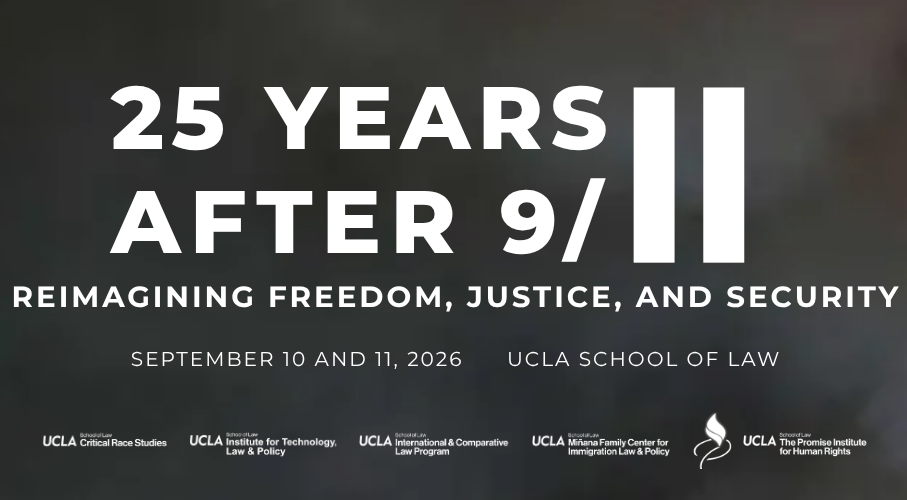
On the 25th anniversary of the September 11 attacks, the University of California, Los Angeles will host a symposium titled "25 Years After 9/11: Reimagining Freedom, Justice, and Security." The event, organized by the UCLA Law School's Critical Race Studies program, has drawn national attention because several invited speakers have publicly called for attacks on Israel, defended the murder of UnitedHealthcare CEO Brian Thompson and serve on the defense team for Khalid Sheikh Mohammed, the mastermind of the 2001 attacks.
The opening panel, scheduled for September 10, will feature Hussam Ayloush, executive director of the California chapter of the Council on American‑Islamic Relations. In a November 2023 interview Ayloush said "Israel should be attacked" and likened the Jewish state to Nazi Germany. The same panel is billed as an invitation to "imagine futures beyond militarization," a phrase that critics say masks extremist rhetoric.
Another session will include Amna Akbar, a political science professor at the University of Minnesota. Akbar has written that the 2024 killing of UnitedHealthcare CEO Brian Thompson by self‑styled activist Luigi Mangione was a "spectacular act of protest." In a January 2025 essay she argued that "calls to 'Free Luigi' express solidarity not just with one man but against the catastrophic realities of capitalism." The murder, which occurred in Chicago after Thompson was identified as a target of an anti‑health‑care protest, resulted in a life sentence for Mangione.
Melanie Partow, a professor at the University of California, Irvine, will also appear. Partow is a member of the defense team for Khalid Sheikh Mohammed, who was captured in 2003 and later tried before a military commission at Guantanamo Bay. The symposium does not include any former prosecutors from the Guantanamo cases, a fact noted by observers who say the lineup skews heavily toward critics of U.S. counterterrorism policy.
Other speakers include Richard Abel, a UCLA law professor who has argued that the election of Donald Trump posed a greater threat to the United States than the 9/11 attacks, and Sahar Aziz, a Rutgers Law School scholar who teaches courses on "Islamophobia" and "critical race theory." Silky Shah, executive director of the Detention Watch Network, will discuss "borders, migration, and national security," reiterating her view that immigration is framed as a national‑security issue to justify repression.
All of the speakers share a common critique of what they describe as a "racist gravy train" in counterterrorism. Aslı Ü Bâli, a Yale Law School scholar, wrote in a 2020 essay that "counterterrorism serves as a kind of racist gravy train" and that defunding the police cannot succeed without addressing the revenue streams tied to security operations. Bâli's essay is cited in the symposium's promotional materials.
The event is being held against the backdrop of a lawsuit filed by the U.S. Department of Justice alleging that UCLA created a hostile environment for Jewish students. The DOJ complaint, filed in early 2024, claims that university officials failed to address anti‑Jewish harassment linked to campus events that featured anti‑Israel rhetoric. UCLA's administration has responded by emphasizing its commitment to academic freedom while distancing the law school's broader faculty from the views expressed at the symposium.
"Events organized by an individual UCLA Law program, centers, or institutes, and the views expressed, do not imply endorsement by UCLA Law," a university spokesperson told the Washington Free Beacon. "UCLA Law does not review or approve these choices, nor does the school withdraw invitations because a speaker or viewpoint is sensitive or controversial." The spokesperson added that the law school's Critical Race Studies program describes itself as "the premier setting for studying the intersection of race and the law."
UCLA's decision to host the symposium raises questions about the limits of academic freedom on public campuses. Legal scholars note that public universities receive state funding and must balance First Amendment protections with the duty to provide a nondiscriminatory learning environment. In Canada, similar debates have unfolded at institutions such as the University of Toronto, where student groups have pressed for the removal of speakers deemed hateful. The cross‑border relevance lies in how both countries' courts may be called upon to adjudicate whether campus events that appear to endorse violence violate anti‑discrimination statutes.
The controversy also arrives at a politically charged moment in the United States. The 2024 presidential election is less than a year away, and both major parties have been courting voters who are concerned about campus speech. Republicans have repeatedly warned that "left‑wing campuses are becoming breeding grounds for anti‑American sentiment," while Democrats argue that attempts to silence controversial speakers undermine the core mission of higher education. The UCLA symposium could become a talking point in upcoming primaries, especially in California's swing districts where public‑college funding and free‑speech policies are hotly contested.
For students, the event presents a dilemma. Some student groups have organized counter‑protests, arguing that the platform gives legitimacy to extremist views. Others defend the right to hear "unpopular" ideas, citing the university's role as a marketplace of ideas. The UCLA Student Government Association released a statement urging the administration to ensure that any event that could incite violence be subject to a thorough risk assessment.
Beyond the immediate campus, the symposium touches on broader policy debates. The inclusion of a defense attorney for Khalid Sheikh Mohammed highlights ongoing disputes over the legal status of Guantanamo detainees and the extent to which the United States can prosecute terrorism cases in civilian courts. Meanwhile, the discussion of police abolition and the critique of "white Christian nationalism" echo legislative proposals being debated in state legislatures across the country, from New York's police‑reform bills to Texas's efforts to limit critical‑race‑theory curricula.
Whether the symposium will influence public opinion or remain a footnote in the larger culture‑war narrative remains uncertain. What is clear is that UCLA's Critical Race Studies program has placed the university at the center of a national conversation about the balance between free expression and the responsibility to protect marginalized students from hate‑filled rhetoric. The outcome of the Justice Department lawsuit and the reactions of elected officials in California will likely shape how other public universities approach similarly controversial events in the future.