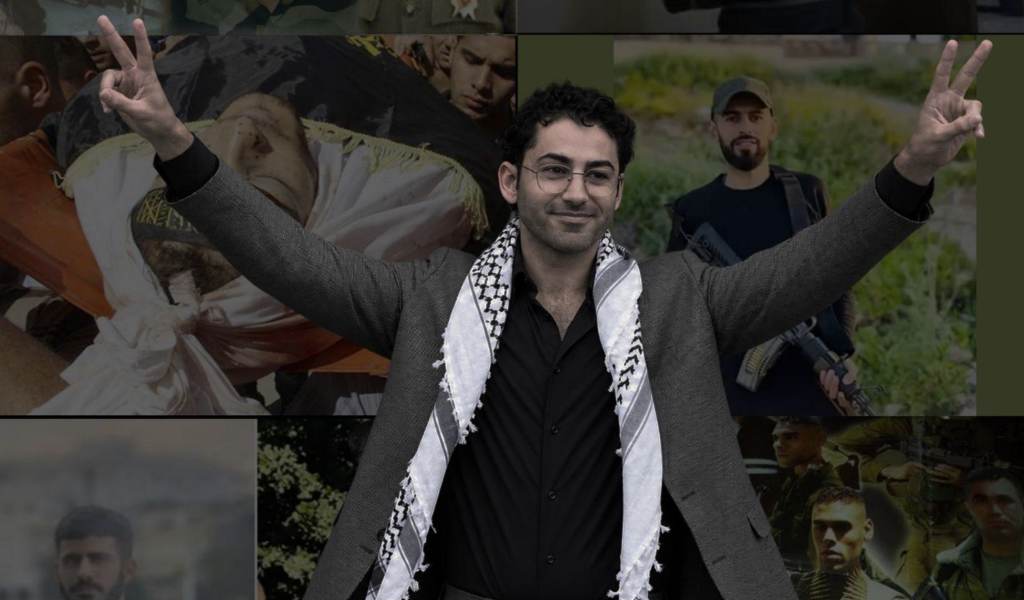
Investigative journalists David Collier and Rachel Feldman released a 100‑page report on Wednesday that documents a series of online posts by Mohsen Mahdawi in which he praised Hamas, called for the annihilation of Jews and boasted about the capacity of Palestinians to kill and wound. The findings directly challenge the narrative advanced by several mainstream outlets that have described Mahdawi as a reformed peace activist targeted by the Trump administration for his anti Israel stance.
The report, compiled from publicly available social‑media posts, police records and immigration filings, cites at least a dozen statements made between 2013 and 2024. In a 2013 video, Mahdawi is heard urging "every young man … to resist, to kill and to wound." A December 2024 Facebook video, posted to a friends‑only list, lauds an operation by Palestinian Authority security forces in Jenin as "a slap in the face of the resistance" and celebrates armed fighters as "the heart of the struggle." The authors argue that these messages show a continuity of extremist rhetoric rather than an isolated youthful outburst.
Mahdawi, a native of the West Bank, arrived in the United States in 2014 and earned an undergraduate degree from Columbia's highly selective program before enrolling in the School of International and Public Affairs. He emerged as a visible figure in the campus protests that followed the Oct 7 attacks in Israel, helping draft a joint statement titled "Oppression Breeds Resistance" that asserted occupied peoples have a right to resist occupation. In April 2025, the New York Times published a profile portraying him as having stepped back from the protest movement to seek dialogue with supporters of Israel. The new investigation suggests that portrayal omitted a substantial record of extremist advocacy.
Mahdawi's immigration case began when ICE agents detained him during a citizenship appointment in 2023. An immigration judge ordered his removal on June 3, 2024, citing alleged support for terrorist organizations. Mahdawi appealed the decision, and the case remains pending. Under the Immigration and Nationality Act, a non‑citizen may be deemed inadmissible for "participating in the persecution of any person because of race, religion, nationality, membership in a particular social group or political opinion" or for "providing material support to a terrorist organization." The report argues that Mahdawi's documented statements meet the statutory threshold for material support.
Beyond his own posts, the investigation identifies connections between Mahdawi's family and armed Palestinian factions. At least seven relatives were found to have affiliations with groups such as the Popular Front for the Liberation of Palestine. The authors note that Mahdawi repeatedly framed these relatives as innocent victims of Israeli aggression, a narrative that diverges from the public record of their militant involvement.
Police records from Vermont in 2015 add another layer to the picture. After Mahdawi applied for a position at a gun shop, the store's owner reported that Mahdawi claimed experience with modified submachine guns and allegedly said, "I like to kill Jews." The owner also said Mahdawi boasted of having manufactured weapons for Hezbollah. Vermont police forwarded the report to the Department of Homeland Security, and the FBI later interviewed Mahdawi before closing the investigation without filing charges. The Collier‑Feldman report emphasizes that the incident was not disclosed in earlier media coverage.
The findings arrive at a moment when U.S. immigration policy is under intense scrutiny. The Trump administration pursued a broad campaign to deport foreign students deemed to have engaged in hateful or extremist conduct, a policy that continued in part under the Biden administration through heightened enforcement of existing statutes. Critics argue that the focus on campus activism risks conflating protected speech with material support for terrorism, while advocates for stricter enforcement contend that failure to act on clear evidence undermines national security.
Columbia University, like many elite institutions, has grappled with how to balance free expression and campus safety. The university's administration has faced lawsuits alleging that it failed to protect Jewish students from harassment during the post‑Oct 7 protests. Mahdawi's case adds a new dimension, prompting faculty and student groups to question whether the school's vetting processes for international students adequately assess security risks.
In Canada, universities have encountered parallel debates over anti‑Israel protests and the presence of international students with alleged extremist ties. Canadian immigration law also bars individuals who have provided "any form of support" to designated terrorist groups, and recent high‑profile cases have sparked calls for more rigorous background checks. While Mahdawi's case is confined to the United States, the broader conversation about campus activism, immigration screening and media framing resonates across the border.
Legal experts note that the appellate process could extend for months, during which Mahdawi may remain in the United States if a stay is granted. The outcome will hinge on whether the appellate court finds the evidence of extremist advocacy sufficient to uphold the removal order. A reversal could set a precedent for how immigration judges weigh social‑media statements against claims of protected political speech.
For Columbia, the report forces a reassessment of how the university presents student activists to the public. If Mahdawi's extremist statements are verified, the institution may face pressure to distance itself from his narrative and to clarify its policies on student conduct. The episode also illustrates the challenges journalists face in navigating competing narratives: one that casts Mahdawi as a victim of political persecution, and another that portrays him as a promoter of violence.
As the appeal proceeds, the Collier‑Feldman investigation is likely to shape public and legal perceptions of Mahdawi's case. By providing a documented trail of extremist rhetoric, the report offers prosecutors a stronger basis for arguing that Mahdawi's presence in the United States poses a security concern, while also giving critics of media coverage concrete evidence to question earlier portrayals of him as a peaceful advocate.