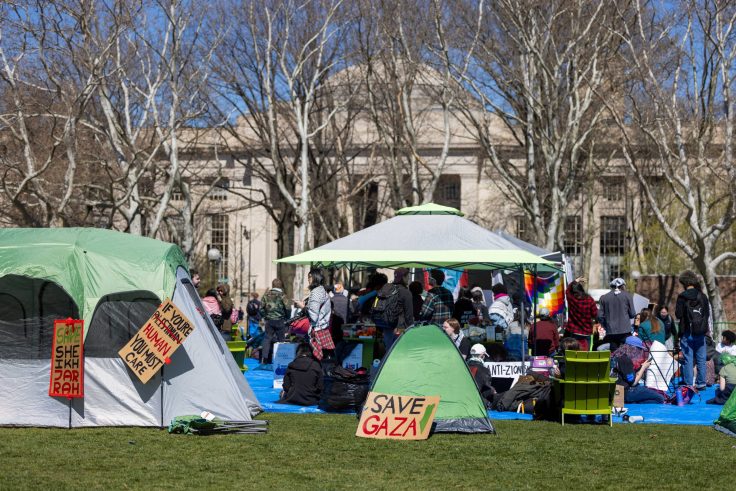
Yossi Sheffi, who has taught at the Massachusetts Institute of Technology for almost five decades, has released a self‑published volume titled Unsafe at MIT. Drawing on interviews with dozens of students, postdoctoral researchers and faculty, the book offers a chronological account of the 2023‑24 school year and the hostile environment that Jewish students say they endured.
Harassment and protest on campus
The narrative describes a campus where antisemitic vitriol and harassment were commonplace. According to Sheffi’s interviewees, protesters regularly occupied public spaces, disrupted lectures and blocked access to university buildings. Groups identified by the author – including chapters of Students for Justice in Palestine and the Coalition Against Apartheid – were said to intimidate and delegitimize Jewish students and staff.
Leadership criticised
Sheffi places particular blame on the university’s senior management. He indicts President Sally Kornbluth for not condemning the antisemitic rhetoric and actions, instead framing them as an exercise of free speech. The book argues that the anti‑Israel and antisemitic factions were able to operate with little resistance, amplified by social‑media campaigns.
Personal perspective
As an Israeli immigrant who witnessed the October 7 massacre, Sheffi brings a personal dimension to the account. He contends that the campus climate reflects a broader evolution of antisemitism and a failure of institutions to protect Jewish members of the community.
Reception and shortcomings
The New York Times first reported on Sheffi’s self‑publication, noting the work’s impact despite technical flaws such as the absence of an index and footnotes that are difficult to read. Nonetheless, Sheffi’s conclusion that the coordinated campaign of delegitimisation and intimidation was "shielded by institutional paralysis, and justified by a moral framework that denied Jews the protections routinely extended to other minorities" has been described as a chilling indictment of MIT’s culture.
Positive developments and broader implications
Sheffi records a modest rise in the sense of satisfaction among Jewish students since 2024, which he attributes to federal enforcement actions introduced by the Trump administration. He also observes that the Supreme Court’s decision to outlaw racial discrimination practised under the banner of affirmative action has coincided with a reduction in the proportion of Black students enrolled at MIT.
Political commentary
Retired Minneapolis attorney Scott W. Johnson, a contributor to Power Line, notes that the book suggests the evolution of "the Hamas wing of the Democratic Party, which is in control," as Louisiana senator John Kennedy recently put it. The work raises further questions about the adoption of the claim that Israel commits "genocide" and the alleged necessity of supporting groups such as Hamas.
Overall, Unsafe at MIT is presented as a powerful, if unsettling, account of Jewish student experiences and institutional shortcomings, aimed at readers concerned with antisemitism, campus politics and the future of academic freedom.