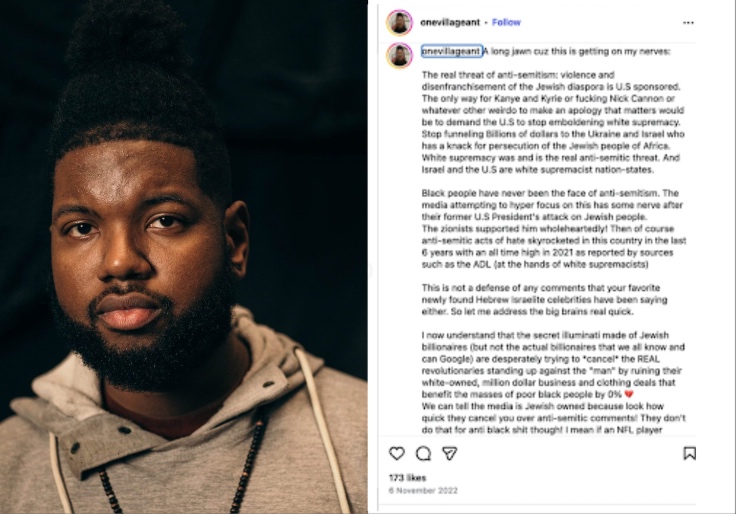
The School District of Philadelphia approved a series of "Liberation Symposia" that were taught by Anthony Smith, a man who pleaded guilty to obstructing law enforcement during a civil disorder and who has publicly claimed that Jews control the media and praised the Hamas attacks of October 7.
Smith's involvement was part of a partnership with the W.E.B. Du Bois Movement School for Abolition and Reconstruction, a program that describes itself as a "political education program for aspiring revolutionaries." According to emails obtained by the North American Values Institute, the workshops ran between February 2025 and early 2026 and reached more than 150 students from four public schools and two private schools.
One session, titled "Imagining a World Without Prisons," asked participants to consider alternatives to incarceration and to discuss community safety without police. Other sessions included "Restorative Yoga for Restorative Justice" and a discussion on the ideas of Antonio Gramsci, the early‑20th‑century Marxist theorist who argued that revolutionaries must build influence in civil society.
School officials who signed off on the program included Assistant Superintendent for School Performance Jeffrey MacFarland, who thanked the organizers in a February 2025 email, and Ismael Jimenez, the district's social‑studies director, who also sits on the Movement School's board. Both MacFarland and Jimenez declined requests for comment.
The workshops were mandatory for students, although they could choose among different sessions. Teachers such as Hannah Gann, a 10th‑grade history instructor, volunteered to help with lesson planning and expressed enthusiasm for the "Education Not Incarceration" theme that linked school funding shortfalls to the growth of the prison‑industrial complex.
Philadelphia's public‑school system is the largest in Pennsylvania, serving over 200,000 students and currently confronting a budget gap estimated at $300 million. State test scores show that none of the students at the Workshop School, where the symposia were held, met proficiency standards in mathematics, and only 18 percent of eighth‑graders read at grade level. Critics argue that the district's financial strain makes it difficult to justify spending on controversial external programs.
The partnership has drawn attention from a congressional committee that is investigating reports of antisemitism in the district. Jimenez has previously posted tributes to convicted cop‑killer Assata Shakur on social media and has described Israel as a "terrorist state." In 2024 the district settled a federal discrimination lawsuit after Jewish students reported being subjected to Nazi salutes, swastika graffiti and threats to "kill the Jews." Parents have complained that the schools have become a venue for radical political messaging that borders on hate speech.
Smith's background adds a further layer of controversy. He was arrested in October 2020 after a crowd flipped an empty police car in the wake of George Floyd's death; a road flare set the vehicle ablaze and Smith threw a piece of paper into the fire. He later pleaded guilty to a single felony count of obstructing law enforcement during a civil disorder, acknowledging that he aided and abetted arson. His attorney noted that the conviction bars him from teaching for ten years, yet the district allowed him to serve as a facilitator under the Movement School's banner.
In addition to his criminal record, Smith has used social media to praise Hamas "freedom fighters" and to repeat the antisemitic trope that "Jewish billionaires" control the media and seek to cancel "real revolutionaries." A 2022 Instagram post from Smith claimed that "the secret illuminati made of Jewish billionaires … are desperately trying to cancel the REAL revolutionaries." These statements were cited in the NAVI documents that first revealed the workshops.
The curriculum presented by Jimenez and his collaborators also reflects a broader shift in the district's social‑studies materials. Documents obtained by the Free Press show that students are taught that "racist attitudes played a foundational role in the formation of American identity" and that a "mythology of whiteness" sustained capitalism throughout the Cold War. One assignment asked students to propose a song that could replace the national anthem in light of America's history of racism.
Supporters of the program argue that exposing young people to critical perspectives on the criminal‑justice system is essential for civic engagement. They point to the district's high incarceration rates and the disproportionate impact of policing on Black and Latino communities. Proponents also note that restorative‑justice practices, such as the "Culture Talk" workshop, aim to teach conflict‑resolution skills without involving law‑enforcement agencies.
Opponents, however, contend that the workshops cross the line from education into political indoctrination. They cite the presence of a convicted felon with a record of extremist speech as evidence that the district is failing to protect students from hate‑filled rhetoric. Federal civil‑rights groups have warned that schools must balance academic freedom with the obligation to prevent harassment based on religion or ethnicity.
Legal experts note that public schools are bound by the First Amendment to avoid endorsing extremist viewpoints, but they also have leeway to present controversial ideas in a neutral manner. The key question, they say, is whether the district's endorsement of the Movement School constitutes government speech that advances a particular ideology. If a court finds that the program amounts to state‑sponsored propaganda, the district could face lawsuits under the Equal Protection Clause.
In the coming months the School District of Philadelphia is expected to review its partnership agreements in light of the congressional inquiry and the recent settlement of the antisemitism case. The board of education, which is elected by city voters, may face pressure to tighten oversight of external organizations that provide curriculum content. Any policy changes could influence how other large urban districts across the United States handle similar collaborations with activist groups.
For parents and taxpayers, the controversy raises practical concerns about how limited resources are allocated. With a $300 million deficit, the district must decide whether to fund programs that some view as essential to social justice or to redirect those funds toward basic academic improvement and school infrastructure.
The episode also resonates beyond Pennsylvania. Canadian education officials have watched the U.S. debate over "critical race theory" and related curricula, and some provinces have introduced guidelines to ensure that public‑school teaching does not cross into hate speech. While the Philadelphia case is rooted in local politics, it adds to a national conversation about the role of schools in shaping political beliefs and the limits of free expression in publicly funded institutions.
As the district prepares its next budget cycle, the outcome of the federal investigation and any ensuing litigation will likely shape the future of such "revolutionary pipeline" programs. For now, the workshops remain a flashpoint in a city already grappling with fiscal challenges, academic performance gaps, and a growing demand from families for a safe, neutral learning environment.